


Key facts
- The Nasdaq fell 5.5 percent on Friday, its worst percentage drop since April last year when President Donald Trump announced global tariffs (S1, S3).
- Asian equity markets fell sharply on Friday as Seoul and Tokyo led losses (S1, S3).
- Data centres have encountered wide-ranging opposition from United States voters across the political spectrum (S1, S3).
- Independent Senator Bernie Sanders demanded a national moratorium on data centre construction (S1, S3).
Independent Senator Bernie Sanders demanded a national moratorium on data centre construction, Texas governor-elect Gina Hinojosa called for an immediate halt to new data centre construction, and Representative Yassamin Ansari urged on November 4 a pause on advanced artificial intelligence development until proper regulations exist. Democrats won majorities in the House of Representatives and the Senate in the Nov. 3 midterm elections.
United States voters broadly oppose data centers, and many victorious midterm candidates promised to restrict their construction. Data centers have encountered wide-ranging opposition from United States voters across the political spectrum. A Colorado legislative staff report said states have passed assorted laws and executive orders on data centers, citing energy use, water and electricity costs.
Fears of tighter artificial intelligence regulation drove the sharp sell-off in United States technology stocks on Thursday. Democrats are generally viewed as more doubtful about fast AI growth than Republicans, who favor deregulation. The election results intensified worries that companies have invested hundreds of billions in the sector without knowing when returns will arrive.
The Nasdaq 100 fell 6.36 percent to 26,629.81 points on Thursday, erasing $2.3 trillion in market value. The S&P 500 dropped 4.36 percent to 7,353.73 points, its largest daily decline since April 2025. The Dow Jones Industrial Average fell 3.44 percent to 51,523.06 points.
On Friday, the Nasdaq fell 5.5 percent, its worst percentage drop since April last year when President Donald Trump announced global tariffs. The Philadelphia Semiconductor Index fell about 16 percent this week and faces its worst run since April last year. Asian equity markets fell sharply on Friday as Seoul and Tokyo led losses. United States employment data was due later on Friday after generally positive readings earlier in the week.
Seoul fell nearly 9 percent at one point and closed 6 percent lower. South Korea’s KOSPI fell as much as 8.8 percent, triggered a circuit breaker, an automatic pause in trading, and ended 6 percent lower after losing more than 10 percent of its value for the week. SK hynix fell 10 percent or more than 10 percent. Samsung fell 8 percent or 6.4 percent.
Tokyo fell 7 percent or 6 percent depending on the source. Kioxia and SoftBank each fell more than 10 percent, with Kioxia at 8.7 percent in one tally and SoftBank at more than 10 percent in another. Advantest dropped more than 8 percent.
Hong Kong, Shanghai, Sydney and Singapore fell more than 1 percent, while Wellington and Manila also declined. Jakarta and Bangkok also fell. Taiwan Semiconductor Manufacturing Company fell 7 percent, dragging Taipei’s Taiex about 8 percent lower, or fell 4.7 percent dragging the Taiex down about the same amount depending on the source.
Taiwan stocks posted their worst week since 2001, falling 4.5 percent to their lowest close since late April. Taiwan’s market dropped more than 20 percent from its early-October record high.

MSCI’s emerging markets index fell 4.7 percent to its lowest level since early April. Singapore stocks slid 2.8 percent, and the benchmark lost more than 4 percent this week. Malaysia stocks fell 1.4 percent, and the ringgit weakened to 4.056 per US dollar. Indonesia’s rupiah stayed close to its June record low while Indonesian stocks fell 2 percent.
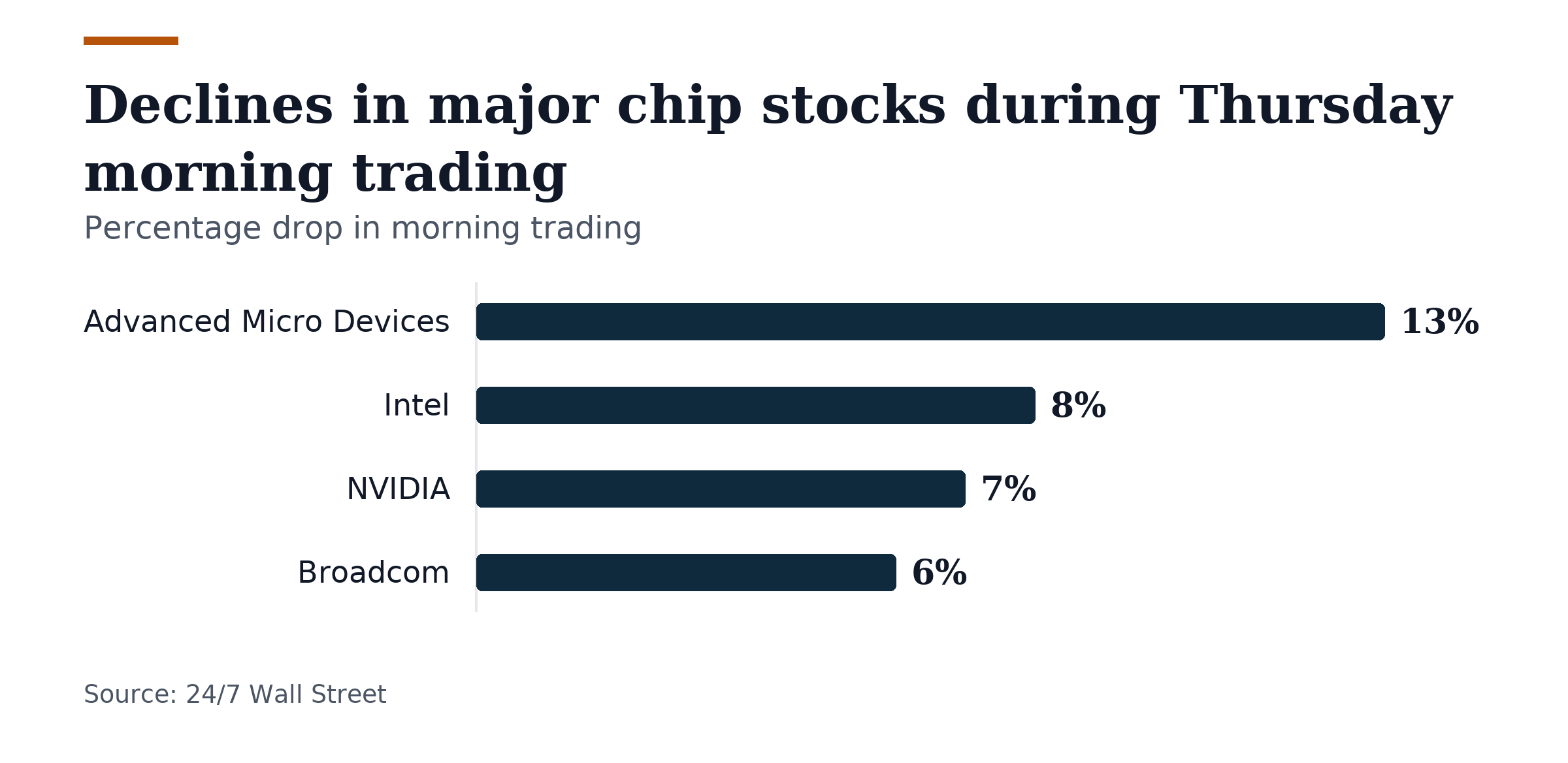
United States chip shares fell even as some companies reported strong results. Advanced Micro Devices fell 13 percent to $424.36 in morning trading. NVIDIA fell 7 percent to $186.81.
Intel fell 8 percent to $53.46. Broadcom fell 6 percent to $304.51.
Advanced Micro Devices reported November 3 third-quarter 2026 revenue of $13.38 billion, up 44.7 percent from a year earlier. Non-GAAP earnings per share reached $2.09, topping the $1.94 estimate. The company guided fourth-quarter 2026 revenue to about $17 billion, plus or minus 3 percent. Chief Executive Officer Lisa Su forecast revenue growth above 80 percent for 2027.
NVIDIA trades at a trailing price-to-earnings multiple of 40x, while Advanced Micro Devices carries a price-to-book multiple of 12.67x. NVIDIA guidance already leaves out China data center compute revenue.
Intel guided fourth-quarter revenue to $15 billion to $16 billion on October 29, a sequential decline. The United States government holds a significant equity interest in Intel, a risk the company disclosed in SEC filings. Broadcom guidance dated September 2 projected fourth-quarter fiscal 2026 AI semiconductor revenue of $21.7 billion.
Higher borrowing costs increased anxiety about company finances, and lofty valuations in many firms created unease among traders. President Donald Trump blamed Democrats for the market crash in a post on Truth Social. Michael Hewson at MCH Market Insights said investors sold shares due to worries about stronger resistance to AI build out plans.
Dilin Wu at Pepperstone said panic drives the selling, amplified by crowded positions, deleveraging and possible forced liquidations. Bank Negara Malaysia left interest rates unchanged on Thursday, citing moderate inflation and an expected resilient economy next year. MSCI warned Indonesia might lose emerging-market status because of concerns about market access and transparency. Focus now moves to MSCI’s November index review next week.
Join the discussion