
Key facts
- The UK Parliament's Home Affairs Committee launched an inquiry into technology use in policing.
- The inquiry examines a government Police Reform White Paper stating that police forces are failing to adopt and use new technologies such as live facial recognition.
- Centralized procurement could save money, bring capabilities to forces that cannot afford them, and create common requirements for evaluations, accuracy, data handling and oversight.
- The white paper "From local to national: a new model for policing" was released in January 2026.
The UK Parliament’s Home Affairs Committee has opened an inquiry into technology use in policing. It examines live facial recognition and the government’s plan to centralize procurement under the proposed National Police Service for England and Wales, Biometric Update reported.
The inquiry examines the Police Reform White Paper “From local to national: a new model for policing,” released in January 2026. The paper states that police forces are failing to adopt and use new technologies such as live facial recognition.
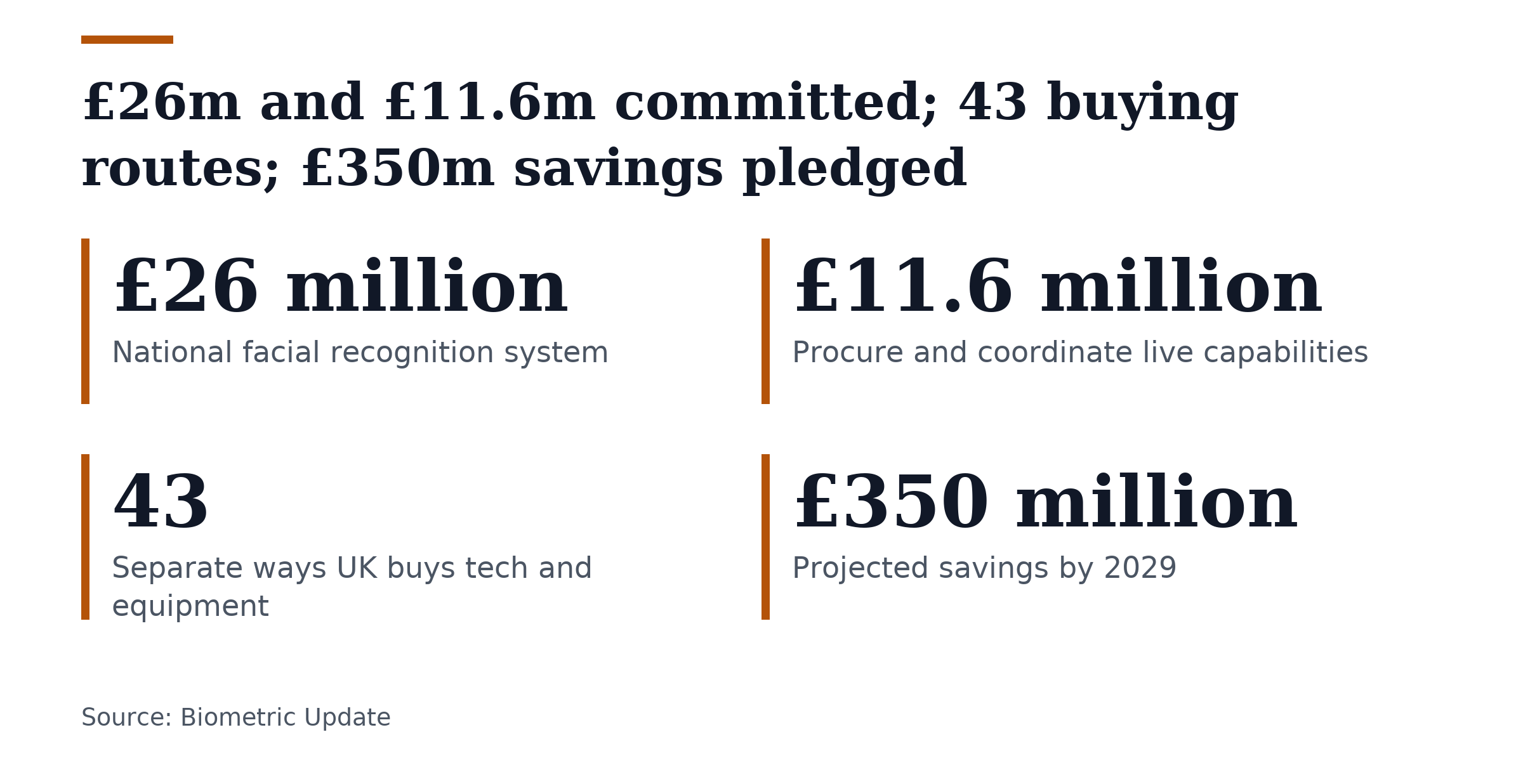
The white paper argues that the UK wastes money because it buys technology and equipment in 43 separate ways. That approach leaves smaller forces without the tools they need, the paper says. It says buying centrally can generate savings through economies of scale.
Centralized procurement could save money and bring live facial recognition capabilities to forces that cannot afford them. It could also create common requirements for evaluations, accuracy, data handling and oversight.
The government commits more than £26 million, approximately US$34 million, to develop and deliver a national facial recognition system. It separately commits £11.6 million, or $15.2 million, to procure and nationally coordinate live facial recognition capabilities. The government projects that around £350 million will be saved by the Police Efficiency and Collaboration Programme by 2029, when the current parliament ends.
The white paper proposes a national forensics service under the National Police Service. The National Data Integration and Exploitation Service will buy tools to help forces merge national data and assist with local purchases, and it will guide local forces.
The committee wants feedback on police technology use and the barriers stopping forces from adopting it. It asks what safeguards are needed for data security and system resilience. It asks what governance mechanisms are needed to keep technology use proportionate and sustain public confidence, and how helpful the white paper’s measures will be for effective police technology use.
The inquiry covers balancing national strategic direction with local flexibility, what lessons can be drawn from past national-level purchases, and whether the government’s technology and data plans will reduce costs. Evidence can be submitted to the committee until February 3, 2027.
Fraser Sampson, the former UK Biometrics and Surveillance Camera Commissioner, said live facial recognition plays a central role in the government’s police reform plans. In September 2026, he called for clear senior oversight, accountability and better staff training as police forces across the UK expand their use of live facial recognition.
Join the discussion