

Key facts
- Unit 42 said healthcare overtook financial services as the more targeted sector for Com-affiliated vishing attacks in September 2026.
- Healthcare and government together made up more than 10% of published ransomware victim claims in the third quarter of 2026, Check Point Research stated.
- Business services was the largest sector at 34% of third-quarter 2026 ransomware victims, with industrial manufacturing next at 13% and consumer goods and services also at 13%, Check Point Research reported.
- In August 2026, attackers targeted financial services organizations roughly twice as frequently as healthcare organizations, but healthcare became the more targeted sector in September 2026, Unit 42 said.
Unit 42 reported that healthcare displaced financial services as the sector most targeted by Com-affiliated voice phishing attacks in September 2026, after financial services organizations had been targeted roughly twice as often as healthcare organizations in August, with intrusions reaching organizations in the U.S., the U.K. and Australia across financial services, healthcare, legal services, construction and high-technology.
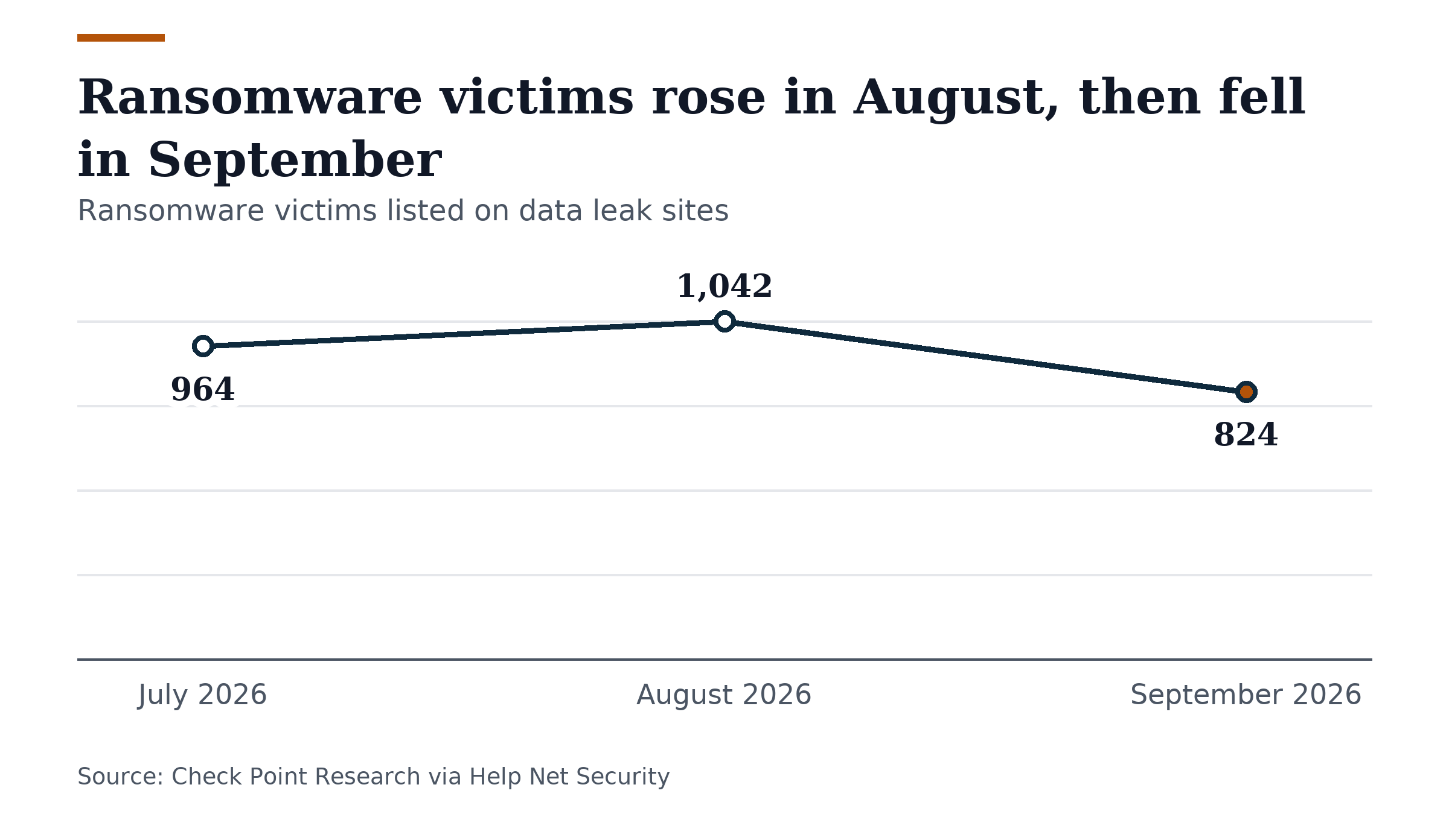
Check Point Research logged 2,830 ransomware victims on data leak sites in the third quarter of 2026, marking the highest quarterly total ever recorded, with monthly counts of 964 in July, 1,042 in August and 824 in September 2026. Healthcare and government together accounted for more than 10% of published ransomware victim claims in the quarter.
Business services represented the largest share at 34% of ransomware victims in the third quarter of 2026, followed by industrial manufacturing at 13% and consumer goods and services at 13%, while the United States accounted for 42% of victims. Silent Ransom Group concentrated exclusively on business services, especially professional and legal services. “Q3 combined sustained activity from established operators with a wider pool of ransomware brands claiming victims,” said Sergey Shykevich, Director, Threat Intelligence at Check Point Software.
Check Point Research’s tally of ransomware brands claiming victims reached 117 in Q3 2026, up from 91 in Q2, and among those brands 51 had no victims in Q2 while 42 brands appeared for the first time in Q3. The ten most active groups claimed 49% of Q3 2026 victims, down from 71% in Q1, and groups outside the top ten claimed most victims for the first time.
Qilin topped Q3 2026 ransomware rankings ahead of The Gentlemen, and the two claimed a quarter of victims after Qilin led in July and August while The Gentlemen led in September. INC Ransom, Akira and DragonForce remained in the top ten throughout 2026, though DragonForce recorded fewer victims in Q3.
LockBit left the top ten after posting fewer victims in every quarter of 2026, and a 2024 law enforcement action called Operation Cronos disrupted the group. Orova surfaced in July, listed 35 victims in August and fell to two victims in September, while DeadLock runs a leak site built on Polygon smart contracts and posted most victims in one July batch of older, previously unlisted cases.
Unit 42 tied the activity to threat clusters named Bling Libra, also known as ShinyHunters, and CL-CRI-1116, CL-CRI-1147, CL-CRI-1182, CL-CRI-1192, CL-CRI-1264, and CL-CRI-1274 after disclosing that Com-affiliated threat actors ran multiple vishing waves beginning in August 2026 that led to data theft and extortion attempts. CL-CRI-1264, also called Vortex, emerged in September 2026 and obtains initial access through vishing by posing as internal IT support.
CL-CRI-1274, also called Cinder, emerged in September 2026 and combines vishing with the Microsoft Graph software development kit to extract data from SharePoint and OneDrive. Unit 42 said the attacks start when attackers pose as IT staff to resolve a supposed authentication issue and direct victims to personalized phishing pages.
After seizing credentials and session tokens, attackers register their own multifactor authentication devices, misuse cloud resources and install malicious browser extensions to steal data. To maintain access, they register multifactor authentication devices, create cloud credentials, authorize unauthorized OAuth applications, enumerate data, alter mailbox rules, delete alerts and gather cloud data.

CL-CRI-1264 frequently registers a device called Pixel 10a across accounts soon after logging in, and following data theft the actor sends Microsoft Teams messages claiming the theft and directing employees to a negotiation site hosted on Tor, the anonymity network. Attackers also direct authentication requests through residential proxies and commercial VPNs into victim environments.
CL-CRI-1192 operators deployed a malicious browser extension named Google Chrome that installs after Developer Mode is turned on, and Unit 42 assesses with moderate confidence that CL-CRI-1192 created the extension to steal credentials from Chromium browsers such as Google Chrome and Microsoft Edge. The campaign also relies on fake apex domains that imitate SSO portals (single sign-on pages where one login reaches multiple systems), help desks and passkey setup pages (pages for creating passwordless login credentials) for each target.
The shared adversary-in-the-middle (AitM) phishing kit Doko’s Panel enables attackers to steal authenticated sessions and reach SaaS (software as a service) platforms including SharePoint, Salesforce, DocuSign and Slack. The individual behind Doko’s Panel recruits skilled callers through Telegram, requires fluent English without an accent and offers weekly returns in the six-to-seven-figure range.
Microsoft reported cloud intrusions where attackers used passkey and SSO lures to add login methods and generate heavy Microsoft Graph, SharePoint and OneDrive activity. Com-affiliated actors including Bling Libra are dropping encryption to move faster through the intrusion process.
Stadler Rail declined a 10 million Swiss francs demand from Everest after a supplier-connected platform compromise exposed technical information. Berlin’s state government rejected a 30 BTC demand from Rhysida, which subsequently published about 5.8 TB of stolen data.
Manchester Airports Group refused payment after a FulcrumSec breach exposed data belonging to roughly 8.7 million customers. Fairlife, a Coca-Cola subsidiary, disclosed a July ransomware attack by Anubis with a reported $15 million demand before the stolen data appeared online.
India and Argentina joined the top ten ransomware victim countries in Q3 2026 in place of Australia and Thailand, and Qilin’s growth tracked Argentina’s rise in the rankings while DeadLock notices across Southern and Central Europe lifted Italy’s victim count. Chainalysis estimates that 28% of victims paid in 2025, the lowest rate on record, and Coveware says under a quarter of incidents end in payment. Average ransomware payments fell 45% from the previous quarter to just over $1 million, while median payments rose 167% to $400,000.
Join the discussion