
Key facts
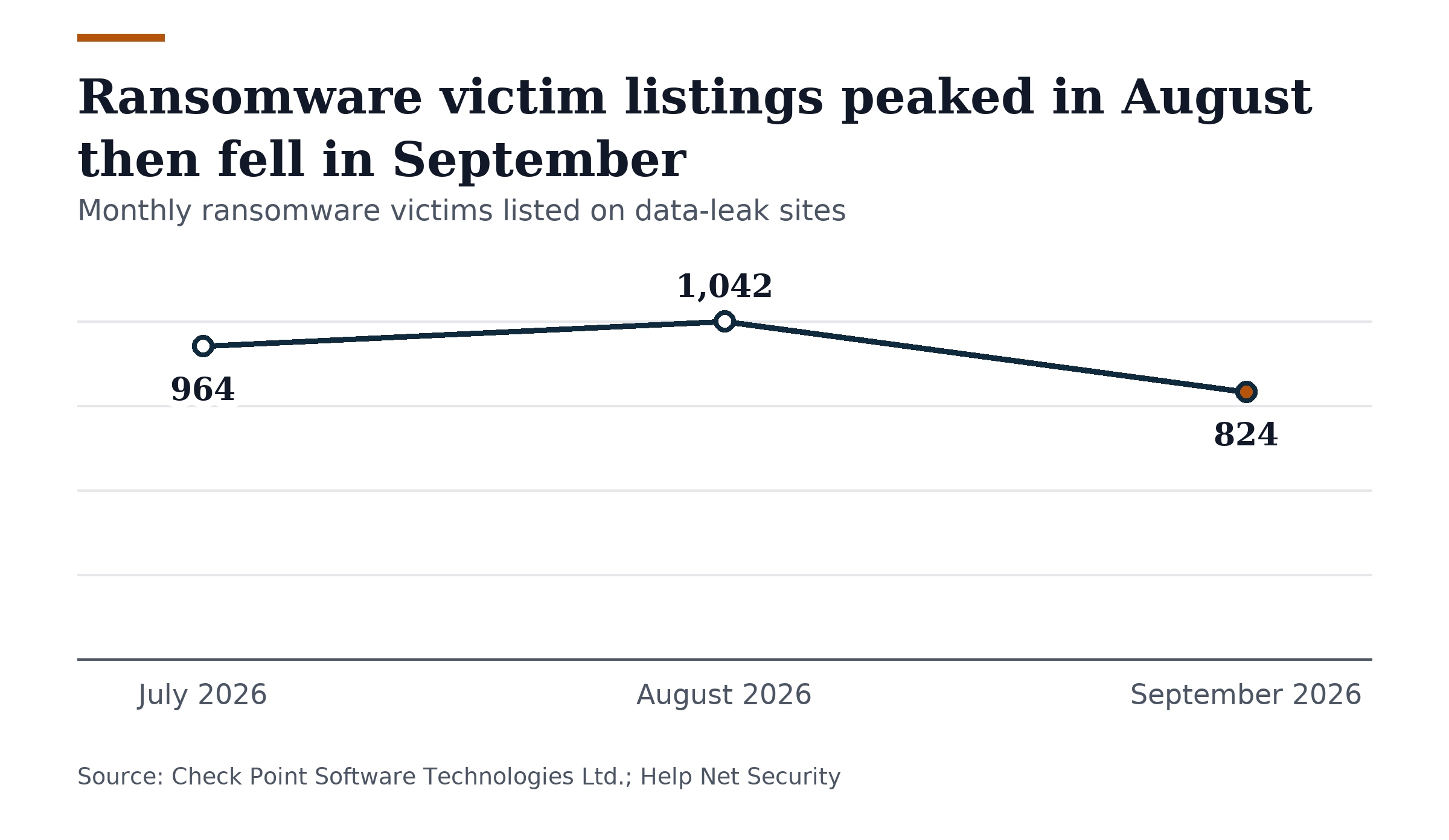
- Monthly listings were 964 victims in July, 1,042 in August, and 824 in September 2026.
- The leading ten ransomware groups made up 49% of Q3 victims, compared with 71% in Q1 and 58% in Q2.
- Ransomware groups outside the top ten collectively outnumbered the top ten in published victims for the first time.
- Qilin remained the top ransomware group for another quarter, with The Gentlemen close behind.
Check Point Research recorded 2,830 victims published on ransomware data leak sites in Q3 2026, the highest quarterly total on record, in its State of Ransomware Q3 2026 report released Nov. 17.
Monthly listings built to a peak in August before declining in September. Researchers counted 964 victims in July, 1,042 in August, and 824 in September 2026.
The quarter also showed brand fragmentation. Check Point Research counted 117 distinct ransomware brands claiming at least one victim during Q3 2026, up from 91 brands in Q2. Of those, 51 had not claimed victims in Q2, and 42 made their first observed victim claims during Q3.
Concentration among the leading groups declined for the third consecutive quarter. The top ten ransomware cartels made up 49% of Q3 victims, compared with 71% in Q1 and 58% in Q2. Ransomware cartels outside the top ten collectively outnumbered the top ten in published victims for the first time.
Qilin remained the top ransomware cartel for another quarter, with The Gentlemen close behind. Qilin led in July and August 2026, while The Gentlemen took the lead in September. Together the two cartels accounted for a quarter of all published Q3 victims. NordLayer Intelligence linked The Gentlemen to 383 attacks and Qilin to 363 attacks in Q3 2026, 746 incidents combined.
LockBit’s victim count declined in every quarter of 2026, and the group dropped out of the top ten in Q3. Operation Cronos disrupted LockBit in 2024, and researchers suggest affiliates moved to rival programs, formed new partnerships, and declined to return after LockBit relaunched.
Other established cartels held their positions. INC Ransom, Akira and DragonForce stayed in the top ten throughout 2026, though DragonForce saw its victim count fall during Q3.
Payment patterns diverged. The average payment dropped 45% from the previous quarter to just over $1 million. Median payments increased 167% to $400,000, showing distinct patterns separating routine payments from the biggest extortion demands.
Fewer victims are paying. Chainalysis estimates that victims paid in 28% of cases during 2025, marking the lowest recorded rate. Coveware says payment happens in fewer than one of every four ransomware incidents today.
Other trackers recorded different totals for the same quarter. Check Point Research recorded 2,830 Q3 victim listings. NordLayer Intelligence counted 2,894 incidents, a 50% rise from 1,933 incidents in Q3 2025 and an 8.6% increase from 2,664 incidents in Q2 2026. NordLayer’s figures cover observed or claimed leak-site listings across more than 200 ransomware cartel blogs rather than every infection worldwide.
Comparitech counted 2,627 claimed attacks in Q3 2026. Comparitech put its average Q3 2026 ransomware demand at $602,400. Only 247 of 2,627 claimed Q3 attacks were confirmed by the affected entity.
Some organizations refused demands and saw data published anyway. Everest made a demand of 10 million Swiss francs ($12.3 million) that Stadler Rail publicly refused after attackers obtained technical information through a compromised supplier-connected platform. Everest subsequently leaked 201 GB of data stolen from Stadler Rail.
Berlin’s state government rejected a 30 BTC ransom demand from Rhysida, which then published roughly 5.8 TB of stolen data. Infosecurity Magazine reported the demand as $2.3 million from the State of Berlin and said Rhysida published 5.7 TB, including citizens’ personal information, after the refusal. Manchester Airports Group reportedly declined to pay after a FulcrumSec breach exposed data tied to about 8.7 million customers.
Fairlife, a Coca-Cola subsidiary, disclosed a July 2026 Anubis ransomware attack with a reported $15 million demand. The stolen data later appeared online, suggesting Fairlife did not pay.
Short-lived brands also appeared. Orova appeared in July 2026, listed 35 victims in August, and fell to two victims in September. DeadLock operates a Polygon smart-contract leak site and posted most victims in a single July batch of apparently older, previously unlisted cases.
The n0n gang, first tracked in mid-September 2026, listed Visa and JPMorgan Chase as alleged victims and gave them 48 hours to negotiate. The gang previously claimed to have stolen billions of traveler records from Expedia.
Visa said its systems were not involved or impacted, with no indication that payment card data was affected, and pointed to a third-party service provider in Asia Pacific without naming it. A Visa spokesperson said:
JPMorgan Chase said its service outage resulted from a software bug, with no evidence linking it to a cyber attack or to the n0n gang’s claims.
ShinyHunters told Cl0p it must pay and issue a public apology, with demands rising every 24 hours. Cl0p removed the apology request and said ShinyHunters’ contact details did not work.
Law enforcement also acted against ShinyHunters. Dutch police arrested a 24-year-old suspect tied to ShinyHunters activity in mid-September 2026. A second alleged member was reportedly detained in Jordan later that month and said to be cooperating with US authorities. Researchers questioned whether rival actors reused the ShinyHunters identity in connection with the Cl0p breach.
Separate takedowns targeted other cartels. Spanish and German authorities, working with Europol, dismantled KillSec in Operation KillSwitch, arresting three people including a suspected 16-year-old operator in Alicante, Spain. Ukrainian authorities, working with the FBI, took four people suspected of belonging to an international ransomware cartel into custody.
The arrested organization was linked to ransom payments exceeding $40.5 million from no fewer than 28 companies. It comprised at least 27 individuals from Ukraine, Kazakhstan, Russia, and other countries, and was connected to a wider network of over 60 members spanning eight jurisdictions, including former Conti ransomware cartel members. Ukraine has not confirmed links to BlackSuit or Chaos.
Conti shut down in May 2022; BlackSuit began as Quantum ransomware in January 2022, became Royal, then adopted the BlackSuit name in June 2023. Maksym Tsutskiridze, acting National Police chief of Ukraine, said:
The United States accounted for 42% of Q3 victims, followed by Germany, Canada, and Italy. India and Argentina entered the top ten victim countries in Q3 2026, replacing Australia and Thailand.
Business services ranked first among victim sectors at 34%, and 13% each went to industrial manufacturing as well as consumer goods and services. Healthcare and government combined made up more than 10% of the published victim claims.
Sector trends varied. Finance and technology ransomware incidents rose 72% and 70% respectively in Q3 versus Q2 2026; education rose 50%, healthcare 39%, government 36%, and utilities 32%. Rebecca Moody, head of data research at Comparitech, said:
Smaller organizations face elevated risk. Those with up to 200 employees and under $25 million in revenue are particularly targeted, with manufacturing hit prominently. Manufacturing accounted for 28% of attacks where the victim’s sector was known in separate research that also identified smaller businesses as particularly exposed.
Victim selection appears driven by access rather than industry. Check Point Research said most victim selection came from accessibility and opportunity rather than deliberate sector targeting. Silent Ransom Group focused solely on business services, especially professional and legal services.
Extortion methods are evolving. Attackers increasingly use triple extortion, encrypting systems, exfiltrating data, and targeting individuals affected by the attack. After MIP Holdings paid The Gentlemen in June 2026 for deletion of stolen data, the group added MIP’s clients to its leak site, seeking to extort them as well. Mantas Sabeckis, a NordLayer Intelligence cybersecurity expert, argued:
AI also entered the ransomware picture. Researchers identified the JadePuffer campaign in July 2026 as believed to be the world’s first ransomware attack completely driven by AI, and Comparitech cited it as an example of AI-enabled ransomware.
Credential markets support access. Flare research found 422,747 stealer logs holding financial-services and banking credentials on forums from September 2025 through August 2026, a 56.3% increase over the previous period. Telegram accounted for 45% of discussions across seven monitored cybercrime categories in the first five months of 2026, compared with 28% in 2025.
CloudSEK research tied The Gentlemen to Fortinet vulnerability exploitation, VPN credential attacks, and Rclone data exfiltration, and also identified Qilin as active in September 2026. Digital Journal previously reported 5,189 publicly claimed ransomware attacks during 2024. Check Point’s threat intelligence director described the quarter as a mix of continuity and change. Sergey Shykevich, Director of Threat Intelligence at Check Point Software, said:
Join the discussion