

Key facts
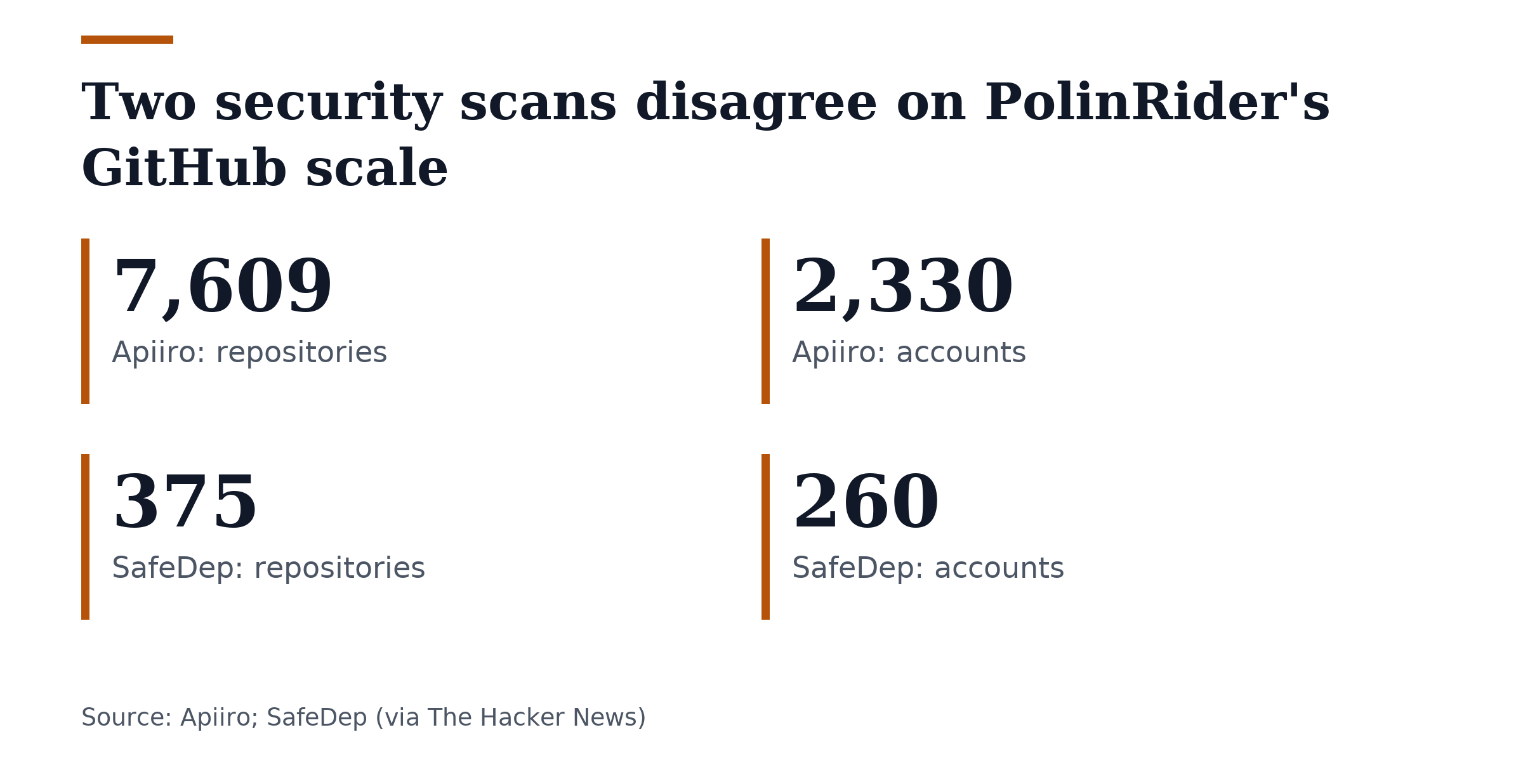
- Apiiro estimates that PolinRider appears in at least 7,609 GitHub repositories controlled by 2,330 accounts, most of them held by developers.
- Threat actors planted a Python loader in GitHub repositories.
- According to SafeDep, the loader is placed in a utils package or conftest.py.
- The loader turns the transaction input data into JavaScript.
North Korean-linked threat actors poisoned at least 7,609 GitHub repositories in the PolinRider campaign, security firm Apiiro estimated, with blockchain records placing attacker activity back to February 2025.
SafeDep found the malicious Python loader across 375 public repositories tied to 260 accounts. Attackers pushed the loader to 2,040 repositories from October 27 through November 6, 2026. OpenSourceMalware said it found a PolinRider attack from May 2025, which predates the earliest documented victims by eight months.
The loader hides inside a utils package or conftest.py, a Python test configuration file. Once Python imports the file, the loader reads the most recent Ethereum wallet transaction addressed to itself, turns the transaction input data into JavaScript, and executes that JavaScript using Node.js, a JavaScript runtime. The JavaScript pulls a second wallet to identify the command-and-control server, the machine attackers use to control infected systems, then forwards the next stage to an interactive Node.js setting using node -i.
The JavaScript malware reads the latest transaction tied to Ethereum wallet 0xa322E5f3D311D3080e6f0121063e9aDC2490Ef1a and obtains the destination wallet address 0x67B38e9b67B38E9b68656c6C6f6970626f742121. It pulls the C2 server address 103.179.142[.]155 from the first eight bytes 67B38e9b and 67B38E9b of the wallet address through NullReceiver, an obfuscation method that hides commands in transaction data. The last 12 bytes of the wallet address stand for the ASCII string helloipbot!!. The JavaScript malware uses that IP address to retrieve payloads 0x/cls and 0x/ls through port 443.
SafeDep said its latest findings show repositories contain an injected 58-line Python loader. The loader reads wallet 0x3b1574417524c11a7403c4b232CAcBb320CceBC6 to pull out JavaScript code. The JavaScript contacts second wallet 0x1eEf0849EDa15d87f64e51C73C8442Cf3c8bCEF3 and obtains the destination wallet tied to the latest transaction 0x5F87b5545F87b55468656C6C6f6970626f742121. That destination wallet helps parse the command-and-control server at 95.135.181[.]84.
The loader obtains an encrypted second-stage payload written in Node.js. The payload scans infected hosts for installed developer tools including GitHub Desktop, Cursor, VS Code, and Google Antigravity. It modifies commonly used tools to run attacker-controlled code and delivers infostealer malware, software that steals information from infected computers. The exact nature of the payloads is not known.
OpenSourceMalware said it found a PolinRider attack from May 2025, which predates the earliest documented victims by eight months. Each package used EtherHiding, a precursor to NullReceiver, to get a JavaScript downloader named JADESNOW. JADESNOW delivers InvisibleFerret, a Python-based backdoor used in Contagious Interview campaigns, plus a Socket.IO RAT, a remote access trojan, and a Python-based stealer.
Security researchers Paul McCarty and Jenn Gile said the 2025 sample contains PolinRider’s payload but lacks its documented spread behavior. They said the spread behavior shows up in the same maintainer’s GitHub repositories during four windows from January through July 2026. The infection likely remained on the maintainer’s computer starting in 2025, since the pushes made in 2026 originated from that machine.
PolinRider’s documented propagation script sets the clock back, places the payload into the latest commit, then force-pushes with the developer’s credentials. Shmulik Cohen of Apiiro said the worm, using stolen GitHub access, overwrites commits the developer already pushed while keeping the author, message, and date. It buries a loader behind hundreds of spaces inside a build configuration file. Cohen said, “In the newest wave, opening the folder in VS Code is enough.”
Attackers used GitHub account Eternity0207 to open more than 200 pull requests against open-source projects including AsyncAPI Generator, CircuitVerse, and Open Food Facts. They force-pushed a modified commit with an obfuscated loader that pulls /0x/cls and /0x/ls from 95.135.181[.]84 using that wallet address. The AsyncAPI Generator maintainer said the payload remained on the branch for 30–40 minutes before being force-pushed away, leaving a clean final diff. GitHub suspended the Eternity0207 account.
The unauthorized modifications let the loader run when a developer executes npm run build for AsyncAPI, loads the test configuration for Open Food Facts, or opens the folder in VS Code for CircuitVerse. Some victims include Neutralinojs, InstaWP Connect, and fxhash.
PolinRider is assessed to be a sub-cluster operating alongside the long-running Contagious Interview campaign, which works as a social-engineering entry point for compromising developer systems. PolinRider abuses access to change repositories and convert them into malware distribution channels.
Palo Alto Networks Unit 42 said North Korean state-sponsored threat actors rely on open-source software registries as a main initial access vector for corporate environments. The firm said compromising one maintainer account or registry scope turns open-source dependencies into widely affected cloud environments.
Previous waves released a stealer that gathers environment secrets, passwords stored in browsers, cookies, and wallet data. Attackers reused wallet address 0x1eef0849eda15d87f64e51c73c8442cf3c8bcef3 across other attack waves. No evidence indicates the loader spread through PyPI or npm.
Attackers pushed compromised versions of legitimate npm packages such as @adminide-stack/utils, @adminide-stack/health-api-server, @adminide-stack/user-activity-browser, @adminide-stack/forms-core, @adminide-stack/yantra-help-browser, server-hemera-mongo, cdeops, @cdmbase/wiki-browser, and @pubngo-stack/help-browser, which use that wallet to fetch /0x/cls and /0x/ls from 95.135.181[.]151. SafeDep said the /0x/cls script executes twice, once with eval in the current process and once in a new process, while the /0x/ls script executes solely in a new process.
A HuntRole fake recruitment campaign uses a VS Code extension called huntrole.assessment-tool from the Visual Studio Marketplace to transmit system information and retrieve and execute a malicious JavaScript payload. The HuntRole script asks the same wallet address for /0x/cls and /0x/ls from 95.135.181[.]84.
Some decoy sites tell candidates to install a Google Chrome extension with Developer mode turned on to receive new job alerts. Some fake websites use ClickFix-style tricks that get victims to paste harmful commands into a terminal according to their operating system. StepSecurity said the job application requests a short verification video, and the camera check always fails with a message about no compatible camera environment until the server marks the candidate as driver-installed. A separate Technical onboarding page supplies a single-line curl command for downloading the driver.
On Windows, the downloaded installer retrieves a script from the careers site that installs Node.js when absent, downloads a JavaScript payload, executes it in the background, and removes itself. The macOS and Linux versions behave the same way.
Join the discussion