
Key facts
- U.S. officials are investigating whether Iranian hackers are behind as many as 50 cyberattacks on commercial shipping vessels in recent weeks.
- The targeted ships carried oil, liquefied gas, liquefied petroleum gas, chemicals and other potentially explosive or hazardous materials.
- In recent weeks, cybersecurity teams from the U.S. Coast Guard went to at least four ships nearing American waters to deal with threats before port entry.
- In September 2026, the VL Prosperity and Kohaku, two tankers heading to Texas, received bomb threats and underwent U.S. cybersecurity inspections.
U.S. officials are investigating whether Iranian hackers are behind as many as 50 vessel cyber attacks in recent weeks.
The targeted ships carried oil, liquefied gas, liquefied petroleum gas, chemicals and other potentially explosive or hazardous materials. Investigators said the intruders exploited a flaw in Fortinet network equipment common across the maritime industry. Hackers may have abused a bug called FortiBleed to enter networks through vulnerable Fortinet-made routers.
A joint FBI-Coast Guard alert from September 2026 warned that Fortinet routers are used on shipping vessels. Several oil tankers bound for the U.S. coast had their navigation systems breached in August 2026, prompting FBI and Coast Guard cyber teams to board the vessels.
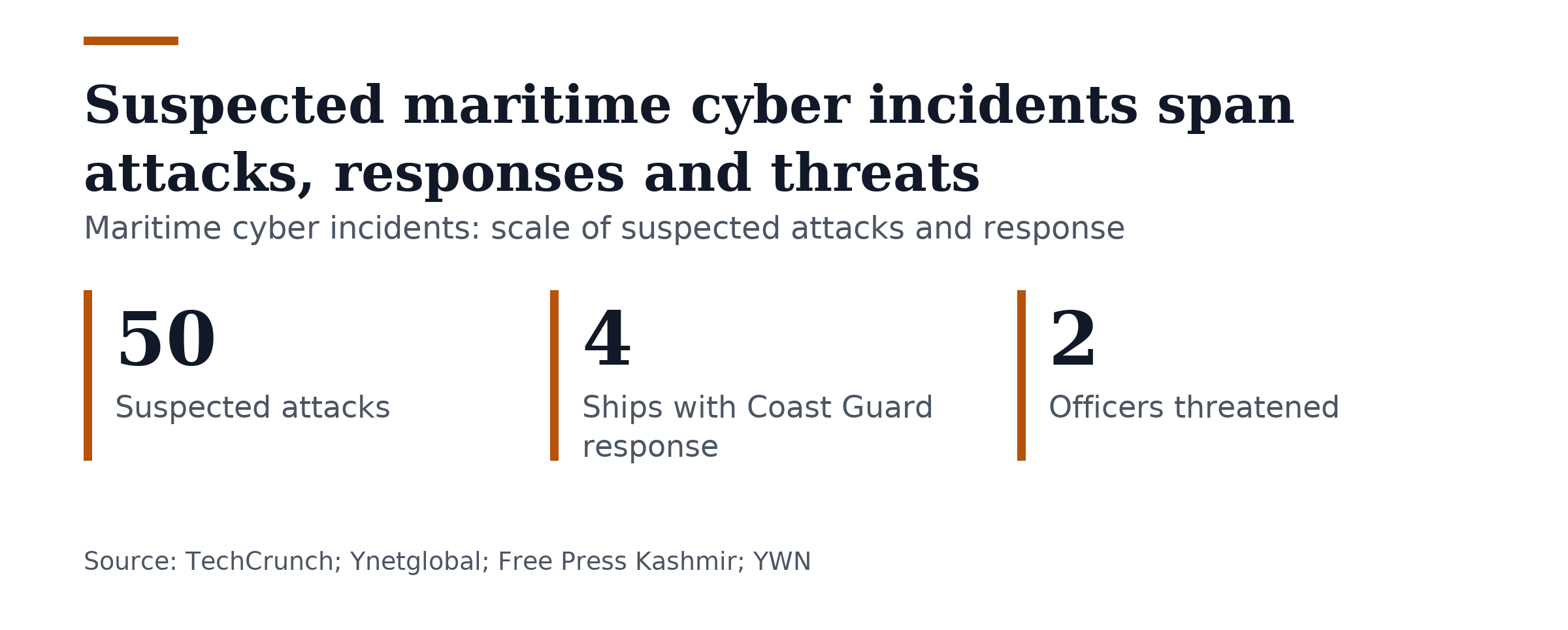
In September 2026, the VL Prosperity and Kohaku, two tankers heading to Texas, received bomb threats and underwent U.S. cybersecurity inspections. In recent weeks, cybersecurity teams from the U.S. Coast Guard went to at least four ships nearing American waters to deal with threats before port entry.
Tracking data near the Italian coast showed unusual sailing patterns on the Vivit Africa, which carried liquefied natural gas from the United States to Italy after receiving a bomb threat. According to a European shipowner, threatening cellphone messages went to two officers aboard one of his vessels in October 2026 as the vessel carried natural gas from Louisiana to two Mediterranean ports.
Some targeted vessels were unaware they had been attacked. Iran is the leading suspect while U.S. authorities are also examining possible Russian involvement.
A Trump administration official said that no evidence links Iran to the attacks according to investigators, and that four incidents were minor disruptions without significant consequences. An FBI spokesperson did not answer a request for comment about the shipping hacks or a more accurate figure.
The Coast Guard declined to comment on specific attacks, though it urged shipping companies to report suspected incidents and to use free cybersecurity resources. A ransom letter sent to the VL Prosperity captain on a Russian-language Telegram channel described the incident as a planned operation and claimed the ship was illegally hauling Saudi oil to American ports.
The company that manages the VL Prosperity said U.S. officials carried out an onboard cybersecurity check and cleared the vessel to resume normal operations, though it declined to discuss the letter. The messages declared there is no ceasefire, threatened to hunt recipients worldwide and warned that traitor ships will burn in hell.
Threatening messages in Persian went to other ships, warning them against loading American cargo. Early reports of some cyberattacks appeared on Iranian and Russian websites and Telegram channels, with some posts linking the incidents to the U.S.-Iran confrontation and portraying Washington as an unreliable energy partner.
Reuters was unable to confirm the Wall Street Journal report. Alon Ayalon, founder and partner at Israeli cybersecurity company Cydome, said most vessels have weaker cybersecurity than a midsize office.
Ayalon said, “What we are seeing in 2026 is that ships are no longer collateral damage in cyber campaigns. They are deliberate targets”. Alon Eyalon, co-founder of Cydome, an Israeli maritime cybersecurity company, said vessels are increasingly deliberate targets and many have less protection than a medium-sized office.
Lars Jensen, chief executive of Copenhagen-based Vespucci Maritime, said remotely seizing or detonating a vessel is a Hollywood scenario because of manual controls, but attackers can disable systems temporarily and cause costly supply-chain delays. Iranian threats had substantially increased, Jay Clayton, the Director of National Intelligence, told a House of Representatives committee.
Ships have backup controls and manual override systems allowing crews to retain control of essential operations if automated systems are hacked or fail. Cyber intrusions can delay shipments, trigger ransom demands and interrupt onboard systems, yet remotely commandeering or blowing up a vessel is less plausible since ships keep manual controls.
Officials are alarmed that international shipping lanes are unsafe and that global energy supplies face disruption risk because of the cyberattacks. Iran has retaliated on multiple fronts after the U.S./Israel-led war began earlier this year, a war that killed the country’s supreme leader, and U.S. officials blame Iran for cyberattacks on hundreds of American water providers and medical technology companies.
Investigators are examining whether Iran is expanding its recent U.S. cyber operations by targeting large vessels to frighten shippers, disrupt routes, or cause a port explosion. The incidents are occurring as Iran continues to target vessels in the Strait of Hormuz, and U.S. officials say Tehran has broadened its threats against American citizens.
Compromising a ship’s networked systems could cause an explosion, a collision or an oil spill. A temporary shutdown of vessel systems could set back deliveries and cost millions of dollars in losses through international supply chains.
Join the discussion