

Key facts
- The rate of prompt injection and tool poisoning reached 22% among flagged MCP servers, versus 16% for install- or import-time execution.
- Independent code verification was impossible for 83% of flagged MCP servers, researchers said.
- Eighty-two percent of researcher-confirmed malicious components were malicious from their first observed version, so no clean version existed for comparison.
- Ox Security researchers identified a new AI attack path where adversaries manipulate AI agent instructions without deploying executable malware.
Ox Security researchers identified a new AI attack path in which adversaries manipulate AI agent instructions without deploying executable malware, drawing on a review of 542,207 open source components between July and October 2026. The research is titled Plug and Pray: How AI Is Changing Software Supply Chain Attacks, and it frames instruction-level manipulation as a vector distinct from executable malware.
The investigation covered suspicious components in npm, PyPI, MCP servers, and Agent Skills, four software ecosystems examined by the researchers. Ox Security said malicious code still poses a major danger, but tool poisoning and prompt injection happen more often in certain ecosystems, turning agent instructions into a fresh attack route distinct from traditional malicious-code threats.
Attackers can exploit an AI agent’s existing permissions through instructions alone instead of malicious code, which helps explain why conventional endpoint and malware defenses may miss this attack path. Conventional security methods do not fit instruction-based deception, since teams traditionally assess software by publisher, code contents, and alteration status. Ox Security said firms give AI agents access to critical systems while depending on trust signals from an earlier era, which makes a new model of software trust necessary.
Among flagged MCP servers, prompt injection and tool poisoning reached 22%, versus 16% for install- or import-time execution. Independent code verification was impossible for 83% of flagged MCP servers, researchers said, leaving teams unable to confirm what code was actually deployed. 82% of researcher-confirmed malicious components were malicious from their first observed version, so no clean version existed for comparison.
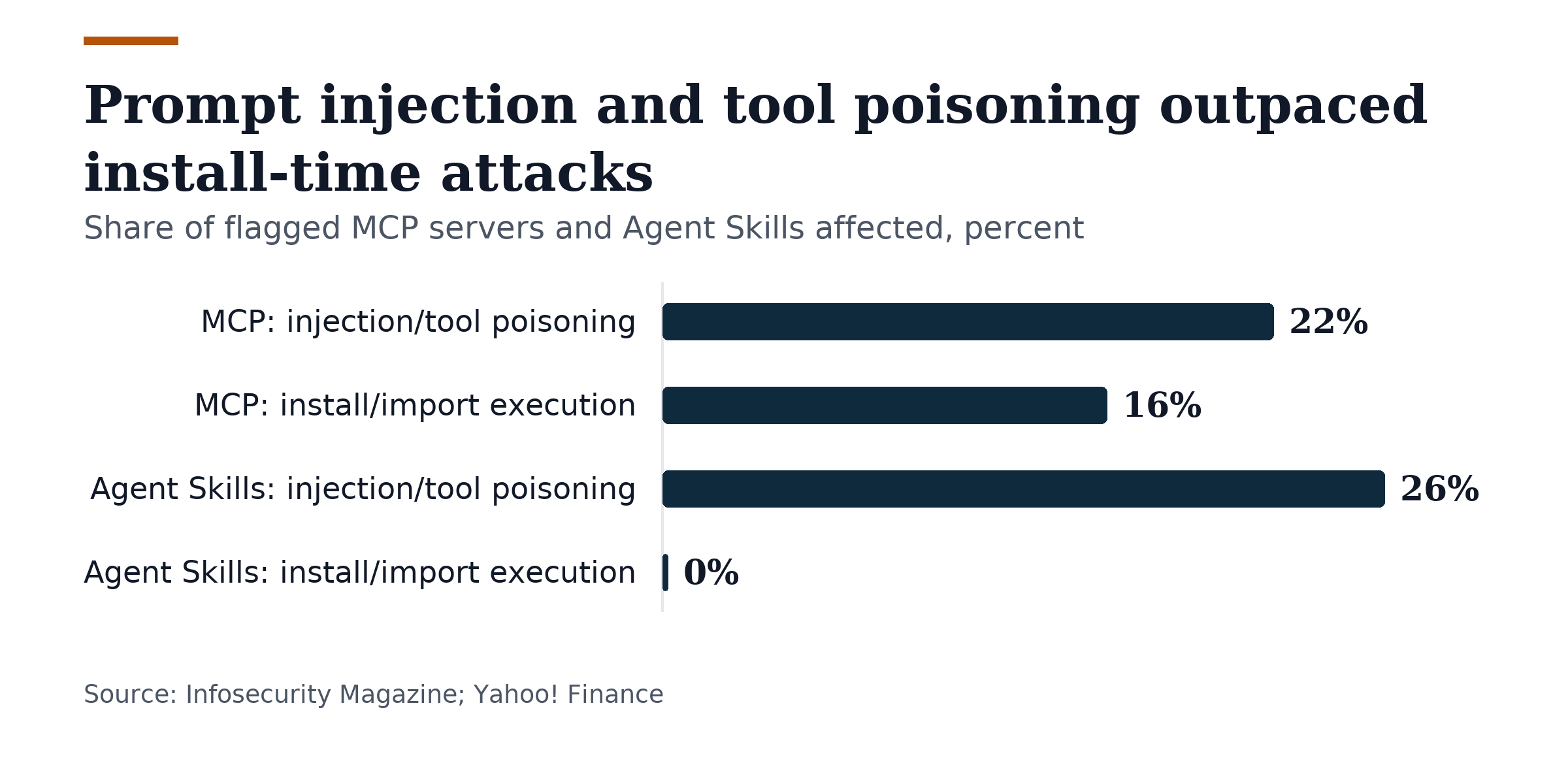
Prompt injection and tool poisoning appeared in 26% of flagged Agent Skills, while install- or import-time execution appeared in 0%, showing an even wider gap between instruction-based and execution-based techniques. Among the 179 flagged Agent Skills, no Skill ran code at install time, while 44% directed agents to send data outside, demonstrating that attackers can exploit existing agent access through instructions alone.
In flagged npm packages, execution techniques occurred six times more often than prompt injection and tool poisoning, an ecosystem-specific reversal of the pattern seen in MCP servers.
Publisher-controlled infrastructure hosted 67% of the 834 flagged servers, blocking independent confirmation of deployed code. Most flagged MCP servers run on infrastructure the publisher controls. A separate 16% of flagged MCP servers delivered files unlike the versions publishers declared, an additional mismatch between declared and served code.
Only 70% of MCP servers had an identified source owner, compared with 93% of npm packages, showing ownership transparency is lower for MCP servers than for npm packages. The OX Radar system traced ownership for 69.8% of MCP servers versus 92.8% of npm packages, a slightly different precision on the same ownership metric.
44% of flagged MCP servers came from two publisher accounts, including one that released 2,364 servers within 17 days, creating publisher concentration risk where a single compromised account could expose thousands of tools. OX Security stated that high volume by itself does not prove malicious intent, though one breached publisher account may put thousands of tools at risk.
Malicious components often enter environments already compromised, so update review alone will not catch them. Already compromised components entering an environment will escape detection through software update reviews alone, a consequence researchers tied to enterprise patching strategies.
The report argued that organizations deploying AI agents need to look past dependency scans for vulnerable or malicious code. Security teams should identify who controls agent-connected tools, confirm whether tool code matches publisher claims, and monitor for code changes. Ox Security said these steps address the new software trust problem created by outdated trust signals.
Neatsun Ziv, CEO of Ox Security, said companies let AI agents reach important systems while using trust signals made for another time. Moshe Siman Tov Bustan, research lead at Ox Security, said attackers need only persuade an agent to use permissions it already holds. Neatsun Ziv said trust depends on who controls a tool, what code it executes, and what directions it provides to an AI agent.
OX Security’s OX Radar system serves as an early-warning threat intelligence platform that watches software ecosystems for suspicious components and new attack patterns, providing the research infrastructure behind the findings. Researchers relied on OX Radar to trace ownership and flag suspicious components across the ecosystems studied, and the system continues to watch for new attack patterns as part of Ox Security’s threat intelligence work.
Join the discussion