

Key facts
- SpaceX caught a Starship upper stage with the Mechazilla launch tower's mechanical arms for the first time at Starbase in Texas on Saturday.
- The booster's 33 Raptor 3 engines produced thrust exceeding 18 million pounds at liftoff.
- Stage separation included hot-staging about 2.5 minutes after launch.
- Eight minutes into the flight, the ship's Raptors finished their initial burn.
SpaceX caught a Starship upper stage at Starbase in Texas on Saturday, using the launch tower’s Mechazilla mechanical arms for the first successful recovery of an upper stage after three earlier catches of its Super Heavy booster.
Liftoff for Flight 15 came at 5:47 p.m. ET on Friday, Nov. 13, from Starbase in South Texas, and the milestone arrived roughly 22 hours later. The company had aimed for a Starbase return on Saturday at about 4:17 p.m. EST, roughly 22.5 hours after liftoff. Flight 15 had three contingency checkpoints for an early Pacific return, plus a planned 10-second deorbit burn at about T-plus 21 hours and 36 minutes, with atmospheric entry roughly 35 minutes later.
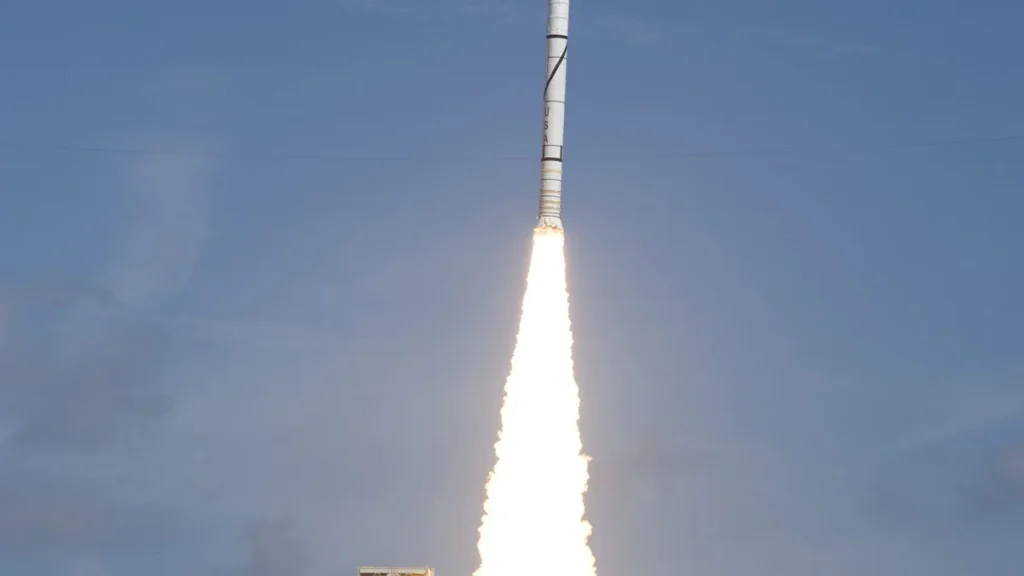
At liftoff, the booster’s 33 Raptor 3 engines generated thrust above 18 million pounds. Hot-staging separated the stages about 2.5 minutes after launch, in which the ship’s engines start before separation, and the Raptors aboard the ship completed their initial burn at the eight-minute mark. Ship entered low Earth orbit at roughly 170 miles, or 275 kilometers, at T-plus 26 minutes 10 seconds, following a second burn of about 20 seconds, and the craft was due to circle Earth 14 times for more than 21 hours.
Ship deployed 26 Starlink V3 spacecraft into low Earth orbit over a 42-minute span that started 35 minutes after launch. A second batch of 26 V3 Starlinks made orbit after Flight 14’s delivery on Sept. 28, the first time Ship reached orbit. V3 Starlinks are significantly more powerful than V2 Starlinks, of which more than 11,000 fly in low Earth orbit, and the satellites contribute a terabit of data capacity—equal to 10 Falcon 9 launches of Starlink V2 spacecraft—with three carrying cameras to inspect Ship’s heat shield tiles after deployment.
The ship flew horizontally until three Raptor engines fired, turning the vehicle vertical near the end of flight. Two nubs, one on either side and each about one foot long, formed the sole grip for the tower’s arms. The tower caught the Starship upper stage less than a minute after it appeared, and recovering the upper stage is harder than recovering a booster since the spacecraft comes down faster and from higher up.
The company had recovered three V1 Super Heavy vehicles before, flying two of them again on later missions. It also flew practice missions into the Indian Ocean ahead of the catch. Flight 14, launched Sept. 28, had been the first time Ship reached orbit, setting up Saturday’s attempt.
The booster catch did not succeed, though the mission originally aimed to catch both stages — the Super Heavy booster and the Starship upper stage. Dan Huot said, “the booster aborted itself for a GNC (guidance, navigation and control) issue that it detected.” SpaceX said a premature engine shutdown during descent forced the booster to divert, and that it exploded over the Gulf of America; the company also said it diverted to the Gulf of Mexico off the launch site and destroyed itself automatically before reaching the water.
Clayton Swope, with the Centre for Strategic and International Studies, described the mission as mixed following the booster catch failure. On Friday, NASA Administrator Jared Isaacman congratulated SpaceX on a spectacular launch and did not mention the booster disappointment. Walter Isaacson said, “This is actually a bigger deal for humanity than most people can imagine.”
NASA picked Starship as an Artemis crewed lunar lander, and the agency plans a demonstration flight with Orion and Artemis III astronauts for Earth orbit in the summer of 2027. The agency is counting on Starship technology for its Artemis program to bring astronauts to the moon. Elon Musk hopes to eventually fly Starship missions to Mars.
Full reusability underpins SpaceX’s ambitions for V3 Starlink satellites and proposed orbital data centers. According to Musk, the planned next-generation Starlink constellation includes about 100,000 satellites, supported by an AI network ten times that large. Musk has said SpaceX is targeting 10,000 Starship liftoffs each year by 2030, and recovering both stages would mark a milestone for fully reusable rocket systems able to cut mission costs and support frequent launches.
Join the discussion