
Key facts
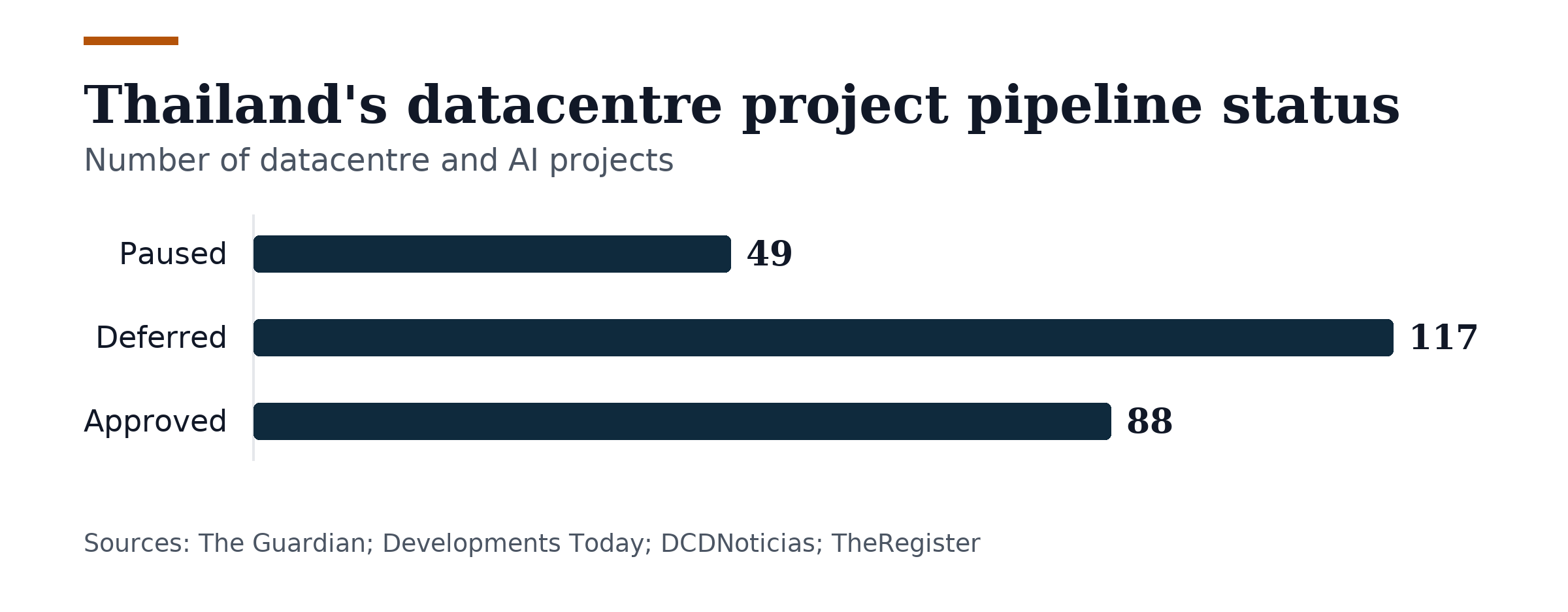
- Thailand paused construction on 49 datacentre projects and deferred approval decisions on 117 more in September 2026 because officials lacked sufficient detail for regulation and monitoring.
- Singapore's Ministry of Energy, Trade and Industry said the moratorium on new datacentres ran from 2019 to 2022 because the facilities consume large amounts of water and electricity.
- Operators and investors get a week during the pause to file information about their operations, helping the government speed creation of a single regulatory framework.
- A 2026 Cushman and Wakefield report says south-east Asia holds the biggest share of datacentre capacity under construction in Asia Pacific, around 50% of the total, with Malaysia and Thailand making up a large portion.
Thailand paused construction on 49 datacentre projects and deferred approval decisions on 117 more in September 2026, after the National Economic and Social Development Council ordered a nationwide hold because officials did not have enough detail to regulate and monitor the facilities. The council announced the suspension in a communiqué on Sept. 7, 2026, following a meeting of its Datacenter Business Policy Committee, and gave operators and investors one week to file information about their operations to speed creation of a single regulatory framework. Prime Minister and Interior Minister Anutin Charnvirakul said datacentres matter to the economy, but the government does not have solid data on how many facilities operate or what new builds are planned.
The freeze lands on an investment wave that had just crested. Thailand’s Board of Investment approved 88 datacentre and artificial intelligence projects worth about 886 billion baht ($27 billion) in the first half of 2026, with backers including TikTok, UAE-based Skyline and Bridge datacentres of Singapore. Investment applications exceeded 1 trillion baht, about US$30.7 billion, in the first quarter of 2026, with the digital sector making up roughly 874 billion baht. Approval from the Board of Investment does not mean a facility will be built, and Thailand’s promoters concede power readiness and a shortage of skilled operators remain real constraints.
Singapore offers the earlier cautionary tale. Its Ministry of Energy, Trade and Industry said the moratorium on new datacentres ran from 2019 to 2022 because the facilities consume large amounts of water and electricity. Only 95MW of operational capacity was added there between 2023 and 2026 as approvals stayed selective amid land and sustainability limits. Singapore was south-east Asia’s leading datacentre hub through the 2010s, with companies such as Alibaba and Facebook opening facilities there, and a 2026 Cushman and Wakefield report says the region holds around 50% of Asia Pacific’s datacentre capacity under construction, with Malaysia and Thailand making up a large portion.
Malaysia has absorbed much of the overflow. Johor’s operational datacentre capacity grew more than tenfold from 94MW in 2023 to 1110MW in 2026, with 3088MW more under construction or planned, and Menteri Besar Onn Hafiz Ghazi said Johor is south-east Asia’s largest datacentre hub with $40bn of investment drawn as of 2026. Microsoft said in 2024 it would invest $2.2bn in cloud and AI infrastructure across Johor and Kuala Lumpur, while AirTrunk plans to spend $3bn doubling its Johor datacentres from two to four. JLL projects Malaysian datacentre capacity will more than double to 2,055 megawatts by the end of 2026, a pace of roughly 70% compound annual growth, with 3,500 megawatts more planned after that.
Indonesia is building too, though not without friction. Greater Jakarta accounts for a 1699MW datacentre development pipeline, and the country is developing Batam as a secondary hub. In West Java, Indonesia’s governor stopped work on a datacentre because permits were missing and the environmental review had not been completed. As part of a $1.7bn investment in Indonesia, Microsoft is building five datacentres, while Singapore-based operators Princeton Digital Group and Digital Edge are expanding.
A Solo venture received $1.7 billion from Microsoft and a smaller sum from Nvidia, and RangeIDC’s $5 billion Batam campus is the first overseas project by a Shenzhen-listed operator.
Thailand’s own pipeline remains large despite the pause. Cushman and Wakefield puts Bangkok’s development pipeline at 2084MW, while Manila and Ho Chi Minh City ramp up as secondary markets. Amazon Web Services launched a cloud region in Thailand in January 2025, Google opened a cloud region in Bangkok in January, and Microsoft is developing a region and revealed in October 2025 that it would use True IDC for one availability zone. Alibaba Cloud has two datacentres in the country.
The pressure is physical as well as financial. Wood Mackenzie estimates datacentres in Johor already use 24% of the state’s total power consumption, a share Wood Mackenzie projects could hit 40% by 2035. Research analyst Alvin Tan said rapid growth could spur localized grid connection bottlenecks and increase the need for transmission upgrades and more power supply capacity. Operating datacentres in Johor currently need an estimated 675m cubic meters of water each day, and Johor is prone to droughts.
Thai officials are responding with price and planning tools. Energy minister Akanat Promphan said datacentres require large amounts of power from costly imported gas and called for a new electricity user category with higher tariffs. The new approval framework weighs energy and water use, requires power guarantees and sets higher tariffs for operators. Thai officials plan to disclose the exact details of new datacentre regulations within the month.
Communities are pushing back. Residents in Thailand’s Eastern Economic Corridor worry about pressure on already depleted water reservoirs from datacentre projects. Somnuck Jongmeewasin, research director of EEC Watch, said the Khlong Luang Reservoir in Chonburi is a primary flashpoint, with authorities piping its water to industrial estates even though the reservoir is shallow and under strain. The Rama 9 datacentre facility sits directly inside a densely populated residential community in Thailand.
Johor has seen organized opposition too. Johor’s first public protest against datacentre construction took place in February, when demonstrators picketed a ZData Technologies of China project over dust pollution and possible water supply impact. Residents of Gelang Patah in Johor protested outside a datacentre construction site over water in February 2026.
Some operators are adapting to water limits. Bridge datacentres built a plant and pipe network in Johor that reclaims water to cool a datacentre due to open next year. AirTrunk partnered with sewage treatment operator Johor Special Water in April to recycle unused wastewater for datacentre operations.
Microsoft’s own disclosures show the efficiency problem is not only local. Microsoft said it is examining clean energy projects in south-east Asia for its datacentres, but its published Power Usage Effectiveness data shows its Asia-Pacific facilities are the least energy efficient worldwide. Power Usage Effectiveness measures how much energy a datacentre devotes to computing versus cooling and other overhead.
Singapore has tightened rules since its moratorium ended. Approval for new datacentres is now strictly tied to factors such as power efficiency and carbon emissions. The city-state hosts more than 70 datacentre facilities and roughly 1.4 gigawatts of capacity, and its Energy Market Authority effectively caps datacentres at around 12% of national grid load. In 2025, datacentre construction costs there ranked second only to Tokyo globally, at $14.53 per watt.
In December 2025, Singapore opened a second Call for Applications for at least 200 megawatts, with half of the power required to come from green sources, and it is anchoring a 700-megawatt low-carbon park on Jurong Island.
Malaysia set up a taskforce to review new datacentre projects with energy and water security in mind, and Johor said it would stop approving Tier 1 and Tier 2 datacentres using as much as 50m litres of water a day, equivalent to the daily drinking water needs of 25 million people. CBRE ranks Thailand and Indonesia among high-growth Asia-Pacific destinations, with Eastern Economic Corridor campuses scaling past 300 megawatts.
Thailand’s forthcoming rules will cover construction and operations. New standards will cover safety, electrical systems, backup fuel storage, environmental protection, town planning and separation from neighboring buildings, and current operators get a transition period to comply. The council proposes treating datacentres using more than 2 MW of electricity as industrial businesses, introducing resource utilization fees and establishing an assessment process for future builds. Thai officials said the country is not closed for business and stressed the need for clear, consistent standards and a uniform oversight body.
Bangkok wants a plan that determines how many datacentres Thailand needs and what form those facilities should take, and the council hopes the datacentre ecosystem will create tangible and sustainable added value for the Thai economy.
An academic warns the region is not ready for the pace of investment. Datacentres generally create fewer long-term jobs than other industries using similar amounts of land, electricity and water, said Jie-Sheng Tan-Soo, assistant professor at Singapore’s Lee Kuan Yew School of Public Policy, and communities might wonder whether their share of benefits matches the environmental and infrastructure costs they bear. “Communities may therefore reasonably ask whether they are receiving a proportionate share of the benefits while bearing the environmental and infrastructure costs.” Tan-Soo wants national governments to adopt integrated policy frameworks so datacentre operators bear the full social opportunity cost of consumed resources.
He said south-east Asia is increasingly aware but only partially prepared, and preparedness for environmental impacts needs to keep pace with the speed of investment.
Join the discussion