

Key facts
- The advertisement used artificial intelligence to alter the images of individuals linked to Prime Minister Pedro Sánchez's Socialist Party.
- The video features an AI-generated version of Prime Minister Pedro Sánchez's wife Begoña Gómez and a deepfake of former Socialist president José Luis Rodríguez Zapatero.
- The disclosure that the video was created with AI appeared in very small, nearly invisible text at the bottom.
- Leire Díez, a former Socialist Party member, filed a court complaint against the PP on Friday demanding the advert be removed immediately.
Spain’s opposition People’s Party released an AI-generated deepfake ad ahead of the Nov. 29 general election, altering images of individuals linked to Prime Minister Pedro Sánchez’s Socialist Party. The video appeared to show people linked to Sánchez’s Socialist Party admitting to soliciting prostitutes, taking kickbacks, securing a university position through family ties, and concealing jewellery. It featured an AI-generated version of Sánchez’s wife, Begoña Gómez, and a deepfake of former Socialist president José Luis Rodríguez Zapatero. Neither Gómez nor Zapatero has admitted wrongdoing in the investigations the video references.
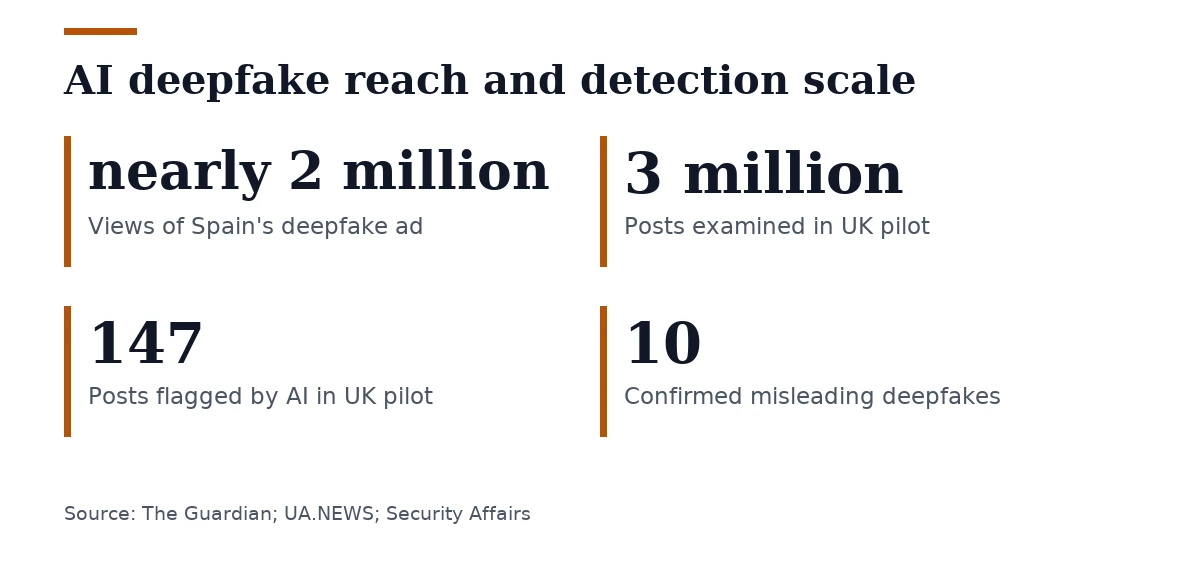
A deepfake is an AI-made video or audio that makes someone appear to say or do something that never happened. The AI disclosure appeared in very small, nearly invisible text at the bottom of the video. The video had received nearly two million views by Friday.
Leire Díez, a former Socialist Party member, filed a court complaint on Friday demanding the advert be removed immediately. She accused the PP of defamation and stealing her digital identity, saying her likeness was used to imply she sought to undermine judicial and law enforcement bodies.
On Friday, Spain’s digital transformation minister Óscar López said people unfamiliar with AI could mistake the video for reality. He said on TVE that putting such a colossal lie on the party’s official accounts seemed intolerable.
Borja Sémper of the PP said the party used digital tools to highlight Socialist hypocrisy and did not intend viewers to believe the depicted characters were real. Most of the nine lawyers consulted by El País said the video was not illegal due to its AI label and satirical tone.
José Javier Olivas, an associate professor at Spain’s National University for Distance Education, called the party’s use of AI-generated deepfakes truly regrettable. He said it crossed a red line for campaigning because it puts words in other people’s mouths and amounts to disinformation. Polls show the PP is likely to win the Nov. 29 general election and may need far-right Vox backing to govern.
Researchers at Wesleyan University identified more than 200 AI-generated political ads ahead of the 2026 US midterm elections, most tied to Republicans. Spending on AI-generated advertisements came to under $50,000 during the 2024 election cycle, the Wesleyan Media Project reported. Erika Franklin Fowler, the project’s co-director, said political advertising often lacks AI disclaimers. Around the world, authorities are working to limit the impact of false information.
The UK Electoral Commission is building an AI-powered tool to notify candidates about major deepfakes within three hours after they appear online. Vijay Rangarajan, the Commission’s chief executive, announced the system while speaking on a Conservative Party conference panel. The system aims to alert candidates or parties within three hours of a deepfake’s first appearance, about the time content takes to go viral.
Rangarajan expects attempts to use deepfakes to disrupt UK elections, saying “an absolutely certain attempt to use some of these deepfakes against the UK.” In Ireland’s 2025 presidential election, a deepfake falsely showed Catherine Connolly saying the election had been cancelled and that she was withdrawing. She went on to win the 2025 Irish presidential election.
In May 2026, Full Fact found AI-built campaign videos for a Glasgow candidate, and the Commission told Full Fact the videos fell outside the pilot because each was labeled an illustrative AI scene. Rangarajan said election information in 2026 must be judged under laws dating from 1983 or 2000. Every month the Commission faces between 30,000 and 40,000 cyber attacks, with daily peaks sometimes reaching 10,000.
Rangarajan said he believes signs of algorithmic bias appeared at election time on at least one social network, which he did not name. The Commission says it found some algorithmic bias in social media campaigns, but British law offers no clear answer. Experts and campaigners have warned about X’s role in British politics and about TikTok’s Chinese ownership.
Rangarajan wants stronger independent security capacity, and he suggests another organization could handle large-scale social media monitoring. Tech Policy Press interprets Rangarajan’s comments as a push to revise election laws and potentially create new offenses. British law sets the next general election for no later than August 2029, and it remains unclear whether lawmakers will act before then.
Join the discussion