


Key facts
- WHMCS disclosed an unauthenticated SQL injection flaw in its shopping cart on November 23, 2026.
- The flaw is tracked as CVE-2026-82981 and carries a CVSS score of 8.7.
- The flaw exposes clients' personal and support information and administrator accounts with hashed passwords, according to WHMCS's advisory.
- WHMCS also disclosed CVE-2026-82979, a second SQL injection in the Client Area with CVSS score 7.1.
WHMCS disclosed an unauthenticated SQL injection flaw in its shopping cart on Nov. 23 that lets anyone access customer records and administrator password hashes without logging in.
The vulnerability is tracked as CVE-2026-82981, a public identifier for a security flaw, and carries a CVSS score of 8.7, a severity rating. No login is required to exploit it, so anyone who can load a vulnerable shopping cart over the internet can reach it. WHMCS’s advisory says the flaw exposes clients’ personal and support information and administrator accounts with hashed passwords. SQL injection is a flaw that lets an attacker interfere with an application’s database queries.
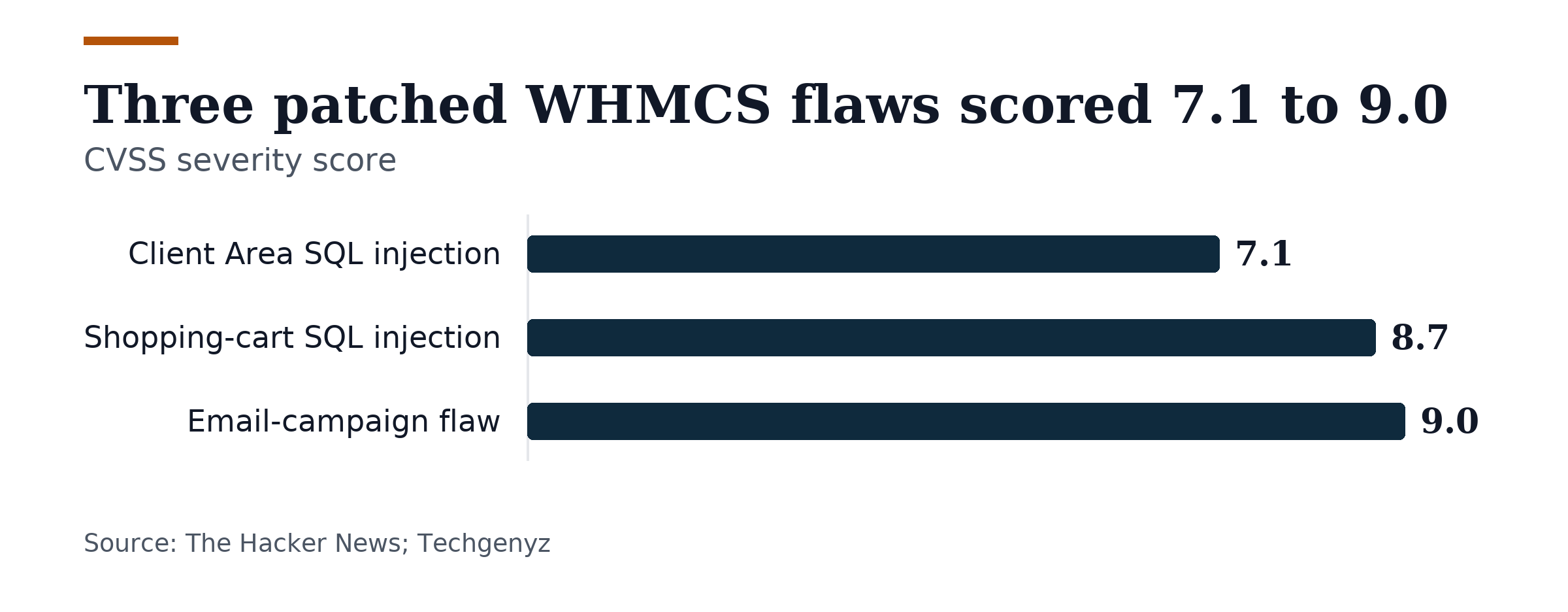
WHMCS disclosed two additional vulnerabilities on the same date. CVE-2026-82979 is a second SQL injection in the Client Area with a CVSS score of 7.1. Exploiting it requires a logged-in client with the View & Manage Contacts permission. That client can view personal, billing, and support records belonging to other customers, along with administrator records and password hashes.
A separate critical e-mail campaign flaw, CVE-2026-93700, carries a CVSS score of 9.0. It allows an authenticated client to read sensitive server configuration files that include database credentials and potentially execute code on the server. Its CVE record relies on CVSS 3.1 while the other two use CVSS 4.0, and its vector indicates some user interaction is required. It is distinct from the two SQL-injection flaws disclosed the same day.
The researcher using the handle alakazamspooon reported all three flaws to the company. WHMCS says no confirmed real-world exploitation has been reported for the vulnerabilities. The company also notes that a stolen password hash—a scrambled version of a password—is not a working password, though attackers can try to crack it offline.
WHMCS released fixed versions 8.13.8, 9.0.10, and 9.1.2 on Nov. 23, and the patches address all three disclosed vulnerabilities. Version 8.13.8 addresses the vulnerabilities affecting the 8.x release. Version 9.0.10 patches the issues in the 9.0.x branch, and version 9.1.2 patches the 9.1.x branch. The 9.1.2 build was missing from the company’s 9.1 release notes page when The Hacker News published.
Only supported versions receive fixes, so installations running the 8.0 through 8.12 series must move to a patched release rather than wait for a patch for the old line. Self-hosted administrators must install the updates themselves because WHMCS Cloud installations receive automatic updates. Cloud customers still must check the installed version and confirm the fixes are in place.

For CVE-2026-93700, administrators must delete every planned or ongoing email campaign under Utilities > Email Campaigns by choosing Delete from each campaign’s Manage Campaign menu. They must empty the template cache through Utilities > System > System Cleanup using Empty Template Cache. Only after those steps should they update to a fixed release.
Once patched, administrators should confirm the installed version, examine administrator accounts and permissions, and look for unusual login activity or unexpected changes to customer records. Administrators should inspect database access, rotate any credentials that might have been exposed, and investigate suspicious behavior connected to e-mail campaigns or server configuration files. When administrators spot signs of compromise, they should save relevant logs and follow an incident-response process instead of assuming the update fixed every problem.
Those on older unsupported versions should move to a supported release with the security fixes instead of waiting for an individual patch. The advisory gives no reason existing campaigns must be removed, so it is unclear whether patching alone suffices.
Techgenyz says billing and customer-management software flaws can affect an entire hosting business. The outlet also says hosting providers should treat the flaws as an urgent need to patch rather than proof that customer data was already stolen.
WHMCS has disclosed similar issues before. An advisory from May addressed an authorization issue in the Client Area disclosed on May 12. A September advisory covered an unauthenticated remote code execution issue disclosed on Sept. 3. Both advisories were issued by WHMCS.
Join the discussion