

Key facts
- Forescout researchers confirmed 99 security flaws across 10 TCP/IP stacks using AI assistance.
- Sixty-six of the confirmed flaws were previously unknown.
- Fifty-two percent of the newly discovered flaws received high or critical severity ratings.
- The research relied on Anthropic's Claude models combined with standard code analysis tools.
Using AI-assisted analysis, Forescout’s Vedere Labs research team confirmed 99 security flaws across 10 TCP/IP stacks. The flaws appear in industrial equipment, medical devices, network gear and other connected products. TCP/IP stacks are the communications protocols that handle network traffic. Forescout researchers confirmed that 66 of the 99 flaws were previously unknown.
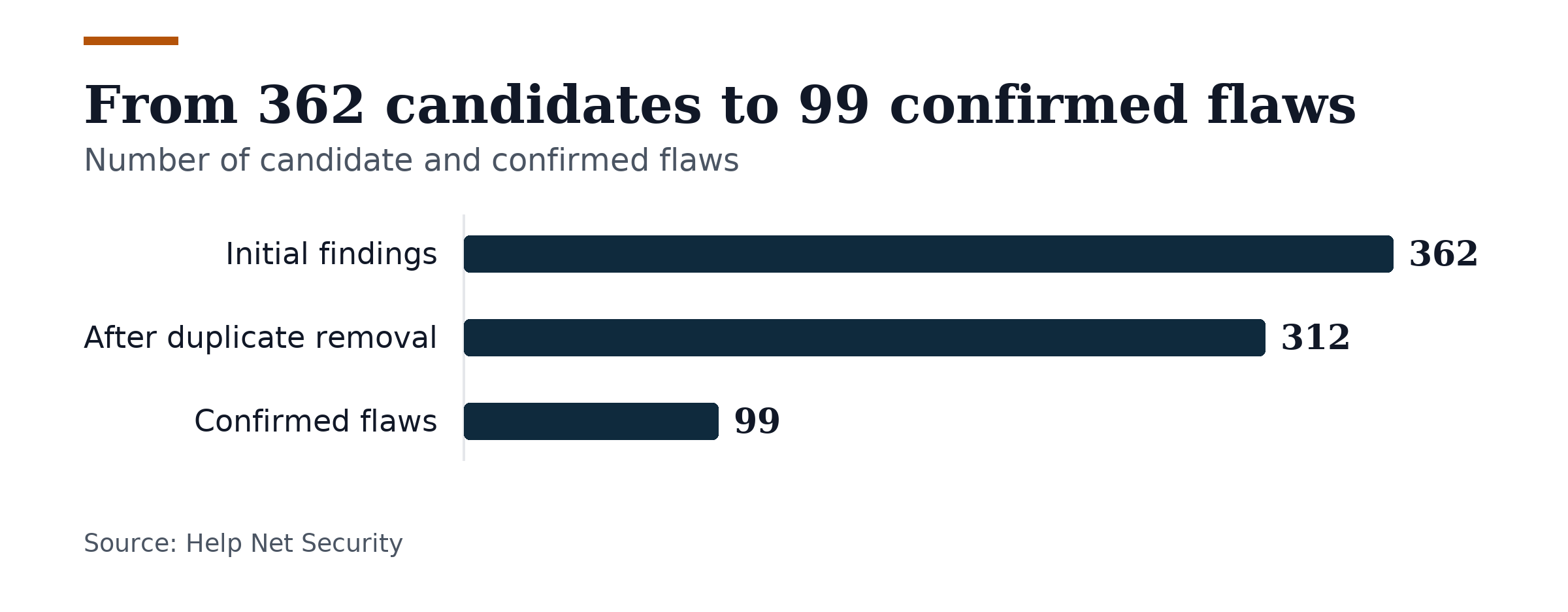
Among the newly discovered flaws, 52 percent received high or critical severity ratings. The work began with 362 initial findings, which fell to 312 candidates after duplicate removal before researchers confirmed 99.
Automated analysis took about 10 hours, and validation required roughly 80 hours. Researchers estimated that the same work would require about nine months of manual code analysis. Static analysis cost about $935, while total model spending ran between approximately $1,200 and $2,300. Checking compiled binaries without source code cost roughly six times more and took about twice as long as inspecting source code.
The research combined Anthropic’s Claude models with standard code analysis tools to hunt for bugs. Against a comparison set, the system flagged 33 of 82 previously known flaws, about 40 percent, in that set. The comparison used different target sets rather than a controlled benchmark, and it did not include system development costs. The approach detected memory errors in network traffic code most effectively, but it struggled with logic and design weaknesses in the code.
The team built 32 scanning rules from records of earlier investigations by the researchers. Project Memoria ran across 14 networking stacks for 18 months during 2020 and 2021. The current study covered 10 stacks, seven previously examined.
Siemens said flaws affected building automation controllers in the APOGEE, Desigo and TALON lines. An Oct. 13 advisory from Siemens covers specified APOGEE, TALON and Desigo PXC/PXM products. An unauthenticated remote attacker could read device memory or cause denial of service on those products. Certain Siemens products on the list lack a planned fix, while updates exist for affected APOGEE PXC and TALON variants.
A discontinued wireless access point from a defunct company contained seven device-specific flaws: unchangeable administrator credentials and a buffer overflow in firmware uploads. Ethernut gave no response to the disclosure.
Forescout shared 54 of the new flaws with developers and maintainers after judging them likely to affect current versions. Three unnamed proprietary stacks remain under investigation after disclosure began. No open-source CVE identifiers have been assigned yet. A maintainer fix issued Oct. 26 addresses an MQTT parsing loop in lwIP, the open-source networking stack, under certain buffer configurations.
A patch may never reach discontinued gear, leaving no supplier to develop or distribute a fix. Protection depends on vendor support and whether a fix reaches the device. Legacy devices and other hard-to-patch gear may remain in service for years. Many manufacturers reuse one networking stack, so one flaw in it can reach hundreds of devices.
Attackers can also use the same widely available AI approach to uncover security flaws. Because the figures are early and come from a vendor selling visibility and segmentation, readers should treat them as directional.
Forescout recommends reducing unnecessary network exposure, isolating unpatchable devices and applying available fixes. Forescout urges maintainers to build AI-assisted analysis into their release process and prepare for many AI-generated bug reports.
Join the discussion