

Key facts
- Intel 471 disclosed that manufacturing remained a prime ransomware and data extortion target in 2026, recording 1,379 claims equal to 16.8% of all monitored victims worldwide from January to October.
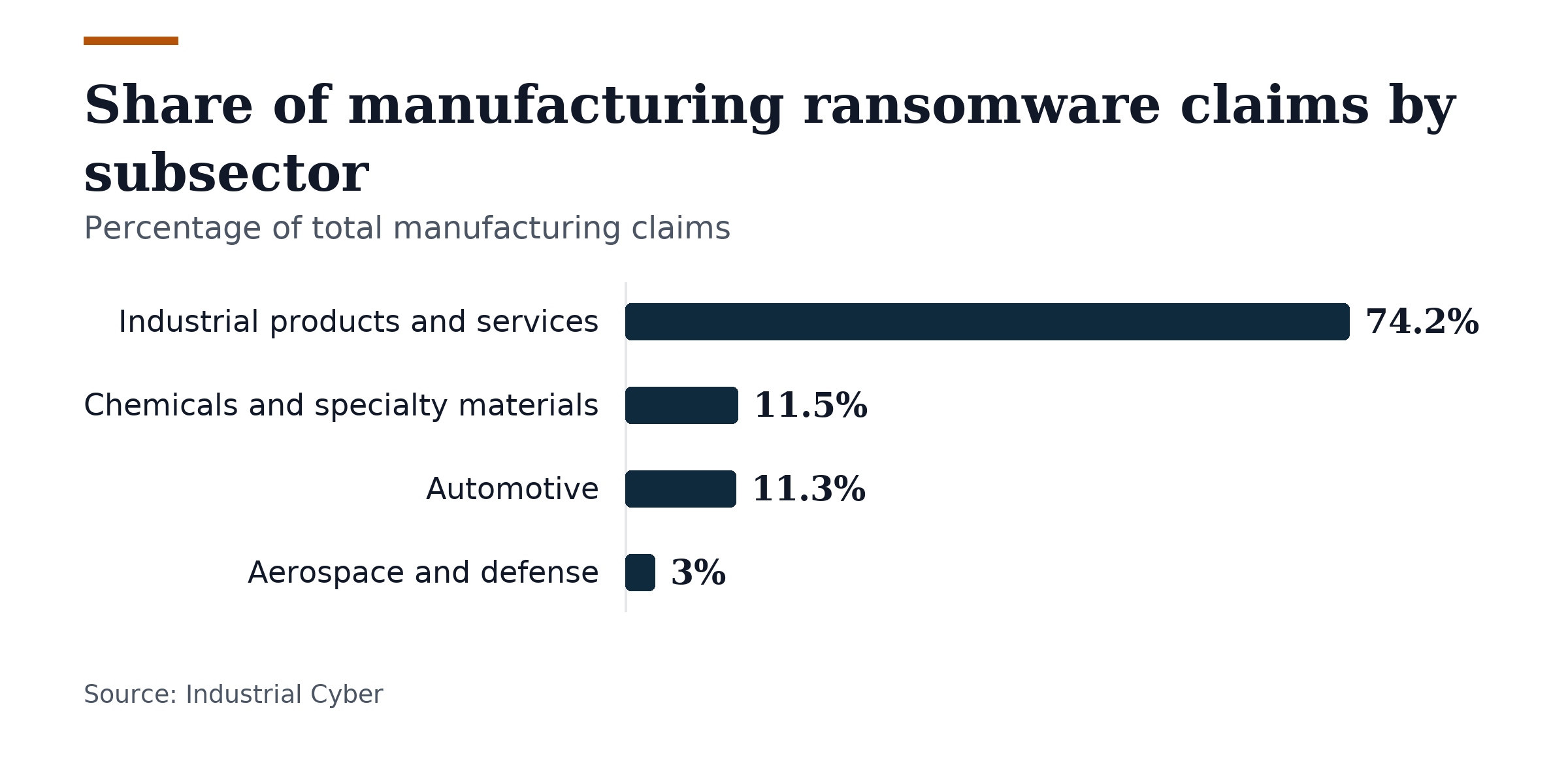
- Chemicals and specialty materials accounted for 11.5% of manufacturing claims.
- Automotive represented 11.3% of manufacturing claims.
- Aerospace and defense represented 3% of manufacturing claims.
Intel 471 disclosed that manufacturers faced heavy ransomware and data extortion targeting in 2026, with claims from January to October totaling 1,379, or 16.8% of all monitored victims worldwide.
Manufacturing held fifth place among targeted sectors, trailing professional services and consulting, public, consumer and industrial products, and technology, media and telecommunications. India, Italy, France and Spain ranked among the most affected countries in descending order. The leading country in victim count was followed by Germany, Canada, Italy and France.
Industrial products and services represented 74.2% of manufacturing ransomware and data extortion claims. Chemicals and specialty materials accounted for 11.5%. Automotive represented 11.3%, and aerospace and defense represented 3%.
Qilin, The Gentlemen and Akira led ransomware cartels targeting manufacturing victims, at 13.6%, 12.9% and 8.4% respectively. Tracking leak sites, Intel 471 found that manufacturing was the most targeted sector for ransomware and data extortion during the reporting period.
Intel 471 reported that manufacturers with yearly revenue under US$50 million accounted for 68% of monitored ransomware and data extortion claims. Revenue estimates covered about 66% of claims, and firms earning $10–50 million formed the largest group at 399. Firms in the $5–10 million bracket accounted for 189 victims, and only 66 victims exceeded $1 billion.
Attackers pick targets based on access ease and low intrusion effort rather than company size, Intel 471 assessed. Many small manufacturers serve as niche component makers and tier suppliers tied to strict delivery contracts, and they usually lack a dedicated security team. Since they cannot afford downtime, many firms pay mid-tier demands quickly rather than letting a supply line stop.
Initial access brokers enter networks using brute-force attacks, stolen malware logs, vulnerability exploits and social engineering, Intel 471 described. After entering a network, initial access brokers resell that access on underground forums to other attackers planning further intrusions. “After gaining a foothold, IABs sell the access on underground channels to other threat actors seeking to carry out further attacks,” Intel 471 said.
Intel 471 internal data showed that from January 1 to October 29, 2026, initial access brokers offered access affecting 172 manufacturing entities, about 10 percent of all access offers worldwide. Wholesale offers covering multiple targets made up 66.8 percent of manufacturing access offers, while 33.2 percent targeted a specified organization.
Exploiting vulnerabilities produced 25% of examined initial access cases against manufacturers, Intel 471 found, while brute-force attacks produced 16.3%. Compromised credentials of unknown origin accounted for 10.5% of advertised access. Information stealers provided credentials for 0.6% of advertised access, and Intel 471 could not determine the acquisition method in 47.6% of cases.
Sellers usually sort access listings by claimed revenue, permission level, host count and access type. Most manufacturing access listings involved perimeter remote access, including VPN services. A VPN, or virtual private network, creates a secure connection over the internet.
VPN services accounted for the largest share at 28.5% of examined cases. Microsoft Remote Desktop Web Access came next at 9.9%. FTP servers, which move files between computers, reached 7.6% and RDP hosts, for remote desktop access, reached 6.4%.
Extortion operators buy access from brokers or break in directly, then expand their foothold to stage demands, often pairing data theft with encryption but sometimes skipping encryption. Middle market firms tied to just-in-time schedules and thin margins represent sources of faster, less-resisted payouts for ransomware operators.
Gaps in finding and fixing vulnerable internet-facing applications may sustain the supply of access, Intel 471 researchers assessed, though they could not confirm patch availability or response speed. Attackers pair threats of losses from halted production lines with theft and auctioning of intellectual property such as CAD schematics, circuit board layouts and chemical formulations.

Manufacturers should go beyond perimeter-only defenses and adopt structural operational decoupling along with proactive threat visibility, Intel 471 recommends. Industrial firms and suppliers should apply strict segmentation between corporate IT and plant-floor operational technology. Intel 471 advises that manufacturers demand multifactor authentication across every external vendor access pathway.
Companies should install compensating controls at the hardware level around unpatchable brownfield controllers, Intel 471 says. Threat intelligence programs should monitor underground channels for early warning signs of activity. Incident response playbooks should address third-party supply chain exposure with enforceable vendor standards and crisis protocols to maintain minimum viable production during enterprise IT outages.
In May 2026, zestix advertised allegedly stolen data from Taiwan-based Pegatron Corp., which Intel 471 described as a supplier to electric vehicle maker Lucid Motors. The listing included 416 unencrypted files totaling about 4.65 GB of specifications and production assets for Lucid’s Gravity and Air programs. The advertised material consisted of technical intellectual property rather than customer records or personal information, and the listing framed it for use in CAD tools such as SolidWorks and CATIA.
Supposedly, the files contained CAD schematics and board layouts for high-voltage and electronic architectures, such as the Gravity AC junction box, center information displays and instrument clusters. Board-level schematics, Gerber files, pick-and-place details for the telematics control unit and files describing the SVCU 2.0 module layout for ADAS support were also reportedly included. Other allegedly included material addressed validation protocols meeting the LV-124 and IPC-A-610 standards.
The SovCali data extortion group listed Lucid Group Inc. on its leak site on August 8, 2026. Lucid confirmed on August 21, 2026 that one of its vendors experienced a cybersecurity event. Lucid said the vendor lacked access to customer databases or systems that could interfere with vehicle operations or core business functions, and production and retail activities were unaffected.
Lucid said it cooperated with third-party investigators and law enforcement to safeguard intellectual property and seek legal remedies. A link between zestix and SovCali remains unconfirmed, Intel 471 said. Intel 471 described the episode as supply chain extortion after a supplier intrusion let adversaries reach proprietary design data.
Taiwan-based Hon Hai Precision Industry Co. Ltd., trading as Foxconn, suffered a major breach in May 2026. Foxconn acknowledged the incident and said the attacks struck several North American manufacturing facilities.
In October 2026, Intel 471 said, the actor Marge was hiring social engineering specialists to gain initial network access for ransomware operations. Claimed employee endpoint access at Wanhua Chemical connected to the Marge activity.
Intel 471 said it does not expect a significant change in the threat environment for financially motivated adversaries targeting manufacturers. Attacks will remain elevated, Intel 471 projected, with extortion campaigns focused opportunistically on small and mid-sized manufacturers.
From Aerospace to Assembly Lines: How Cybercriminals Are Targeting Manufacturing Supply Chains is a report published by Intel 471. The report presents manufacturing cybersecurity as an existential operational risk, not just a data protection issue, due to high-value IP exposure and zero tolerance for downtime. Intel 471 noted that linking enterprise IT with plant floor OT has weakened traditional boundary defenses, exposing legacy controllers and assembly systems to enterprise-level threat vectors and lateral movement. OT, or operational technology, refers to hardware and software that monitors and controls physical devices.
Join the discussion