
Key facts
- Early Access for DNA Shield launched October 15, 2026 to let firms store critical data offline for long‑term trust.
- DNA Shield encodes customer‑selected, encrypted material into synthetic DNA kept offline under managed custody, with recovery requiring a deliberate, controlled process.
- DNA Shield initial use cases include key custody continuity, crown‑jewel IP, regulated integrity records, and sovereign memory/golden records.
- Vincent Franceschini said DNA Shield is the first operational use of Biomemory's molecular platform, moving beyond research demos.
Biomemory announced the launch of DNA Shield on October 15, 2026 from its Paris and Boston bases.
DNA Shield is a managed service (a service where a provider handles operations) for sovereign data protection (protection of a nation’s or organization’s most critical data) aimed at safeguarding an organization’s most critical digital assets. Early Access for DNA Shield also launched October 15, 2026 to let firms store critical data offline for long‑term trust.
DNA Shield encodes customer‑selected, encrypted material into synthetic DNA (artificially created DNA molecules) kept offline under managed custody (supervised storage by a trusted provider), with recovery requiring a deliberate, controlled process. It provides an offline layer (data stored disconnected from networks) that is separate from the active control plane (the part of a system that manages routine operations and is reachable via network) and removed from the network‑reachable attack surface (parts of a system that attackers can access over a network and target). DNA Shield aims to protect data against cyber attack, organizational change, infrastructure replacement, and regulatory scrutiny.
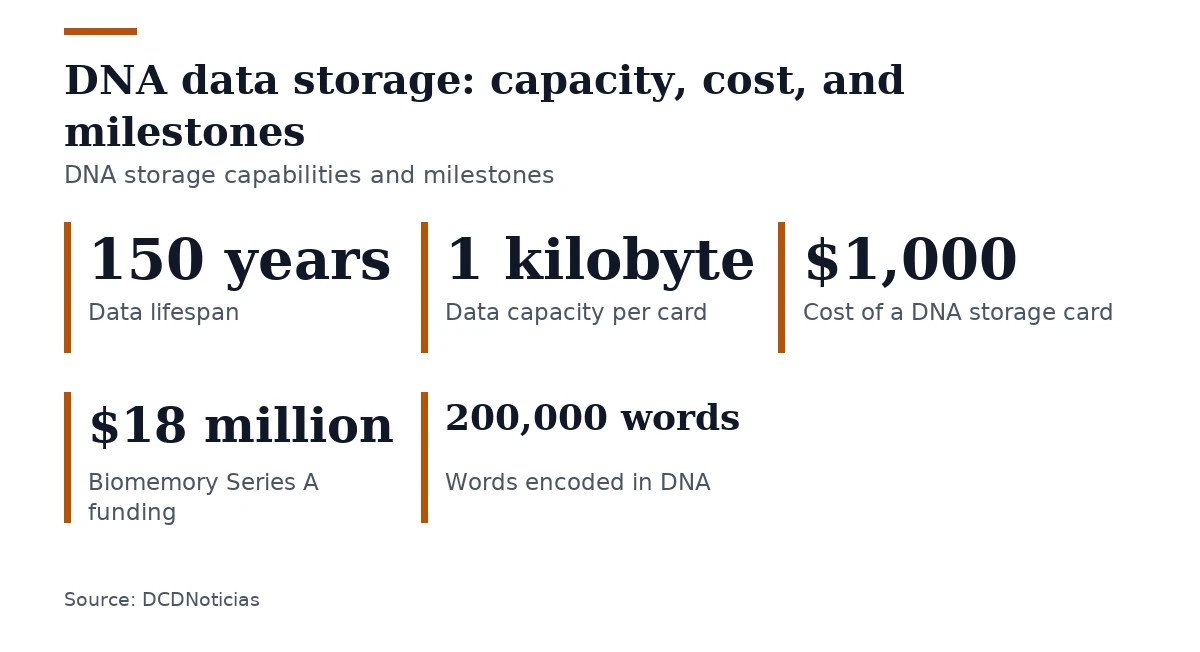
Early use cases include key custody continuity (ensuring continuous control of cryptographic keys), crown‑jewel IP (an organization’s most valuable intellectual property), regulated integrity records (data required to remain unchanged by regulations), and sovereign memory/golden records (authoritative copies of data retained for long‑term trust). Biomemory’s DNA storage cards (physical cards that store data in synthetic DNA), launched December 2023, cost $1,000, last up to 150 years, and hold one kilobyte of data. After launching its storage cards, Biomemory secured an $18 million Series A round (an early stage of venture capital funding) to finish its first‑generation appliance, expand staff, and speed commercialization.
Biomemory acquired Catalog Technologies’ assets in Mar. 2026, adding a Boston research and production hub alongside its Paris base and expanding its IP portfolio. The Catalog acquisition gave Biomemory a North American footprint with a flagship Boston office for R&D (research and development), production, and customer support. Laurent Guengant, appointed Biomemory CEO in Jul. 2026, said DNA Shield marks the shift from proving a science to delivering a commercial product.
Vincent Franceschini said DNA Shield is the first operational use of Biomemory’s molecular platform (technology that uses synthetic DNA for data storage), moving beyond research demos. Biomemory is a leader in commercial DNA data storage and serves as co‑chair of the DNA Data Storage Alliance (industry group developing DNA‑based storage standards). Biomemory, spun from Sorbonne University and CNRS, owns the full stack from molecular biology to enterprise software, producing in Paris and Boston.
Biomemory’s roadmap calls for expanding into DNA‑based storage from 2029, followed by molecular search and compute capabilities (the ability to process data directly within DNA molecules). In 2022, Catalog Technologies encoded 200,000 words of eight Shakespeare tragedies into DNA and demonstrated the ability to search for specific query terms.
Join the discussion