
Key facts
- On October 13, investigators found that attackers used a service provider's stolen credentials on October 7 to reach data Uber had shared with that provider.
- Uber declined to state how many customers were affected by the breach or how many drivers it notified about the incident.
- Driver's licenses belonging to 1,873 residents of Rhode Island were included in the stolen data, according to breach notices seen by TechCrunch.
- An Illinois filing showed that some state residents had driver's license information stolen, while the count of affected people remained pending.
Uber said attackers used stolen credentials from Fireworks AI, a third-party technology company whose platform lets developers reach and use open AI models, to reach Uber driver data on Oct. 7, 2026. Uber disclosed the breach in letters dated Nov. 10, 2026, telling roughly 150,000 drivers attackers had stolen their personal information.
On Oct. 9, 2026, Uber learned of the incident, immediately cut its data connections with the provider and started an investigation. By Oct. 13, 2026, investigators said the intruders reached shared Uber data using credentials stolen from the service provider on Oct. 7. According to Uber, the intruders viewed driver’s license images and details including names, addresses and birthdates, along with driver’s license numbers and government-issued ID numbers.
Uber said, “The service provider’s compromised credentials did not provide access to other Uber systems.” The company said the information was stored in an environment built and run by its Cloud Security team, and that alerts were active but did not fire because the threat actor used valid credentials. The investigation continues.
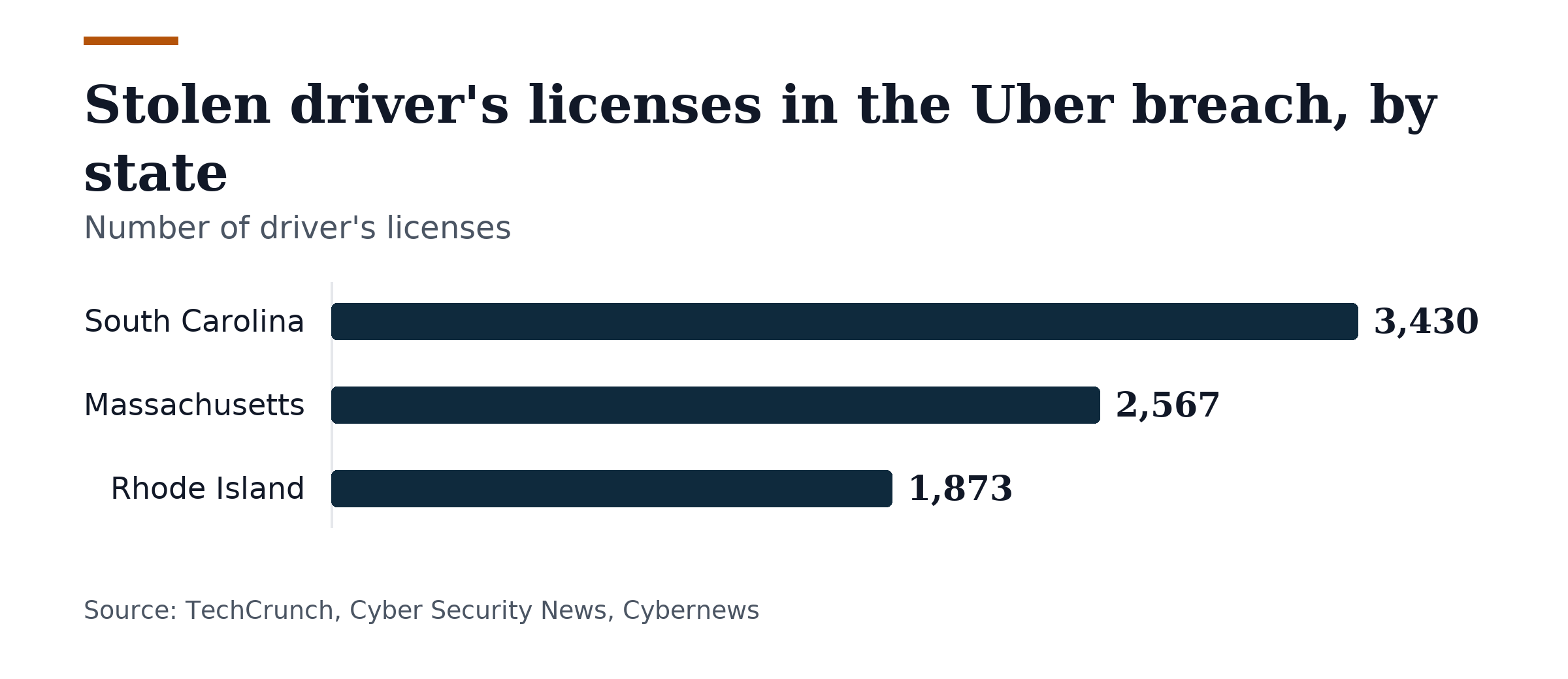
State filings reviewed by TechCrunch show that attackers stole driver’s licenses from 2,567 Massachusetts individuals, and that attackers also took licenses from 3,430 people in South Carolina and 1,873 residents of Rhode Island. Those figures total 7,870 people in three states. An Illinois filing indicated that attackers stole driver’s license information for some state residents, though the affected count remained pending.
According to Uber’s report to the Texas Attorney General’s Office, the breach affected 149,346 people, but the company would not give a customer count or say how many drivers received notice. The company also sent notices to California drivers but gave no count for that state. TechCrunch reports that more breach notifications will arrive, which would push the total higher. The evidence available so far covers drivers and does not confirm that the breach involved all Uber riders or accounts.
The breach involved Fireworks AI, a third-party technology company whose platform lets developers reach and use open AI models. Uber left the provider unnamed in its breach notifications. A spokesperson told TechCrunch the provider was Fireworks AI. Uber filed data breach notifications with several states, including California, Iowa, Massachusetts, South Carolina, Texas and Vermont.
California’s public notice leaves the exposed data fields blank instead of specifying what information attackers took.
Notion confirmed that hackers stole its data in the Fireworks incident, and the company said its systems were not breached even though the incident affected under 1% of customer workspaces. Fireworks AI went through two separate security breaches during October 2026.

The intruders got into Fireworks’ internal network with one employee’s credentials and took resource metadata such as identifiers, display names, descriptions and creation times. Billing details, among them shipping addresses, payment history, account balances and credit usage, were copied as well, and customer model weights and datasets were also compromised.
Fireworks AI canceled and replaced credentials and service accounts, stripped out unneeded elevated privileges and added controls to block creation of new unauthorized credentials. It also enhanced logging and monitoring systems. Fireworks attributed the breach to a financially motivated cybercriminal group seeking to sell stolen tokens used to reach large language models, or LLMs, and no known cybercriminal group has taken credit for the theft.
At first, Fireworks said there was no evidence that customer personal information, models or datasets had been accessed.
Uber is dealing with its second known data breach of the year. Earlier, the company reported a security incident at Uber Freight, its truck shipping unit, and an extortion gang claimed it stole data from that incident. Taken together, the disclosures show that one provider’s security incident can expose data belonging to several customers.
Uber’s breach notice says no improper use of the affected information had been found by the time the letter went out. The company is offering free credit monitoring and fraud assistance services through Cyberscout, a TransUnion company. People receiving the letter have 90 days from its date to sign up with an activation code.
Uber recommends that drivers who were affected look over their personal letters, review account statements and report any suspicious activity. The company also urges people to think about fraud alerts or credit freezes. The Federal Trade Commission explains that a credit freeze blocks access to credit reports, making it harder to open fraudulent new accounts.
Join the discussion