

Key facts
- According to prosecutors, Palacio secretly paid ransoms and billed customers at a markup to generate profit.
- Prosecutors charge Palacio with three counts of wire fraud, exposing him to up to 60 years in prison.
- Prosecutors say Palacio billed the undercover firm about $13,260 for purported decryption technology services.
- Palacio was arrested in Las Vegas on October 22, 2026, and later transferred to Rhode Island.
Federal prosecutors indicted Juan Ricardo Palacio Escobar, co-founder of the Florida-based ransomware recovery site Ransomwarehelp.com, on three counts of wire fraud after an FBI sting in June 2026, according to court documents. Agents arrested the 52-year-old Colombian national in Las Vegas on Oct. 22, 2026, and he was released on pretrial bond on Nov. 20, 2026. The indictment was returned in Rhode Island.
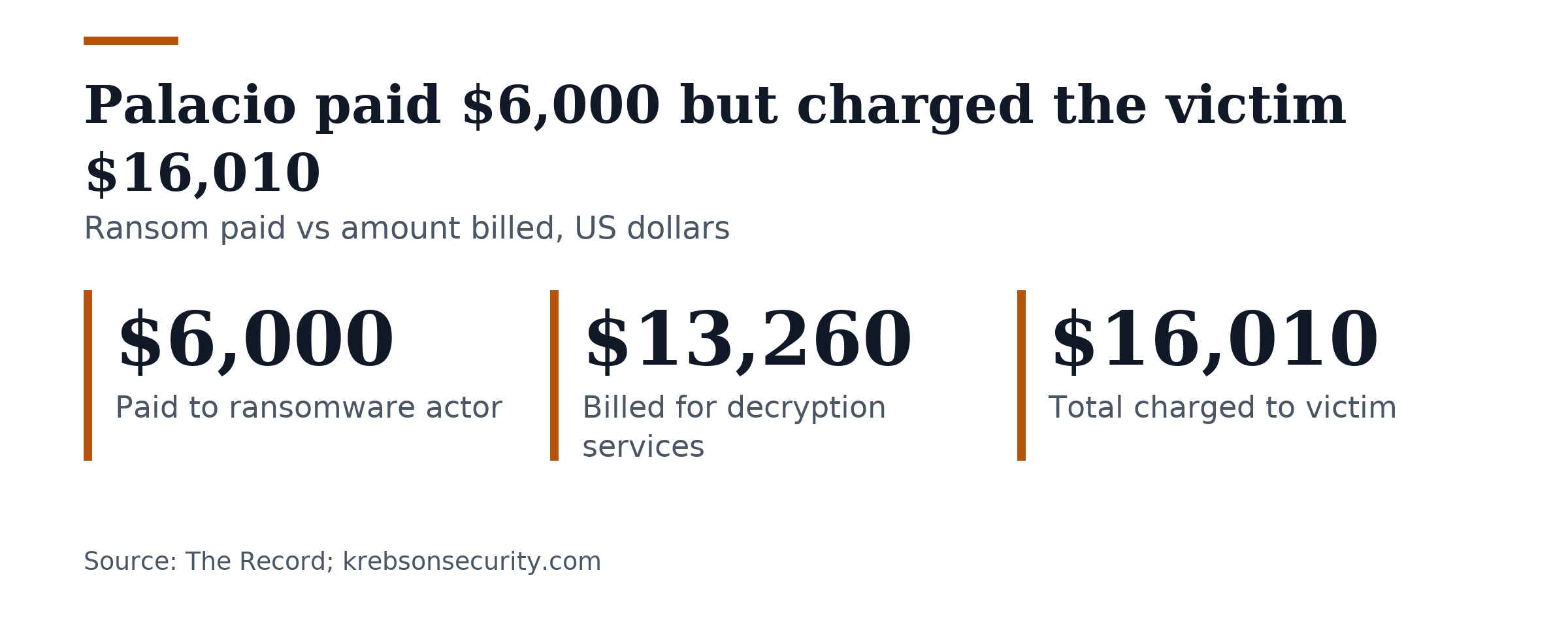
Prosecutors allege Palacio told victims his company possessed decryption tools that could restore data without negotiating or paying ransomware gangs. FBI agents posed as a victim company and as a ransomware group in a June 2026 sting. Palacio negotiated with the fake group, paid about $6,000 in Bitcoin for a decryption key, then billed the fictitious firm about $13,260 for decryption services plus a $2,750 diagnostic fee, a total of $16,010.
The company mainly targeted small and medium-sized businesses with limited technical knowledge. In one 2024 case, an accounting firm paid RansomwareHelp a diagnostic fee after a Lockbit infection and received a proposal listing $438,880 for recovery, including eight six-hour processing cycles and work on 510 preconfigured forensic servers. Soteria co-founder Paul Ihme reviewed the network and found only a single ransom note, and he believes the firm sought remote access through AnyDesk to erase attackers’ notes from victim systems.
Ransomwarehelp.com’s website told victims not to pay and claimed its advanced cryptographic tools could fully restore data, servers and systems. The site also said the firm had more than 28 years of experience and a staff of 80 experts in cryptography, cybersecurity, forensic analysis and reverse engineering, and that it did not promote, intermediate or pay ransoms. The site currently displays an under-maintenance notice.
A parallel case shows prosecutors are pursuing similar conduct elsewhere. A federal grand jury in New York’s Eastern District indicted MonsterCloud CEO Zohar Pinhasi, 50, on Sept. 23, 2026, for wire fraud and conspiracy tied to a scheme running from June 2018 through June 2023. Prosecutors say Pinhasi collected more than $19 million from clients while paying over $8 million to ransomware gangs, and that MonsterCloud typically contacted cybercriminals first to buy decryption keys rather than using its own technology.
In one example cited by prosecutors, Pinhasi paid about $8,200 to a cybercriminal in August 2023 but billed the client roughly $150,000; in another, he paid about $236,000 and billed about $380,000. If convicted, Pinhasi faces up to 20 years in prison on each count. Palacio faces up to 60 years on three wire fraud counts.
Officials framed the prosecutions as protecting victims from being harmed twice. U.S. Attorney Joseph Nocella Jr. said Pinhasi re-victimized clients by falsely claiming to decrypt ransomware without paying attackers while earning a large profit. First Assistant U.S. Attorney Charles Calenda said, “Businesses and individuals seeking to recover from a cyberattack should not be victimized for a second time by those they turn to for help.”

FBI Assistant Director in Charge James C. Barnacle Jr. said Pinhasi turned a victim’s crisis into his personal profit center. Related cases include two ransomware negotiators who received four-year sentences in May 2026 after pleading guilty to covert attacks and coordinating with gangs, and Angelo Martino, a 41-year-old negotiator from Land O’Lakes, Florida, sentenced to 70 months in July 2026 for conspiring with Blackcat/ALPHV.
Federal prosecutors have also charged Edward Dubrovsky, 54, an executive at Canadian firm Cybersteward, in early October 2026 on cyber extortion and conspiracy charges, and a different cybersecurity executive for alleged involvement in a major cybercriminal group that breached the FBI. Prosecutors say this case follows a recent wave of Justice Department actions.
Threat researcher Assaf Morag of Flare found a link between fake fraud-recovery firms and ransomware deployers. Morag said these companies claim to help victims but secretly defraud them, and that victim organizations often do not realize the fraud.
Warning signs for victim organizations: a recovery firm that claims it can decrypt data without paying attackers, then secretly negotiates with gangs and bills far more than the ransom; requests for unrestricted remote access through tools such as AnyDesk; and promises backed by testimonials from paid promoters. The cases remain open as Palacio awaits trial on pretrial bond and Pinhasi faces his own federal charges. Ransomwarehelp.com’s website was under maintenance at the time of reporting.
Join the discussion