

Key facts
- Cranbury Township lost $26 million through a fraudulent wire transfer on Sept. 28.
- The money was meant to buy property for the township's affordable housing obligations.
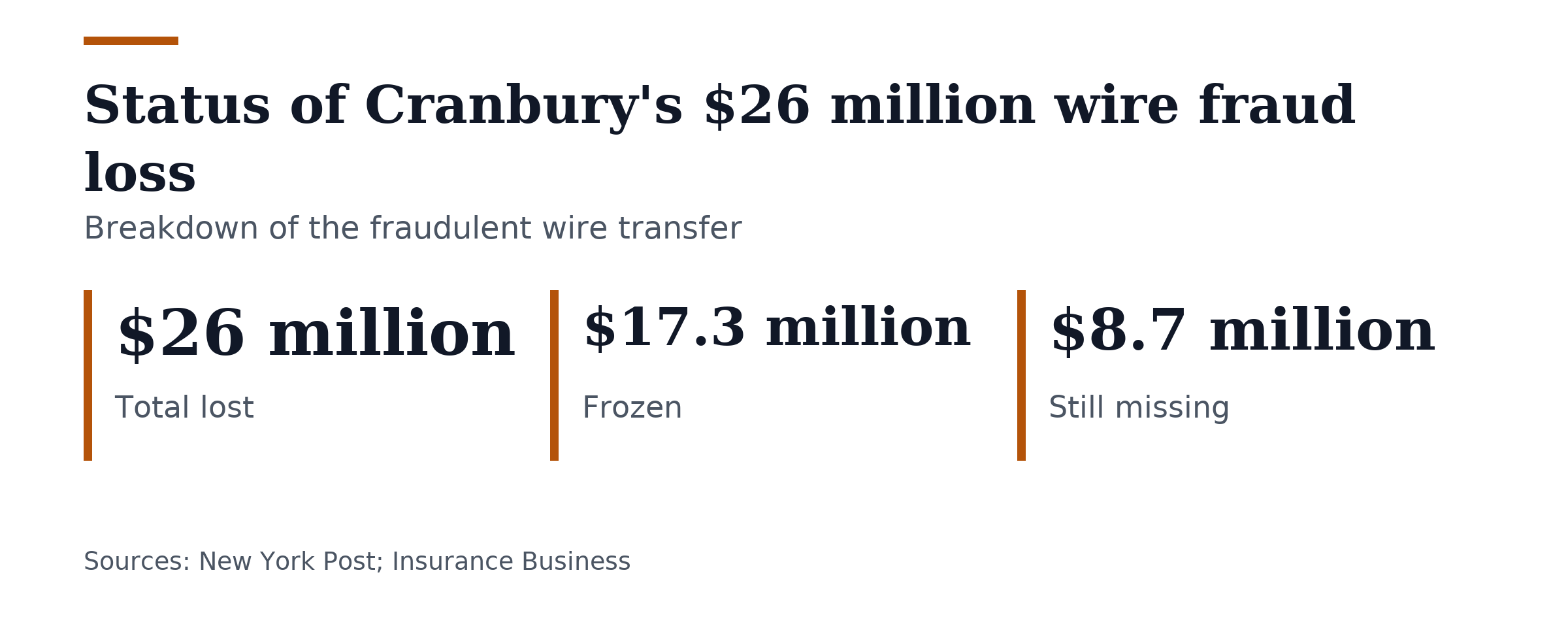
- Law enforcement froze about $17.3 million of the stolen funds.
- About $8.7 million of the stolen money remains missing.
On Sept. 28, a fraudulent wire transfer took $26 million from Cranbury Township, money meant to buy property for affordable housing obligations.
Police Chief Giuseppe DeChiara said the township got false wiring instructions while preparing for the property closing. The township has not said how the false instructions arrived. Township officials attributed the theft to lack of oversight and a severe clerical error rather than external hacking.
DeChiara said his team got to Town Hall within six minutes of the fraud alert, and his first call went to the FBI. Authorities froze roughly $17.3 million of the stolen money. Roughly $8.7 million of the stolen money is still unaccounted for.
According to CBS New York, the police chief said $17 million was recovered and will be returned, with $9 million still unaccounted for. He said the seized $17 million should be returned to Cranbury within 120 days. Nobody has been charged.
Mayor Lisa Knierim announced the theft on Nov. 6 in a Facebook post, describing it as a sophisticated financial incident. Officials disclosed the theft three days after the Nov. 3 local election. Some residents say officials held back the news for political reasons.
Democrat Thomas Szczur Jr. defeated Republican Carol Haring 63 percent to 37 percent on Nov. 3, giving Democrats 5-0 control of the Township Committee. DeChiara said he made the call alone on when to reveal the theft, and that the election played no part in the timing. Committee members asked him a dozen times to make the information public, and he turned them down each time.
DeChiara said he found out who won the election the following day, when someone told him. “I’m telling you right now it has nothing to do with an election,” Giuseppe N. DeChiara said. DeChiara denied that politics played any role in the timing of the disclosure.
A gag order prevented township employees, council members and the mayor from talking about the case while the investigation continued. Officials stayed silent because they worried the thieves would shift the money if they learned it was being traced. The chief said the township announced the theft on Nov. 6 after taking investigative steps.
Cranbury police and the Middlesex County Prosecutor’s Office lead a task force that includes local, county, state and federal investigators. Investigators were working around the clock to trace the stolen money. Late Sunday night after the Nov. 6 announcement, investigators were still issuing subpoenas.
Officials moved the Monday council meeting to the public library to accommodate a larger crowd. The council moved public comment to the top of the agenda. Residents lined up in a hallway to speak to the council. At a packed Monday night meeting at the public library, Knierim told residents that their anger, fear, confusion, frustration and disappointment were valid.
Residents called for a public hearing and demanded to know how the shortfall will be covered and why officials waited until after Election Day to disclose the theft. “communicate openly and honestly with the community we serve, particularly when faced with difficult circumstances,” Lisa Knierim said.
The Township Committee introduced ordinances to create an assistant township administrator and an assistant chief financial officer, with the first reading at Monday’s meeting. A final vote on the ordinances is set for Nov. 23. The mayor said no township funds can move without police oversight for the time being.
Since 2010, one employee has held the jobs of township administrator, chief financial officer and finance director, and is now retiring. Tom Beatty, a resident, told the committee that combining those roles created a systematic vulnerability. “created a systematic vulnerability,” Tom Beatty said. The concentration of duties in one person has been cited as a control weakness.
The township brought in accounting firm PKF O’Connor Davies for consulting work after the theft. Stephen Goodell, the township attorney, told residents on Monday that insurance money could let the housing plan proceed on a delayed schedule. Goodell said that remains true even if the missing $8.7 million is never recovered.
Cranbury’s insurance policy has a $5 million limit. The township is working with its carriers to set the terms and amount of any coverage. Even if every frozen dollar comes back and the full $5 million policy pays out, the township would still face roughly a $3.7 million shortfall. A deductible or sublimit would widen the gap.
Alyssa Orschel, cyber and fidelity claims leader at HUB International, said social engineering coverage generally applies when an employee is tricked into sending money. According to Orschel, funds transfer fraud provisions may apply if a criminal uses stolen banking credentials to initiate the transfer. Some policies make staff confirm changed payment details through another channel, such as a phone callback, and skipping that step can jeopardize coverage. Social engineering coverage often carries a sublimit far below the policy limit.
Payment-instruction fraud could be covered under either a cyber or a crime policy, depending on who moved the money. Residents want to know whether the missing money will appear on property tax bills, and the township has not said.
The FBI’s Recovery Asset Team operates the Financial Fraud Kill Chain with banks to halt fraudulent transfers. The team handled roughly 3,900 incidents in 2025 involving $1.16 billion in attempted theft, the FBI’s 2025 Internet Crime Report said. The team froze $679 million, or 58% of that amount. Cranbury’s recovery rate is higher than this national average.
Most New Jersey towns belong to regional joint insurance funds under the Municipal Excess Liability Joint Insurance Fund, a statewide pool covering about 70% of the state’s municipalities. To qualify for cyber coverage, members of those funds adopt tiered technology standards.
Join the discussion