

Key facts
- The blocked amount was about 91% of the money customers attempted to send in the campaign.
- More than 500,000 people watched a fake YouTube livestream of Tesla's flying car demonstration carrying an Elon Musk deepfake.
- Scammers showed wallet addresses and a QR code and promised that any cryptocurrency viewers sent would be doubled.
- Coinbase said no account was hacked, no password stolen, and no credentials phished; customers logged in and approved payments themselves.
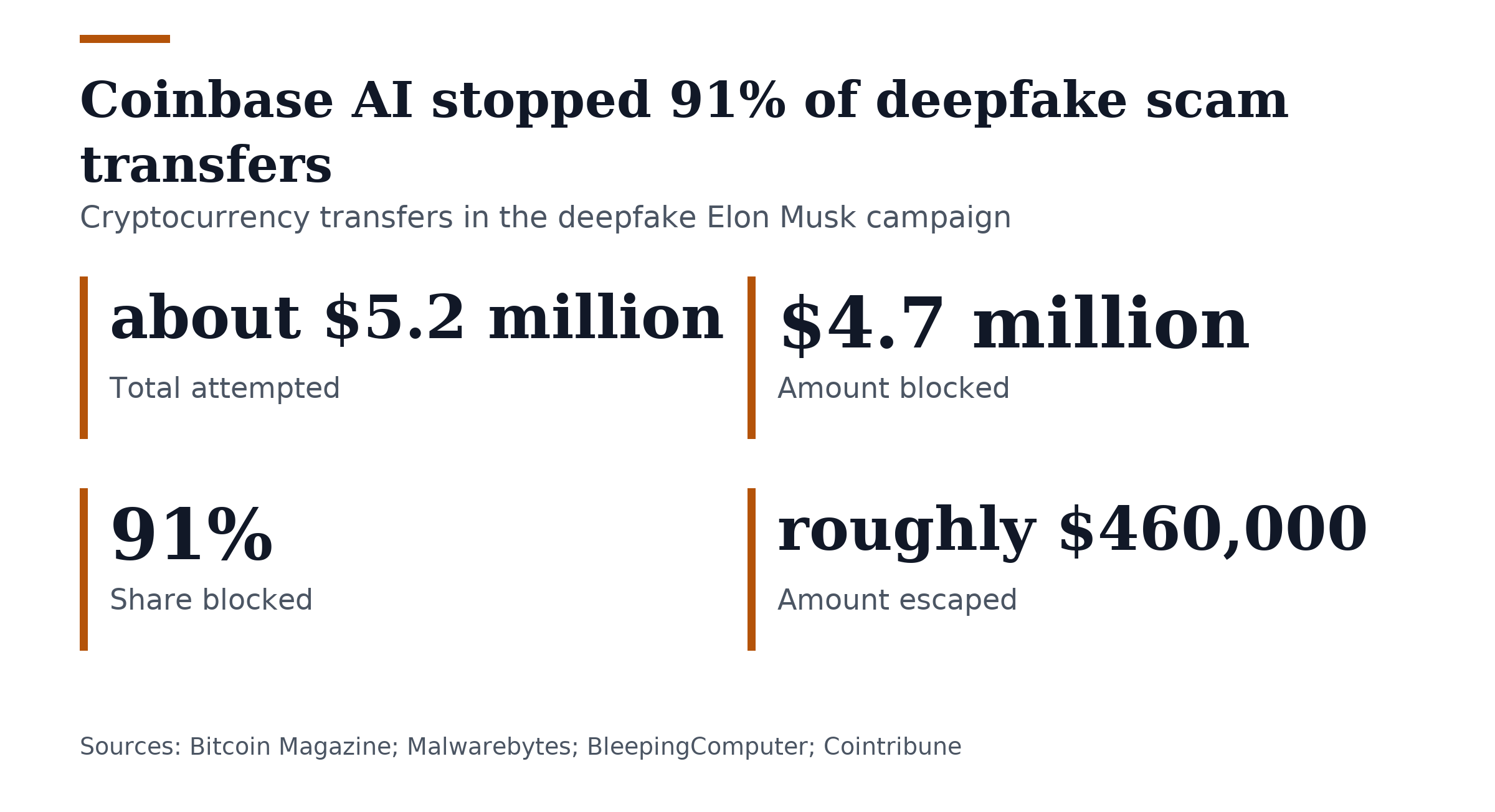
Coinbase said its AI-powered scam defenses stopped about $4.7 million in cryptocurrency transfers from leaving customer accounts, the company disclosed in a November 17, 2026 blog post that was part of a weekly consumer protection series.
Hundreds of Coinbase customers tried to send millions of dollars to the scammers over about two hours. The blocked amount covered about 91% of the money customers attempted to send in the campaign.
The bait was a fake YouTube livestream of Tesla’s flying car demonstration featuring an Elon Musk deepfake that more than 500,000 people watched. Scammers showed wallet addresses and a QR code and promised that any cryptocurrency viewers sent would be doubled.
No account was hacked, no password stolen, and no credentials phished, Coinbase said. Customers logged in and approved the payments themselves.
The customer was logged in, the customer pressed confirm, and the customer believed it was the opportunity of a lifetime.
Coinbase, BleepingComputer
Coinbase said authorized transfers from legitimate account holders are hard to detect because most fraud defenses look for unauthorized activity. Its AI agent had never seen this campaign because such deepfake giveaways were not in its training data. Coinbase said the entire detection and intervention process ran automatically with no human involvement.
Outbound transactions undergo real-time evaluation via machine learning algorithms designed to detect newly generated destinations, fake brands, and promotion schemes. When the system flags a transfer, an AI agent starts a short conversation with the customer explaining the suspected scam. The system scores each agent reply for confidence before showing it to customers, so it can add safeguards when needed.
Coinbase has not said how much money ultimately reached the scammers. Bitcoin Magazine reported that users attempted approximately $5.2 million, with around $460,000 successfully transferring out.
A deepfake is an image, video, or audio recording created or altered with AI, according to Malwarebytes. It makes it seem someone said or did something they did not, and scammers may need only a photo or a short clip of a real person to create a convincing one.
Elon Musk and his companies are popular lures for cryptocurrency scams including hijacked Twitter accounts, fake giveaway e-mails, TikTok promotions, and deepfake investment videos. A separate campaign involving compromised verified Twitter accounts stole more than $580,000 in cryptocurrency in one week.
Coinbase said staging this scam once took a crew, a studio, and weeks, while now it takes a livestream slot and a model. The exchange is expanding AI review of risky sends to every scam. Coinbase said AI labels each new scam case, so its models learn within hours rather than weeks. Coinbase said it will never promise to double, triple, or multiply cryptocurrency that customers send.
Nobody legitimate will double your crypto
Coinbase, Bitcoin Magazine
Changpeng CZ Zhao, founder of Binance, said AI is dramatically accelerating the speed and sophistication of cyber attacks. He said only AI can successfully counter AI-driven attacks. A court sentenced a Brooklyn man to 12 years in prison in September over a $16 million Coinbase phishing scam.
Malwarebytes advises not to send cryptocurrency to unlock a larger payout because promises to multiply the amount sent are a red flag. Malwarebytes advises not to treat an on-screen wallet address or QR code as proof that an offer is legitimate. It also advises closing the offer and going to the company’s official website or account instead of using links supplied by the promotion.
Customers typically cannot reverse cryptocurrency payments, so there is no guarantee of recovery. Malwarebytes advises taking payment warnings seriously, pausing, reading the explanation, and discussing the offer with someone trusted.
Join the discussion