

Key facts
- A consortium of Ericsson, Cellnex, Asseco and Play announced October 22 that Poland built a drone-detection architecture on its existing commercial mobile network.
- CWIX 2026 ran from June 8 to June 26 at the NATO Joint Force Training Centre in Bydgoszcz, Poland.
- Ericsson ISAC repurposes OFDM signals that 5G radios transmit continuously for normal service as an illumination source for sensing reflections.
- Ericsson ISAC radios use Massive MIMO hardware standardized in 3GPP Release 15 in 2018, with units carrying 64 or more antenna elements.
Ericsson, Cellnex, Asseco and Play said Oct. 22, 2026, that they demonstrated a drone-detection architecture on Poland’s 5G mobile network at an Ericsson research center in Krakow on Oct. 15, 2026, describing the test as a capability demonstration rather than an operational nationwide network.
Ericsson’s Integrated Sensing and Communication technology repurposes OFDM (orthogonal frequency-division multiplexing, a method of splitting a radio signal across many frequencies) signals that 5G radios transmit continuously for normal service as an illumination source for sensing reflections. The system analyzes reflections from drones to detect and track airborne objects, including aircraft not connected to a telecommunications network. Industrial radio spectrum powered Ericsson’s sensing equipment during the Krakow demonstration, and the Krakow test did not prove that ordinary commercial 5G transmissions alone detected aircraft.
Ericsson ISAC radios use Massive MIMO hardware standardized in 3GPP Release 15 in 2018, with units carrying 64 or more antenna elements. The arrays resolve angular differences of approximately 5 to 8 degrees in three-dimensional space. Rotating drone propellers produce micro-Doppler frequency modulation at roughly 100 to 300 Hz, a signature distinct from reflections from birds, balloons or commercial aircraft. A multi-static configuration of synchronized base stations, each acting as transmitter and receiver, achieves positioning accuracy below 100 meters.
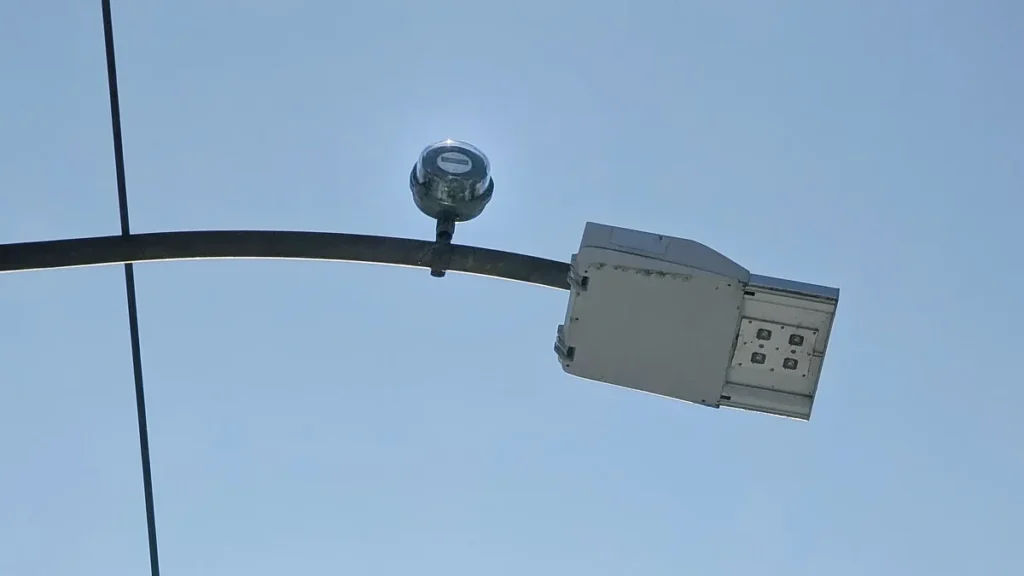
Asseco Poland’s PUSZCZYK platform, named for the Ural owl, deploys Codequest and DGT ZVOOK acoustic sensors mounted on street lighting infrastructure. The mounting points were chosen because they carry dedicated power supply connections requiring no additional procurement. PUSZCZYK’s AI algorithms identify drone type, distinguish specific UAV models, filter false positives from ambient noise, and report speed, altitude and real-time flight route. PUSZCZYK’s command interface blends ISAC radio returns with PUSZCZYK acoustic sensor readings and displays them on two-dimensional and three-dimensional maps.
Designated no-fly zones can trigger automated alerts when any detected object enters restricted airspace. The system detects, classifies and tracks drones but does not physically intercept or electronically neutralize them. Cellnex Poland provided the physical masts hosting ISAC radios. Building the system needs no dedicated procurement program, no new radio network and no towers built just for sensing.
Cellnex Poland manages approximately 18,000 passive infrastructure sites in Poland, none built or procured for defense, and supplied three tower sites for the Krakow tests. Play operates more than 13,500 base stations and reaches nearly 100 percent of Poland’s population with mobile coverage, while its fiber-optic infrastructure serves more than 11 million households and its 5G backbone routes all ISAC detection data to the processing layer.
The companies stressed that the Krakow test was not an operational national security service or a completed nationwide sensing network. Cellnex manages approximately 18,000 telecommunications sites in Poland, but those sites are a potential infrastructure base rather than an operational drone detection installation. The companies have announced no procurement contract, nationwide deployment agreement or confirmed delivery schedule. No confirmed timetable exists for outfitting thousands of sites or folding the system into a nationwide security network.
CWIX 2026 ran from June 8 to June 26 at the NATO Joint Force Training Centre in Bydgoszcz, Poland. CWIX 2026 was the largest edition on record of NATO’s annual interoperability exercise, with 46 nations represented. More than 500 digital systems underwent more than 40,000 individual tests spanning command and control, communications and multi-domain operations.
Poland shares a long border with Belarus and Russia’s Kaliningrad exclave and has confronted drone incursions from the east. A drone wave of 19 to 23 Russian Gerbera drones in September 2025 prompted a NATO Article 4 consultation. The drone wave forced four Polish civilian airports to close temporarily. During those incursions, Poland’s SkyCTRL drone monitoring system was offline while an ongoing modernization program continued.
In January 2026, Prime Minister Donald Tusk signed a contract valued at approximately PLN 15 billion with a Kongsberg-led consortium for the San counter-UAS system. Using an October 21, 2026, exchange rate and approximate conversions, the contract is worth approximately $4.0 billion USD. The San system provides kinetic and electronic countermeasure effectors, while the consortium architecture is a detection and tracking layer for a nationwide common airspace picture. Deputy Defense Minister Cezary Tomczyk described Poland’s intent as building counter-drone capability in distinct layers.
Estimates put Poland’s counter-UAS systems market at roughly $63.6 million in 2025, with a $212 million projection for 2030. The counter-UAS market’s projected 27 percent compound annual growth rate outstrips global averages. Forecasts call for roughly 29 percent compound annual growth in Poland’s broader anti-drone market over the same period.
UKE granted industrial-spectrum authorization separate from standard commercial allocations for the Oct. 15, 2026 demonstration. Privately owned sensing infrastructure that uses commercially licensed spectrum lies outside the procurement and oversight rules governing dedicated military systems.
The consortium plans pilot operations with strategic partners for 2027, though it has not specified which sites or institutions will participate. The consortium expects the 2027 pilot phase to begin answering questions about governance of ongoing operations, regulatory access rights and transparency obligations. Ericsson anticipates a few systems in Poland in 2027 for institutional and research partners to evaluate.
Ericsson and Finnish operator Erillisverkot conducted an ISAC drone detection trial at Vuosaari Harbor in Helsinki in 2026. Ericsson positions ISAC as a bridge between 5G Advanced and 6G, with broader commercial applications expected as 6G standardization progresses through 3GPP.
The Oct. 15 demonstration at Ericsson’s R&D Center in Krakow was attended by government, military, regulator and industry representatives, including Poland’s Parliamentary Committee on Digitalization, the Military University of Technology, the Swedish Embassy, UKE, ORLEN and Polish Air Navigation Services Agency. Ericsson signed a Letter of Intent with WAT, the Military University of Technology in Warsaw, to advance sensing and defense research. Martin Mellor, Head of Ericsson Poland, said, “Together with Asseco and using Play’s mobile network for the backhaul, we can create an advanced, situational awareness platform for drone detection and tracking.”
Join the discussion