

Key facts
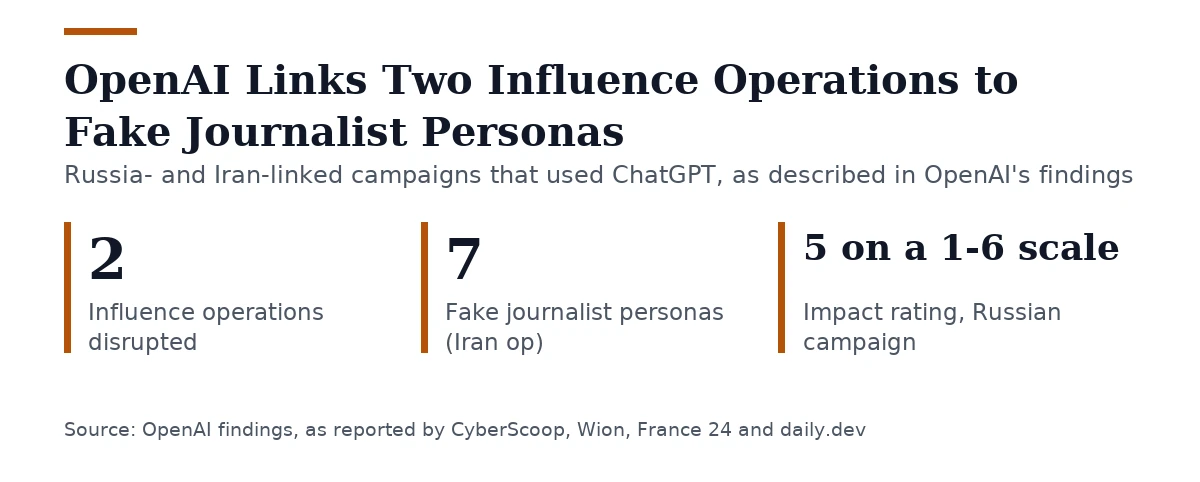
- OpenAI said it disrupted two influence operations, one linked to Russia and one to Iran, that used ChatGPT to support false-front entities including fake journalist personas and a purported think tank.
- The Russia-linked cluster, which OpenAI calls Dark Clark, ran a purported Latin American think tank called the Social Research Center (SRC), presented as led by a fake AI persona named Mia Clark.
- OpenAI's evidence indicates the SRC's Latin American employees did not know they were working for a Russian group, and the SRC produced mostly original content through this co-opted staff.
- OpenAI rated the Russian campaign 5 and the Iranian campaign 4 on a 1-6 impact scale; most tracked campaigns rate 1 or 2.
OpenAI says it disrupted two influence operations, one linked to Russia and one to Iran, that used ChatGPT to support false-front entities, including fake journalist personas and a purported think tank. France 24 reported the findings in Oct. 2026. In OpenAI’s account, the operations did more than post propaganda: they built identities meant to look like the sources reporters and analysts normally trust.
This analysis draws on reporting by CyberScoop, Wion and France 24, plus a summary on daily.dev. I did not review OpenAI’s own report, so everything below is OpenAI’s account as relayed by those outlets, not independent verification.
The Russia-linked think tank
According to CyberScoop and daily.dev, OpenAI calls the Russia-linked cluster Dark Clark. It ran a purported Latin American think tank called the Social Research Center, or SRC. The center was presented as led by a fake AI persona named Mia Clark.
The notable detail is the staff. CyberScoop, Wion and France 24 each report that OpenAI’s evidence indicates the SRC’s Latin American employees did not know they were working for a Russian group. Through this co-opted staff, the SRC produced mostly original content.
The available evidence indicates that the SRC's employees in Latin America were not aware that they were working for a Russian group
OpenAI, France 24
Per the three outlets, OpenAI ranks the SRC as the hardest front-identity effort it has disrupted in the past two and a half years. CyberScoop adds that OpenAI pointed to another Russia-linked think tank it exposed recently, which leaned more on plagiarized content. A similarity check can catch copied text; it cannot catch a front that pays real people to write.
That is my reading, not OpenAI’s. When the authors are real, the writing is original and they can answer questions about their work, so individual-level checks may come back clean. The deception sits one level up, in who owns and directs the institution.
What the Russian content aimed to do
CyberScoop and Wion report that the Russian operation’s content mainly aimed to damage Ukraine’s reputation in Latin America. It also touched on political issues in Argentina and Bolivia.
CyberScoop reports that fake audio clips were part of the effort, according to OpenAI. One purported to capture a Ukrainian consul in Ecuador insulting Ecuadorians. Another, presented as a water company employee in Bolivia, prompted a denial from the Bolivian government, per the same report. I could not check either clip independently.
CyberScoop reports that OpenAI does not attribute the Russian activity to a specific government or intelligence agency. This analysis makes no such attribution either, and nothing in the cited reporting supports one.
The Iranian byline operation
The Iranian operation took a different route. All four outlets report that it used seven fake journalist personas, each claiming to be from a Western country including the US. Together they placed almost 100 articles across roughly a dozen small to medium online outlets focused on geopolitics and the Middle East.
Wion and France 24 report that the earliest article OpenAI identified dates to July 2025 and the latest to Oct. 2026. They also say output rose after the US-Iran war began earlier this year. The reports give the timing; I have seen no explanation of why output changed.
One persona, Ervin B. Hoskins, billed himself as an American freelance writer. Wion and France 24 report that platform transparency data in OpenAI screenshots tied his X account to a West Asia Android app and his Instagram account to Iran. Both accounts appeared suspended, according to those outlets.
Transparency data is a label some platforms show about where an account is based or how it connects. It is a clue rather than proof of who runs an account. Still, a supposed American freelancer whose accounts point elsewhere is a mismatch worth chasing.
CyberScoop reports that OpenAI said the operation resembled a commercial, paid-by-the-client influence business, yet it named no specific actor behind it. The company is describing the style of the operation, not identifying a client.
How OpenAI rates the impact
OpenAI periodically publishes reports on disrupted influence operations and scores them on a 1-6 impact scale. CyberScoop and daily.dev report that it rated the Russian campaign 5 and the Iranian campaign 4. Most campaigns OpenAI tracks rate 1 or 2.
Those scores come from the company doing the disrupting, and the reporting describes no outside audit of them. They show how OpenAI’s own analysts weigh these two cases against the rest of their caseload. Readers should treat the numbers as OpenAI’s judgment.
What AI changed, and what it did not
One summary of the report, published by daily.dev, says both operations used AI mainly to speed up traditional tactics rather than create new ones. Invented personas and placed articles existed before large language models, the chatbot-style systems behind ChatGPT. On that reading, the tools mostly changed how fast the work could be done.
That reading rests on a single summary source. A fair conclusion is narrower than the alarm some headlines invite. By OpenAI’s account, the operations still needed real outlets and, in the SRC case, real people to carry the output.
Why it matters for verifying sources
Fake bylines and think tanks placed in real outlets, with real unwitting staff, make provenance checks essential for editors and analysts. Provenance means the documented origin of a piece of content: who wrote it, who owns the institution behind it, and where the accounts attached to it are based.
The two cases point to different checks. What follows is my analysis, not something OpenAI reported. In the Iranian case, author identity is the weak spot: a freelancer whose platform metadata disagrees with the stated biography deserves direct contact before publication.
In the SRC case, institutional ownership is the weak spot, because honest analysts working for a hidden sponsor can pass any test applied to the individuals. Two habits follow, again as my suggestion: ask who funds a think tank before citing it, and confirm a new contributor’s identity through a channel the contributor did not supply.
The Iranian personas landed in roughly a dozen small to medium outlets, which suggests the target was not only major publications. Editors and analysts who cite or republish material from lesser-known sites inherit the same verification problem.
The fake audio adds a separate lesson, if CyberScoop’s account of OpenAI’s findings holds. A government denial of the Bolivian water company clip shows that an official response can be one of the few ways a fabricated recording gets challenged. Newsrooms receiving unsolicited audio of officials or company staff would do well to find a second source before treating it as real.
What to watch
These are my own questions, not claims from the reporting.
- Whether the outlets that ran the Iranian articles are identified, and how they respond.
- Whether any government or independent researcher attributes either operation, since CyberScoop reports OpenAI named no specific government, agency or client.
- Whether other AI developers publish comparable findings, which would test the daily.dev summary's claim that AI mostly speeds up old tactics.
The open question is how often co-opted staff will be the model. If hidden sponsors can hire real people who believe their employer is legitimate, checking a name will not be enough. Editors will also need to check who is paying.
Join the discussion