

Key facts
- The program is named Resilient Missile Warning and Tracking Medium Earth Orbit.
- Space Systems Command runs the program and builds the constellation in batches called epochs.
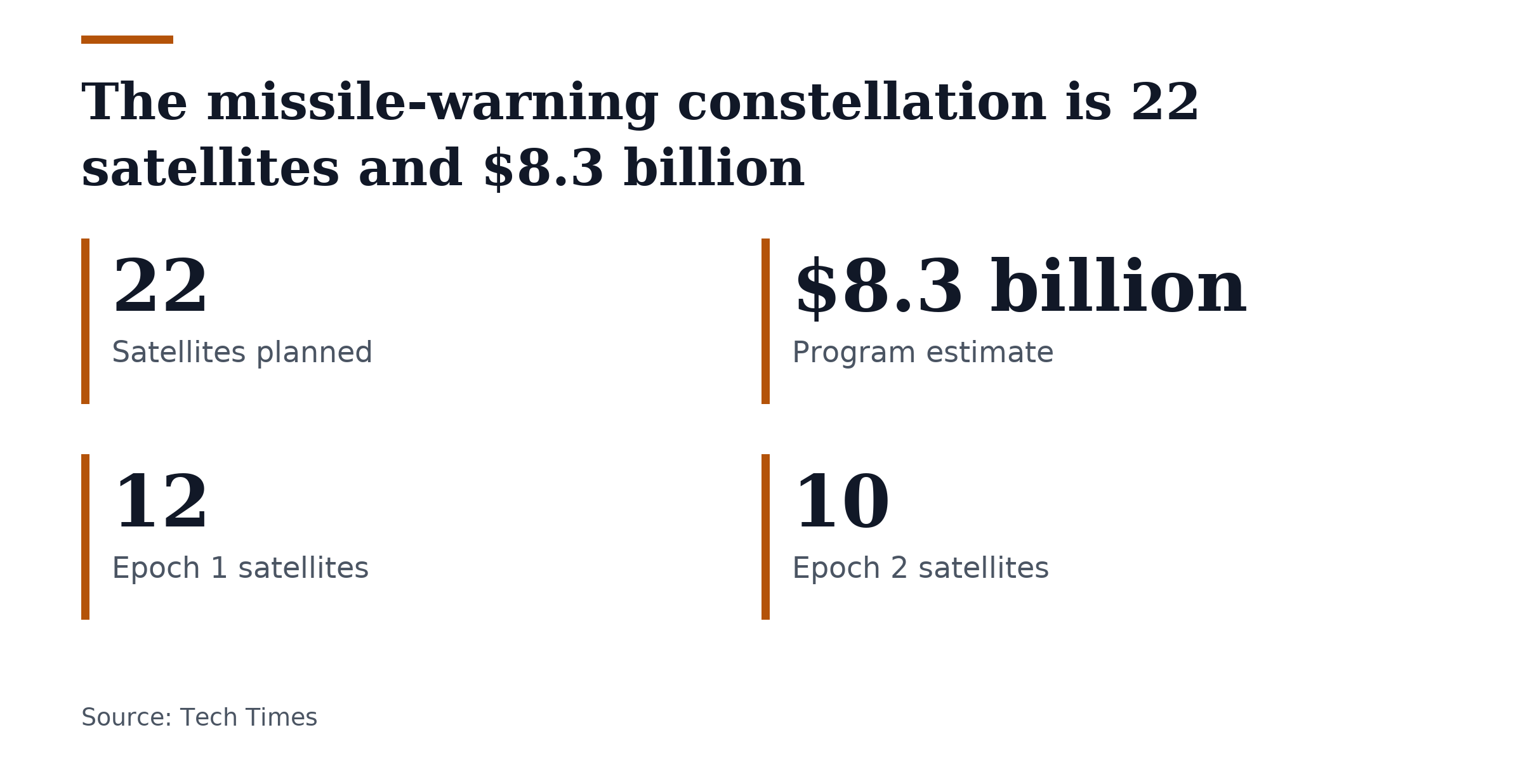
- The constellation plans 22 satellites.
- GAO estimates the program at $8.3 billion across five fiscal years.
GAO said component shortages pushed the first launch of the Space Force’s Resilient Missile Warning and Tracking Medium Earth Orbit constellation from September 2026 to May 2027, an eight-month delay.
The program is named Resilient Missile Warning and Tracking Medium Earth Orbit. Space Systems Command runs it and builds the constellation in batches called epochs. The full plan calls for 22 satellites, and GAO estimates the program at $8.3 billion across five fiscal years.
Space Systems Command completed the design review on Nov. 27, 2023, for six satellites that Millennium Space Systems built, clearing production ahead of a first launch then planned for late 2026. In July 2025, Air & Space Forces Magazine said the initial launch had moved to spring 2027. GAO’s report identifies May 2027 as the specific month and names component shortages as the cause.
Officials linked the move from September 2026 to May 2027 to delivery delays and component shortages. They pointed to printed circuit boards and long lead times for microelectronic parts. The shortages grew worse because suppliers produced parts for one vendor across many platforms.
Space Systems Command says medium Earth orbit spans 1,243 to 22,236 miles above Earth. Spacecraft there pass through the Van Allen belts and need radiation shielding. Because of the higher vantage point, fewer satellites cover the globe than in low Earth orbit.
The Space Warfighting Analysis Center created the multi-orbit concept, placing medium orbit satellites behind geosynchronous and low orbit layers as backup under the 2022 missile warning force design. Derek Tournear, who was Space Development Agency director then, pointed to that design, and SIGNAL Media said sensors in medium and low orbit track hypersonic glide vehicles.
The Defense Department concurred with all three recommendations in the report, which apply to the programs GAO reviewed rather than only this one. GAO flags optical communications technology as a risk for the missile warning program. The Space Development Agency’s low orbit Proliferated Warfighter Space Architecture also identified optical communications technology as a risk, and SDA created an optical terminal standard for PWSA that allows vendors to interoperate.
Brig. Gen. (Select) Robert Davis heads the program from SSC’s space sensing directorate. Davis called laser crosslinks central to new proliferated constellations in low and medium orbit, and said crosslinks were the risk the Space Force watched most closely. He said medium orbit crosslinks require different standards than low orbit links because of the distances involved, and that his team worked with SDA and industry on baseline requirements.
Davis said crosslinks for Epochs 1 and 2 connect satellites built by the same vendor. His team chose not to try links between satellites built by different companies. Davis said cross-vendor interoperability in low orbit is what SDA is pursuing, not this program.
Epoch 1 consists of 12 Millennium Space Systems satellites. In October 2024, a $386 million contract added six more Millennium Space Systems satellites. Epoch 2 includes 10 satellites, with SSC giving BAE Systems about $1.2 billion during 2025. On Sept. 8, SSC finished the critical design review covering Epoch 2’s first two orbital planes.
SSC’s request for information for Epochs 3 and 4 asks industry whether producing space vehicles is feasible. That same request includes the command and control ground segment and digital engineering integration. Responses were originally due Oct. 31. A Sept. 8 amendment changed the deadline to Dec. 1, a Tuesday.
The continuing resolution finances the government through Dec. 11. Defense Department items lacking production funding in fiscal 2026 or earlier cannot receive money for new production under the continuing resolution. The program’s next scheduled dates are Dec. 1 and Dec. 11.
SpaceNews reported on Oct. 28, 2026 that the first operational missile-tracking satellites were expected to launch in spring 2027, nearly two years later than originally planned. Space Development Agency Director Gurpartap “GP” Sandhoo said on Oct. 28, 2026 at the MilSat Symposium during Silicon Valley Space Week that the first missile tracking satellites would not launch this year and were expected to launch next spring. SatNews reported these comments on Oct. 31, 2026. The government is weighing extra flight demonstrations before making large purchases of next-generation sensors.
Sandhoo said 84 satellites were on orbit. Northrop Grumman’s Oct. 10 launch placed the fourth Tranche 1 transport plane in orbit. Every Tranche 1 transport vendor has at least one plane in orbit, with six more Tranche 1 launches remaining.
Tranche 2 covers 190 transport satellites and 54 tracking satellites, with about 18 launches planned. Tranche 3 has only tracking satellites, with no transport satellites. Another 36 accelerated missile defense satellites are tied to Golden Dome. Through Tranche 3, the total reaches about 474 satellites.
SDA’s Tranche 4 request for information looks at next-generation sensors, compute, processing and fusion. Sandhoo took on Space Force portfolio acquisition executive duties for missile warning and tracking, placing SDA’s proliferated LEO work under one executive alongside the Space Force’s MEO, HEO and GEO sensing programs. This executive also oversees the Space Force’s early-warning radars.
As of Oct. 31, 2026, Sandhoo said the new portfolio acquisition executive organizations would stand up within the next month or two. He said the change would not alter anything in the short term. A separate executive responsible for space-based sensing and targeting oversees the Space Data Network and manages data transport.
On May 27, 2026, Space Systems Command announced that SpaceX won a $2.29 billion firm-fixed-price contract for the Space Data Network Backbone. The Space Data Network Backbone will anchor a rearchitected network for distributing space-based sensing and targeting data. The network draws on technology first developed for SpaceX’s Starlink global internet constellation. Starshield satellites for military applications are built and launched by SpaceX.
Before transferring them, SDA will field transport satellites from Tranche 1 and Tranche 2. Sandhoo said the ground segment will become the bottleneck. In later tranches, more autonomy and on-orbit compute will relieve the bottleneck. For the first tranches, SDA must get the ground segment right.
Join the discussion