

Key facts
- Around 12:30 a.m. on November 28, 2026, German air traffic control DFS issued the all-clear, after which flight operations started again.
- No authority has confirmed whether the drone-detection system, which has been live for roughly two months, picked up the aircraft; neither the airport nor DFS provided details other than the all-clear.
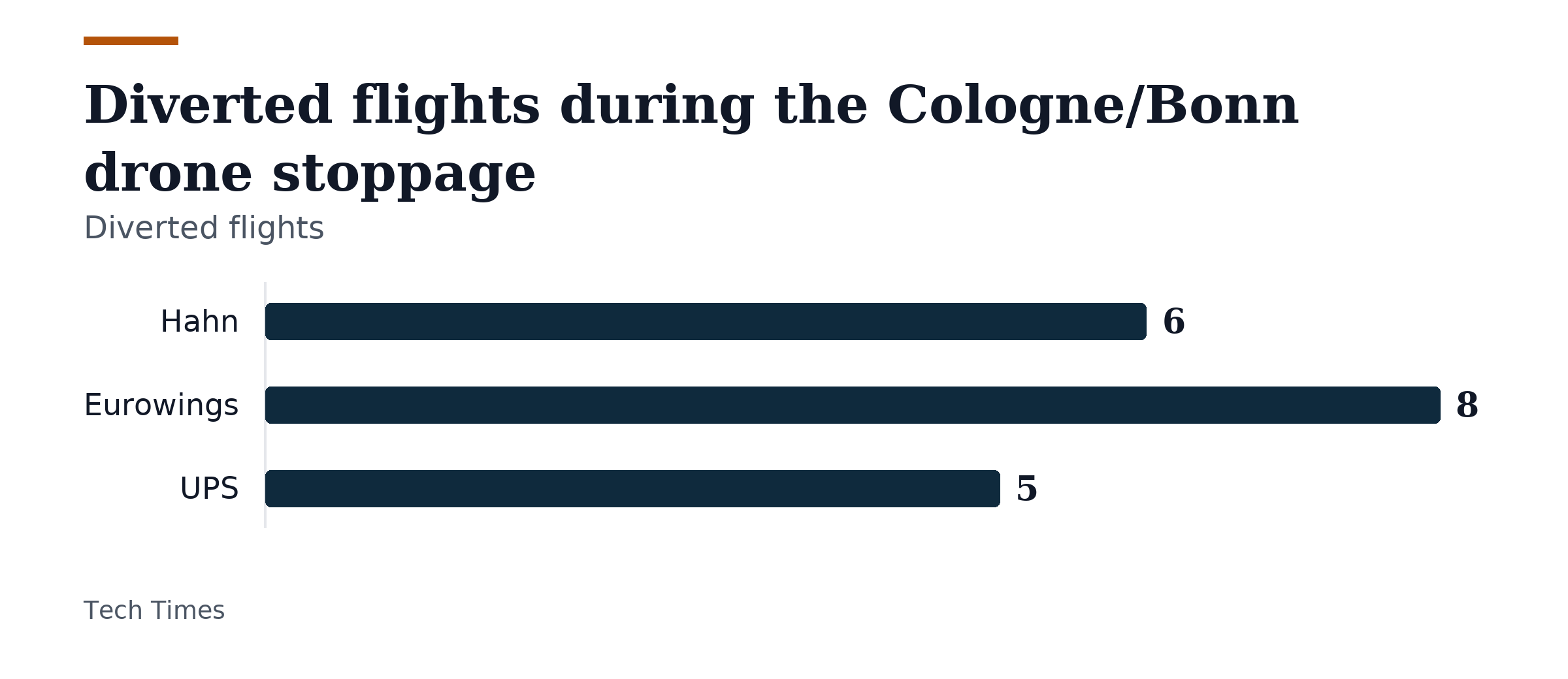
- Hahn received six diverted flights; Eurowings had eight diversions and UPS had five.
- The airport site showed four passenger departures delayed and one cancellation, DroneXL reported, although WDR was not certain the drone caused every one.
A drone sighting stopped all departures and arrivals at Cologne/Bonn Airport for about two and a half hours on the evening of Nov. 27.
The sighting was reported shortly before 10 p.m. local time. DFS, the German air traffic control, issued the all-clear around 12:30 a.m. on Nov. 28, and flight operations started again.
No authority has confirmed who operated the drone, whether the aircraft was found, how many flights were affected, or whether the police detained anyone. Authorities have not said whether there was one drone or several.
According to aeroTELEGRAPH, 32 inbound flights were diverted, 15 passenger and 17 cargo, to 10 alternate airports, and the figure is third-party rather than official. Hahn received six diverted flights; Eurowings had eight diversions, while UPS had five.
A Wizz Air flight from Chișinău touched down at Hahn after the crew’s cockpit announcement cited the drone sighting. DroneXL reported four delayed passenger departures and one cancellation on the airport site, although WDR could not confirm the drone caused each of them.
Cologne/Bonn serves as a hub for FedEx and UPS and counts among Germany’s few 24-hour airports. In 2024 the airport handled more than 10 million passengers, and it hosts the executive transport wing of the German Air Force.
The drone-detection system at Cologne/Bonn has been live for roughly two months, but no authority has confirmed whether it picked up the aircraft, and neither the airport nor DFS gave details beyond the all-clear.
Near runways, DFS provides only technical detection, while security authorities decide any response and police handle identifying the pilot. Citing security concerns, DFS declines to explain how its detection system works.
DFS says a drone sighting can halt takeoff and landing clearances and often leads to delays, diversions or cancellations. The detection system at Berlin Brandenburg gives controllers and authorities useful minutes but offers no defense against anything.
The transport ministry commissioned DFS detection in stages, beginning with Berlin Brandenburg and then Düsseldorf and Cologne/Bonn at the end of September. Stuttgart and Hamburg received detection on Oct. 5, then Leipzig/Halle, marking completion of the first expansion stage at eight airports; Frankfurt and Munich already had detection.
Steffen Bilger, the federal transport minister, said early detection and rapid situation assessment are crucial. Alexander Dobrindt, the interior minister, oversees responses to drone incidents near airports.
The police counter-drone unit went into service on Dec. 2, 2025, and Interior Minister Alexander Dobrindt ordered it enlarged to 300 officers after the August Leipzig/Halle incident. Under changes to the Aviation Security Act, the armed forces may assist state police, though weapons are a final option only.
The law protecting critical infrastructure has been in force since Mar. 17, but it includes no drone-specific rules. Without special permission, drones are banned close to airports—within 1 km (0.6 miles)—and within a 5 km (3.1 miles) strip along runways, unless they have special permission. Under criminal law, violations can be prosecuted and punished with fines up to €50,000, roughly $54,700 at the Nov. 28 conversion. Security expert Manuel Atug, who founded AG KRITIS, urged a clear alert chain running from detection up to the federal police.
On Aug. 12, police recorded five drone sightings around midday at Cologne/Bonn and halted landings for roughly 30 minutes. Police sent two Ryanair flights to Hahn and opened a case against a drone pilot discovered near the airport after those sightings. That stoppage lasted about five times as long as the Aug. 12 stoppage and halted takeoffs as well as landings.
By September 2025, DFS’s count of drone-related interruptions reached 172, already above the full-year figure for 2024. Radio Bonn/Rhein-Sieg counted 15 drone incidents at Cologne/Bonn in 2025 and five more in the first half of 2026.
Limited operations at Gatwick resumed around 6 a.m. on Dec. 21, 2018, after a closure that began after 9 p.m. on Dec. 19, 2018. It affected 1,000 flights and 140,000 passengers, following 170 drone sighting reports, and no photograph or video of a drone emerged.
Berlin Brandenburg stopped flight operations for roughly two hours after a drone sighting on Oct. 31, 2025. Inbound planes were rerouted to Dresden, Leipzig and Hamburg.
Join the discussion