
Key facts
- The guidance presents emergency readiness as practical resilience rather than alarm.
- A wider reckoning across Europe, including around France's presidential campaigns, is being sparked by recent security breaches.
- Mattens said increasingly concrete examples appear through cyberattacks or physical sabotage targeting critical infrastructure.
- Ireland's booklets echoed the European Commission's earlier Preparedness Union Strategy.
Authorities in France and across Europe are calling on households to be ready for as long as 72 hours without electricity, water or internet access, France 24 reported.
Officials point to cyber attacks, infrastructure failures and extreme weather as threats that expose France and other countries to national security vulnerabilities, the outlet said. Officials frame the advice as practical resilience rather than alarm.
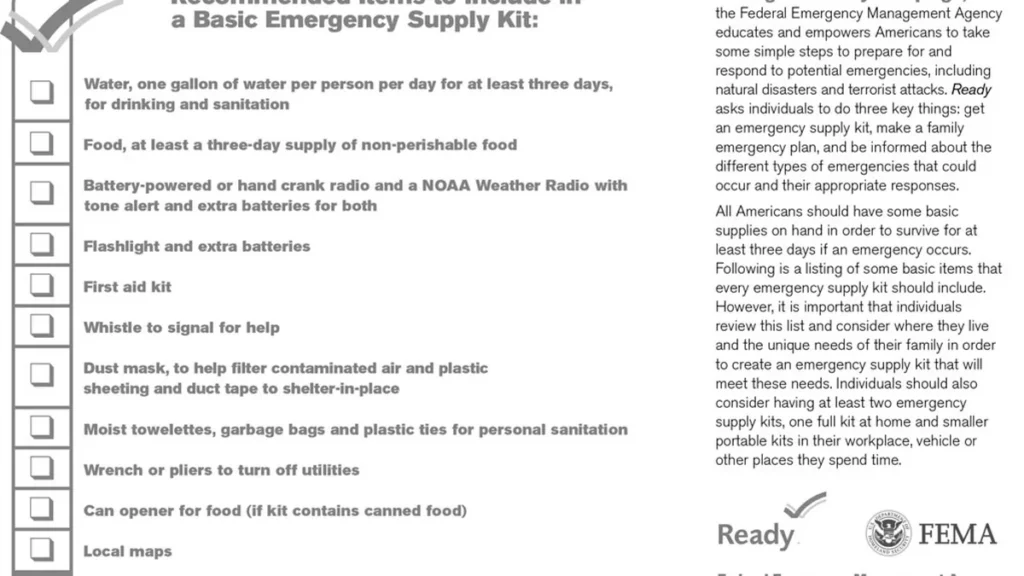
The Interior Ministry’s website lists an official emergency supply of six liters of water per person, long-life food, a wind-up radio, cash and identity documents. Planners say the message is practical readiness rather than panic, and that people should know what they might need, how to get information and which neighbors might require help.
France set its first national 72-hour self-sufficiency guidance in November 2025 through the public civic-security guide Tous Responsables, which updates earlier risk-prevention initiatives. Planners describe 72 hours as a practical operating window in which households may need to cope before roads are cleared, substations repaired, telecoms restored or supply chains re-routed. They call it a pragmatic admission rather than doomsday prepper survivalism or Cold War bunker planning, and say modern societies that rely on electricity, software and just-in-time supply chains have a slim margin for error.
The UK Cabinet Office began the Be Ready campaign in October 2026, urging households in England and Wales to manage for 72 hours with no electricity, water or internet access. Weeks earlier, Ireland posted its Be Emergency Ready booklets to 2.2 million homes, echoing the European Commission’s earlier Preparedness Union Strategy. Sweden advises at least one week of self-sufficiency. Switzerland, a country outside the EU, has approximately 370,000 public and private shelters, and Swiss law requires the government to make sure every person has a protected shelter nearby.
France’s national cybersecurity agency, ANSSI, has repeatedly warned that reliance on digital systems creates cascading risks across critical infrastructure. In 2025, ANSSI recorded 1,366 confirmed malicious incidents out of 3,586 treated security events. Linky electricity smart meters reach 95 percent of households, and they depend on continuous connectivity along with Carte Vitale health reimbursements and SNCF railway ticketing, illustrating France’s digital dependence.
French authorities said in October 2026 that investigators traced an attack on supermarket refrigeration systems to a cyber operation linked to Iran. Temperatures were allegedly raised from -1°C to above 50°C in that attack, which hit nearly 700 French food distribution sites and spoiled perishable food inventories. Similar refrigeration attacks were reported in at least 11 other European countries. Kyle Chan, a fellow at the US-based Brookings Institution, said the French refrigerator cyber incident shows that digital intrusions can have direct physical effects.
A later attack on a French blood bank exposed fragility from over-reliance on single system providers and pointed to a need for digital diversification across key industries, Bernard Benhamou noted. Benhamou, Secretary General of the Institute for Digital Sovereignty in Paris, called the situation a hybrid war and said architectural security must be completely renewed from the bottom up. He added that the threat is “now fully present in the mind of all policymakers in Europe,” Bernard Benhamou said.
The ORSEC framework, a decentralized civil protection system that departmental prefects activate when local capacity is overwhelmed and vulnerable residents need help and support, is part of France’s institutional foundation. Storm Ciarán knocked out electricity for 1.2 million households in November 2023 and killed five people. Enedis, the public grid operator for 95 percent of continental France, restored electricity to 95 percent of customers within five days. It typically restores electricity within 48 hours for 90 percent of customers affected by major storms.
France still has some way to go in adopting a risk culture more widely present in other countries, said Gaél Musquet, a meteorologist and ethical hacker involved in the UN’s Caribe Wave initiative. He said Russia and other governments want to interfere with and disrupt democratic processes. He said protecting democracy also shields industry and the economy, so sovereignty must be addressed, and that Europe could invest in open-source software, open hardware and open protocols to build sovereign solutions, allowing engineers and technicians to respond quickly if attacked. He said France can address technological sovereignty during the next presidential term.
Recent security breaches are sparking a wider reckoning across Europe, including around France’s presidential campaigns. Benhamou said that for the first time ever, every candidate in France’s presidential election has mentioned a technological problem. Jean-Luc Mélenchon, leader of the far-left France Unbowed party, embedded French resilience proposals addressing different national threats into his 2027 presidential campaign, Musquet said. Cannes Mayor David Lisnard, a right-leaning newcomer candidate, had prepared Cannes for tsunami threats, Musquet noted; Nice is the only other French city to have done so.
Politicians must respect Article 3 of the Universal Declaration of Human Rights, which states that each human has the right to security of life, a right the state and government owe citizens, Musquet said. The threat is very real, said François Mattens, who lectures in defense and security strategies at Sorbonne University and Sciences Po. He said increasingly concrete examples appear through cyber attacks or physical sabotage against critical infrastructure. He said France has a strong institutional foundation, though the next step is embedding preparedness into schools, workplaces and local communities, and resilience is also a question of mindset.
Social media amplification is sometimes deliberately orchestrated by hostile actors trying to destabilize societies, and it is also built into platforms’ business models because fear, outrage and strong emotions drive engagement and revenue, Mattens said. Each recent cyber event is a reminder that society must prepare for any occurrence that can shut down networks coordinating food, water, safety and healthcare, Musquet said.
A global Microsoft outage over the past two weeks disrupted services at businesses, schools and public bodies, leading the Japanese government to use telephones and the UK’s National Health Service to switch to paper records. A US aviation failure caused a nationwide ground stop, the second in US history and the first prolonged air-traffic shutdown since the 9/11 attacks. JP Morgan Chase experienced a transaction processing disruption tied to a bug in internal hardware systems rather than a cyberattack, the bank said.
Rafe Pilling, who is senior director of Threat Intelligence at Sophos Counter Threat Unit, cited a mix of unrelated outages and prominent disclosures of AI-discovered vulnerabilities in widely used technologies. Pilling pointed to the 2024 CrowdStrike incident, where a faulty software update from the US cybersecurity firm triggered technology outages across many global sectors and disrupted banks and media. He warned against misassociating recent events with imminent Armageddon.
Join the discussion