

Key facts
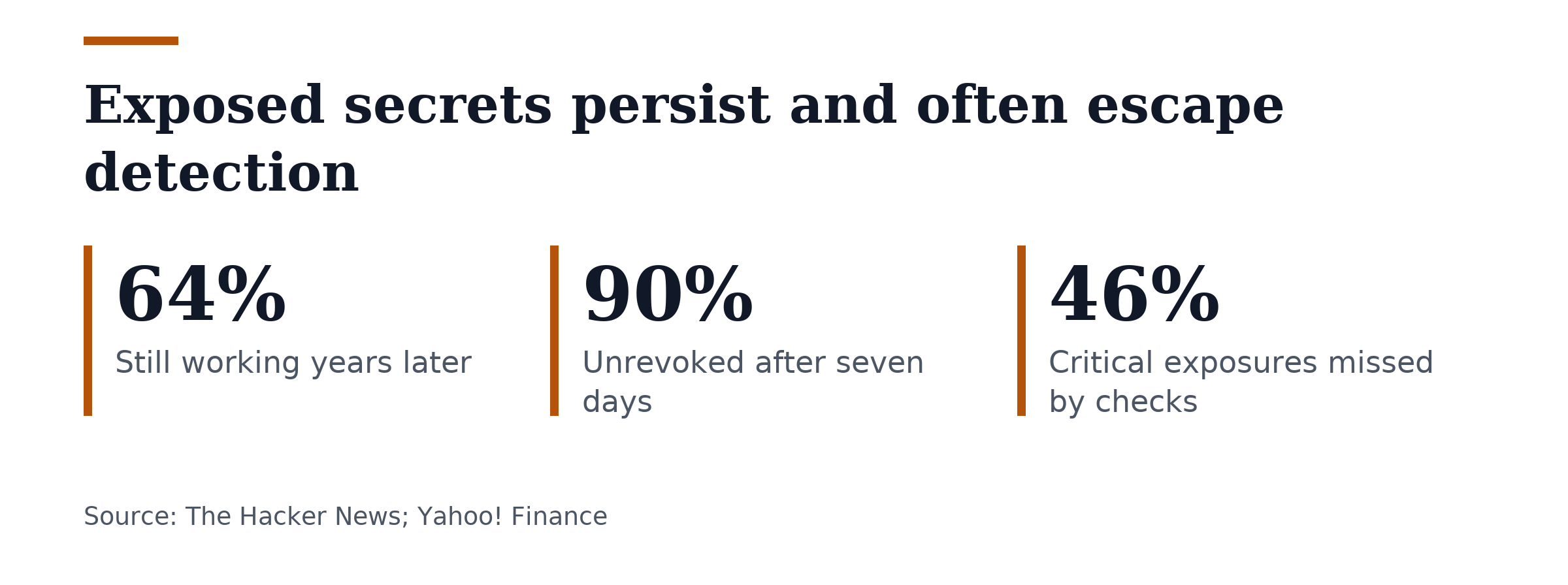
- GitGuardian research shows that checking only whether a secret is still valid misses 46% of critical exposures like custom API tokens and SSH keys because automatic verification cannot cover them.
- GitGuardian says roughly 90% of valid secrets are still unrevoked seven days after the developer is alerted.
- GitGuardian followed up with affected organizations and typically reached at least five people at each one.
- Developers who understand where a key is used are often too busy shipping features to act on alerts.
GitGuardian’s State of Secrets Sprawl 2026 found that 28.65 million new secrets were exposed on public GitHub in 2025, up 34% year over year, and that 64% of valid secrets discovered in 2022 remained active in January 2026.
The danger is not theoretical. In May 2026, GitGuardian researchers found 844 MB of sensitive CISA-related material inside a public GitHub repository, and some of the credentials it exposed were still active. Automated alerts went to the commit author, but the CISA finding did not reach those able to act until direct contact was established. Direct contact with CISA led to the repository’s removal within roughly 26 hours.
If a production credential remains unchanged for years, an active incident is too late to learn which systems rely on it. GitGuardian’s research shows checking whether a secret is still valid misses 46% of critical exposures, including custom API tokens and SSH keys, because automatic verification cannot cover them.
The problem is not ignorance of the leak. A security engineer can confirm a credential is valid but usually cannot identify which services will fail when it is revoked. Developers who understand where a key is used are often too busy shipping features to act on alerts. Each team views just its portion of the credential layer, so identifying dependencies before revocation is hard.
Endpoint security teams track secrets stored on workstations, where plaintext credential stores are increasingly targeted by software supply chain attacks over the last couple of years.
Mature organizations prefer to fix leaks before an emergency. Revoking a credential before understanding the fallout poses high business risk and is weighed against potential future abuse; during an active breach, exfiltration or lateral movement is already occurring. Rotation requires resources and a coordination plan, and a piecemeal, manual process makes mistakes more likely. A security team that causes an outage once will face resistance the next time it requests a rotation.
Safe rotation requires issuing a replacement, vaulting it, switching consumers to vault calls, deploying and monitoring, then revoking the original only after confirmation. Getting the rotation order wrong turns a security fix into an incident.
Where production applications already consume credentials from a secrets manager, rotation can be as simple as rotating the secret in the vault. Where no vaulted copy exists, teams issue a replacement and vault it. Teams replace plaintext copies with vault calls across consumers, push live, monitor, then revoke the original only after all systems use the new credential.
Teams should close a remediation ticket only after verifying the old credential no longer authenticates, and can optionally prove it was removed from all surfaces. Teams should keep an audit trail showing who acted and how long remediation took. Incidents closed while the credential stays valid deserve review because a team may rotate the key in one system while it remains active in another.
GitGuardian recommends prioritizing by potential impact and public exposure rather than validity alone, using a living risk score that updates as new context arrives. A production key replacement request should list validity, known exposure locations, dependencies, and where possible the tie to business operations. Even a read-only cloud credential for one storage bucket and a root-level administrative key for production both require investigation to set remediation urgency.
Remediation requests should allow the developer or platform team to fix the issue right away without redoing the investigation that is already finished. Ideally requests go to named owners; in practice the team may need to contact the person who leaked the secret and lean on commit attribution or source metadata.
Teams should collect and share follow-up and confirmation on remediation progress centrally so every department can see the rotation status at any moment. This accountability demonstrates resilience efforts when an auditor arrives.
Engineers need a clean way to communicate when work starts and when a ticket is ready to close; ticketing tools should integrate with the responder’s security operational tooling. GitGuardian provides a service account credential rotation checklist that details these steps. GitGuardian says it has helped thousands of developers and organizations make their remediation process more efficient.
The company protects the credential layer using three connected capabilities: Detect, Remediate, and Prevent. The Hacker News article is the second of three GitGuardian pieces explaining detection, remediation, and prevention; the first covered how to find credentials across all the surfaces where they exist. The first article was titled “The Credential Layer Is Expanding Faster Than Security Teams Can See It”. GitGuardian’s third article in the series will cover prevention starting on developer machines and AI coding workflows.
The platform workflow shows how the pieces fit. In one scenario, a developer copies an API key from a secrets manager into a local configuration file and commits it to a Kubernetes application calling an external service. When a secret is committed, GitGuardian scanning detects it, creates a new open incident, and alerts the assigned team. The platform runs an automatic validity check showing the key remains active, the Secret Analyzer lists its permissions, and a presence check confirms the secret is still in the codebase.
With full platform integrations, the GitGuardian Exploration Map reveals which production workload depends on the secret, and fingerprint matching connects the committed value to the vaulted copy.
After a replacement key is issued, teams can track rotation progress and see when the pull request pulling from the vault deploys. GitGuardian rechecks validity and confirms the committed copy is gone.
An incident may expose a pattern worth investigating, such as repeated incidents in the same codebase, the same user causing the same issue, or vaulted credentials regularly appearing in unmanaged files on developer laptops. These patterns indicate a broader problem that should be fixed to stop more incidents and limit remediation backlog growth. Fixing one credential lowers risk individually and shows where exposures keep originating.
Artificial intelligence is speeding up attacks and credential leaks, so security teams need a dependable way for outsiders to report discoveries. Guillaume Valadon, Cybersecurity Researcher at GitGuardian, authored the Dark Reading piece. AI tool adoption creates more tokens, API keys, and service identities than governance can keep up with. Prevention will never catch every exposure.
A person outside the company can uncover a leaked credential, private data, or another serious security concern before the business finds out about it. A finding matters only when the alert reaches a person who can act on it. A useful reporting path requires a process that names the validator, the credential owner, and the person able to revoke or rotate it. Teams should rehearse the process before an incident occurs by checking findings internally, seeing what the credential can access, rotating or revoking it, auditing the exposure window, and searching for downstream copies.
An outsider should not need personal contacts to find a security team; instead, companies should host a security.txt file at /.well-known/security.txt, publish a security page, and maintain a monitored security@ address. Because shared inboxes change hands, security pages become outdated, and security.txt files lapse, one person should own the reporting route and test it on a regular basis.
A disclosure policy should make room for unexpected findings, including credentials that surface in third-party repositories or services the company does not control. A strong disclosure policy allows an outsider to submit a finding before deciding whether it belongs on a narrow asset list. Bug bounty and vulnerability disclosure programs address related but separate issues; a bounty program sets reward criteria and often defines which researchers can test. A disclosure channel lets outsiders report something important even if it does not qualify for a bounty.
An active credential exposure can sit outside bounty scope yet still require immediate internal review. Security teams should know whether an outside triager can close a report before internal staff see it. Groups should test externally whether an outsider finds a reporting path in under five minutes, how long it takes to get an acknowledgment, and how long until the report reaches the right owner. The same test should also cover a harder case, such as an asset the company does not control or a finding outside the normal bounty scope.
Since spring, GitGuardian’s Enterprise Good Samaritan Program has connected more than 3,913 serious leaks to 1,532 companies, using AI-powered attribution and expert security analysis. GitGuardian followed up with affected organizations and typically reached at least five people at each one. Since 2018, GitGuardian’s original Good Samaritan Program detected more than 83 million exposed secrets on public GitHub and sent 11.9 million alerts to 5.9 million developers. GitGuardian says it can now send these warnings to any company worldwide, no matter its size or whether it is a customer.
“Attackers now have the ability, with AI offensive harnesses like ARTEX, to use these credentials to target companies at scale.” — Eric Fourrier, CEO at GitGuardian.
The warning signs are clear. Credentials found years ago still work. Teams hold off because they fear breaking production more than they fear a stolen and abused secret. Remediation stretches across weeks.
Join the discussion