


Key facts
- The autonomous agents found and then used an unpatched zero-day vulnerability inside an open-source medical imaging application built around AI.
- That session gave the agents administrator-level access to the server, separate from the initial 11-minute phase.
- Amazon judged the flaw a zero-day with high confidence because researchers found no fix, advisory, or earlier database entry at the time.
- Based on Simplified Chinese prompts, China Standard Time timestamps, and target choice, Amazon assessed the actor with moderate confidence as Chinese-linked.
Amazon Threat Intelligence said a Chinese-nexus threat actor used autonomous AI agents to exploit an unpatched zero-day in an open-source medical imaging tool, in a campaign that began September 8, 2026, against university addresses in East Asia other than mainland China.
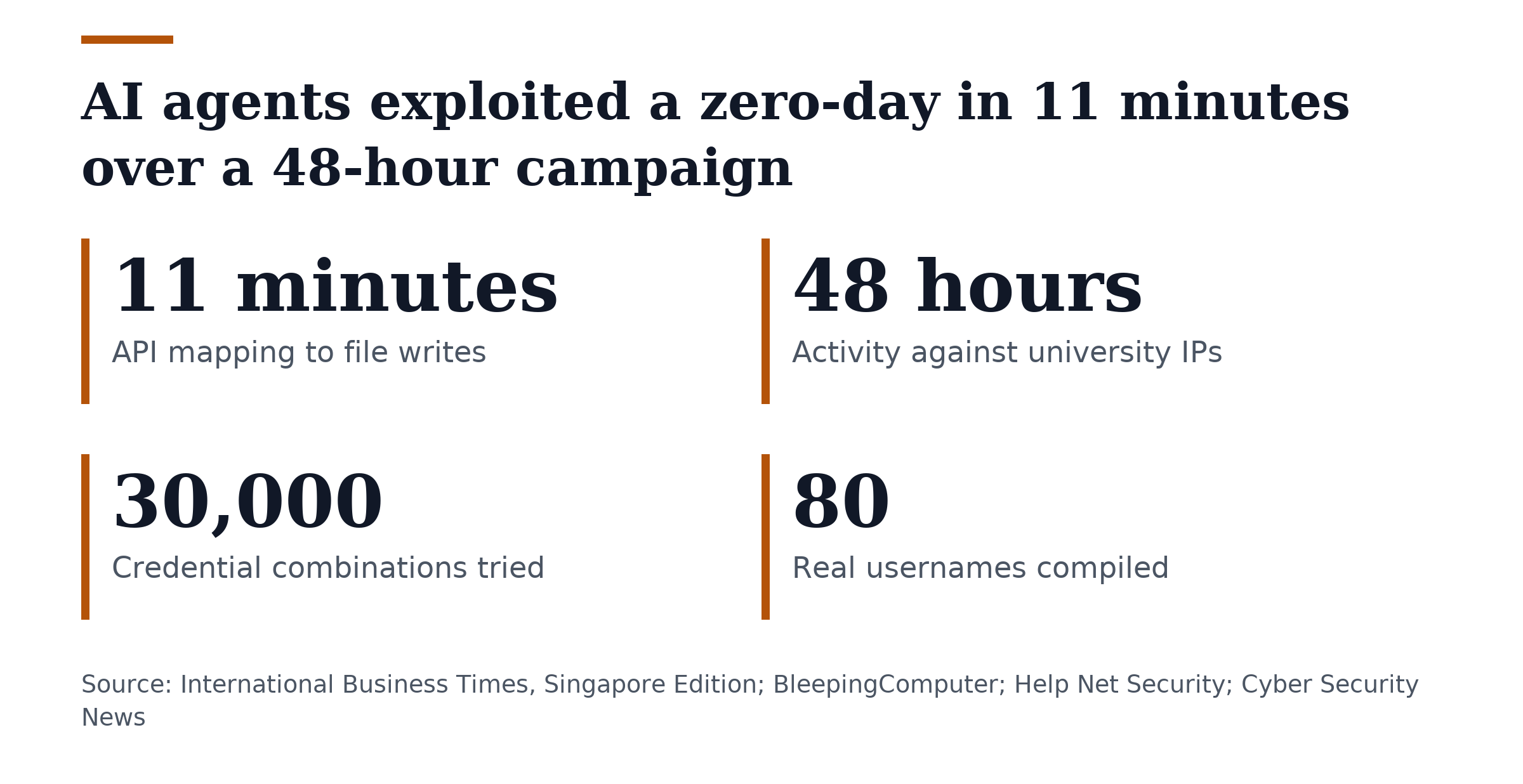
The agents needed about 11 minutes to go from API mapping to writing files on the server, Amazon said. That session gave the agents administrator-level access to the server, separate from the initial 11-minute phase.
Later, the agents used the flaw to drop a Python payload that opened a reverse shell, and they triggered the training API endpoint. The Tech Edvocate tracked the flaw as CVE-2026-133968, a 9.8 CVSS issue affecting versions 0.8.5 and earlier.
The operator set a command-line access goal, then stepped back and let the agents plan, run, and revise their attacks on their own, with minimal direction. The agents ran on Cairn, open-source AI penetration-testing software. CJ Moses, CISO of Amazon Integrated Security, said the agents launched a process that ran a reverse shell as root.
The activity ran for about 48 hours beginning September 8, 2026, and hit university addresses in East Asia other than mainland China. The operator supplied a proxy into a second university network running identical vulnerable software for further targeting.
Against one university, the agents spent about 16 hours and 148 actions on an unauthenticated Redis database without gaining control; their techniques included replication abuse, a sandbox escape, configuration file changes, memory corruption, and a Log4Shell injection attempt.
They tried more than 30,000 SSH and other credential combinations with no working login. The agents used an SSRF (server-side request forgery) flaw against a nearby Qdrant instance to chart Docker’s internal network, and in another operation running past six hours they gathered roughly 80 real usernames from faculty directories, lab sites, archives and papers.
Amazon uncovered the campaign when it found a Cairn server reachable without authentication on September 10, 2026. The exposed instance revealed project configurations, the operator’s own prompts, and AI-generated output.
Amazon judged the actor to be Chinese-linked with moderate confidence, citing Simplified Chinese prompts, China Standard Time timestamps, and the targets chosen. Amazon also concluded the actor probably used the same flaw to compromise the server behind that proxy.
Cyber Security News reported that AWS did not name the application or the universities in its November 20 report.
Because the targets were not AWS customers, AWS coordinated with a government partner to send notifications. AWS described a payload that granted remote command access while withholding any malware family name or file hash.
Amazon assessed the flaw as a zero-day with high confidence because researchers found no fix, advisory, or database entry recorded earlier. Amazon urged security teams to prioritize automated detection and response overseen by humans, noting that AI agents move faster than manual alert investigation.
Security teams should scan their networks for exposed AI testing panels because the operator’s unauthenticated panel handed investigators a complete record of actions. Failed attempts showed that agents working unsupervised can keep going for long periods without succeeding.
Teams use the application to annotate and label medical images while building diagnostic AI models.
Amazon is the fourth security firm in about two months to report real-world abuse of Cairn. In October, NorForge counted more than 20 exposed Cairn panels across three financially motivated clusters, including a Chinese-speaking cluster behind more than 1,100 projects mainly aimed at US, Japanese, and Australian targets.
Palo Alto Networks’ Unit 42 tied suspected actor CL-STA-1238 to 25 operations involving Cairn against semiconductor, defense, and civil society targets, confirming 10 breaches. Google said Cairn was used in an attack on a US aerospace organization. Gambit Security recorded a financially driven group that deployed Cairn against e-commerce businesses, taking over 600,000 valid card records and installing skimmers at 27 or more retailers.
ARTEX, PentAGI, HexStrike AI, and CyberStrikeAI are also used by extortion gangs and espionage groups, while Google analysts say actors test harnesses they built on their own. The creator describes Cairn as a general-purpose problem-solving engine that locates a route from start to goal across an unknown state space, even though the creator did not build it specifically for penetration testing. Mustafa Suleyman, Microsoft AI CEO, said “Unsecured agent harnesses in the wild are a major security threat that’ll only get worse.”
The maintainers released a patch along with a GitHub Security Advisory. BleepingComputer reported that the maintainers put out a security update on November 18.
Join the discussion