

Key facts
- A newspaper investigation by Dagens Nyheter found a Russian technology company supported by an oligarch near President Vladimir Putin gathered information on people in Sweden.
- Roman Abramovich, former owner of Chelsea FC and close ally of Putin, was added to international sanctions lists after Russia's full-scale invasion of Ukraine in 2022.
- Websites linked to Between Digital include online directories Eniro and Hitta.se, several digital media platforms, Ratsit.se and Familjeliv.se.
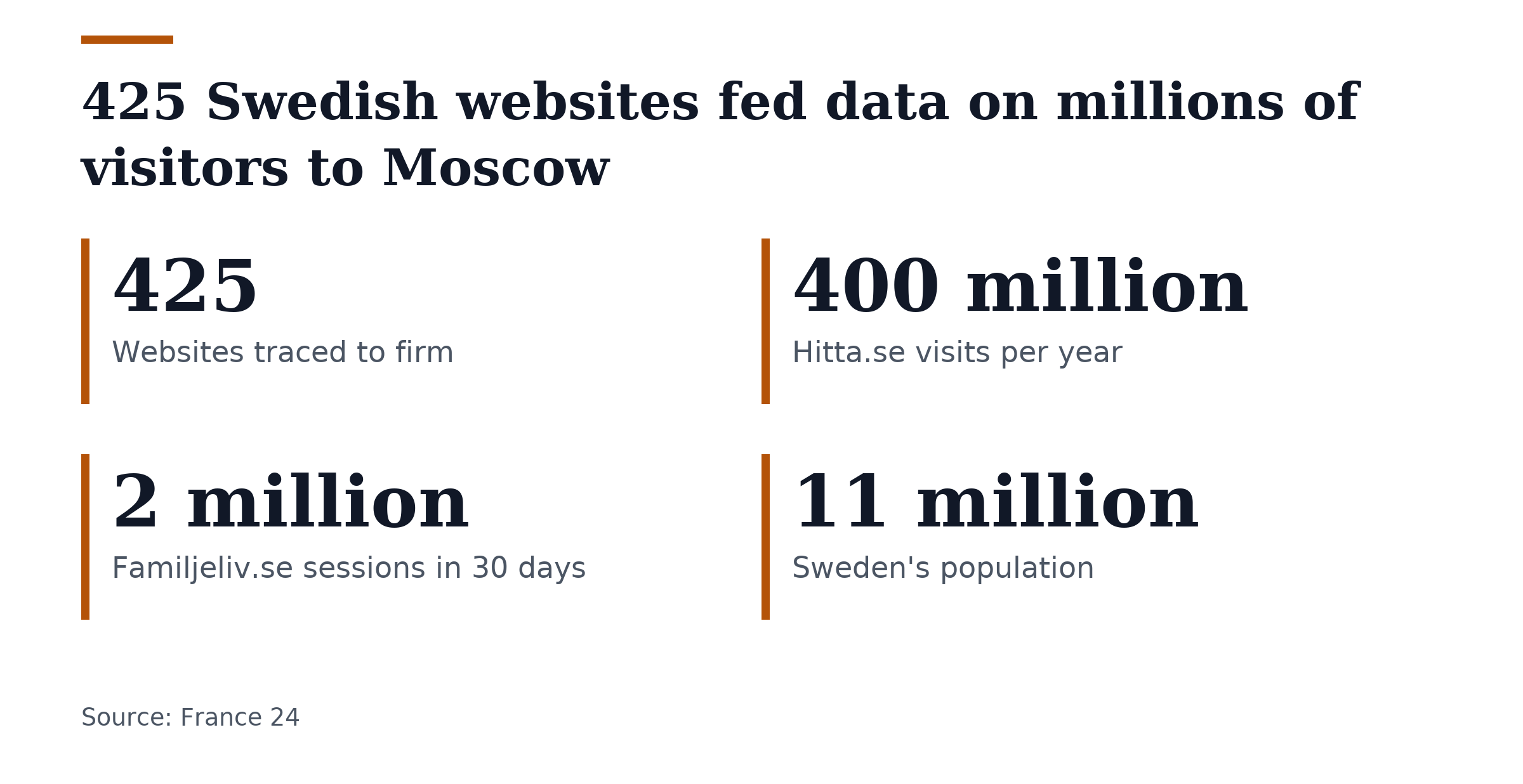
- Hitta.se says it records about 400 million visits annually.
Dagens Nyheter reported on Nov. 21, 2026, that a Russian technology company partly financed by oligarch Roman Abramovich gathered information on hundreds of thousands, possibly millions, of people in Sweden.
DN traced traffic from 425 Swedish websites directly to Between Digital, a Moscow-based company. The data passed through a digital front — an intermediary that hides the data’s origin — in Luxembourg before reaching the firm, whose central server is in Moscow, said Carl Heath, a senior scientist at Sweden’s state-owned research institute RISE.
Heath said Russian authorities such as the FSB can readily access everything Between Digital gathers, and that the data is much more detailed than IP addresses. “Who looks up whom, from where and when is precisely the kind of data that could be of interest to a foreign power,” Heath said. Knowing who looks up whom, from where and when could interest a foreign power, he said.
Roman Abramovich, former owner of Chelsea FC and a close ally of Putin, was added to international sanctions lists after Russia’s full-scale invasion of Ukraine in 2022. Proceeds from the sale of Chelsea FC remain frozen in a British bank account.
Websites linked to Between Digital include online directories Eniro and Hitta.se, several digital media platforms, Ratsit.se and Familjeliv.se. Hitta.se says it records about 400 million visits annually. Familjeliv.se, Sweden’s largest online community and parenting portal, registered nearly 2 million sessions in the past 30 days. Sweden’s population is under 11 million.
Sweden’s freedom of information principle makes all official records except specifically classified ones available to the public, and much of that information is now online. Anyone can anonymously look up home addresses, salaries, dates of birth and court rulings. Ratsit.se lists whether someone is married or what kind of car they own.
Jonas Lejon, who founded the IT security company Triop and works as a cybersecurity expert, said combining online tracking with public records extraction is extremely dangerous. The combination could enable profiling people for blackmail and threats, he said.
Familjeliv.se users often use aliases because topics range from relationships to workplace issues and can be sensitive. Persistent cookies can trace internet activity for weeks or months unless a user clears their browser cache. DN did not reveal what type of cookies Between Digital is thought to use.
Mikko Hypponen, a prominent Finnish cybersecurity expert, called the data a goldmine for intelligence agencies, which can use AI to extract useful information. Website visits alone can reveal behavior such as nightly dating-site visits, weekly psychotherapy-centre visits or Alcoholics Anonymous visits, he said. Even when cookies cannot determine exactly what a person does on a website, the visit itself can reveal behavior.
In October, Al Jazeera reported that an Israeli tech-ad firm used advertising technology to install spyware on some of its devices. In 2023, the Washington Post revealed that a conservative Catholic group in the United States spent millions of dollars to track the online behavior of priests suspected of being gay.
After DN’s investigation, many concerned websites cut ties with Between Digital and launched internal investigations. Gustav Kinde, head of Ratsit, said he did not know until DN contacted him, echoing reactions of many other company executives.
Swedes are worried because Russia is close and Sweden’s open public records make the country vulnerable to hybrid warfare tactics. Website operators believed the ad-tech groups paying for data-collecting cookies were legitimate, and in at least one case the arrangement was a front. Potentially sensitive user information was collected through a digital front in Luxembourg and sent to Between Digital in Moscow.
A Dec. 6, 2024, SCEEU report by Martin Kragh states that under Vladimir Putin, Russia reverted to Cold War-era information influence operations, and that Sweden has been a target. Russian influence activities toward Sweden targeted Swedish-NATO cooperation and military support for Ukraine as key strategic issues, though the operations were ineffective in preventing Sweden’s NATO membership.
Sweden may be a target of Russian influence operations in the future given ongoing regional tensions and Russia’s war against Ukraine, the report says. Soviet and Warsaw Pact states reportedly ran roughly 160 intelligence officers in Sweden by the 1980s. The KGB recruited Stig Bergling, a Swedish Security Police officer, and Stig Wennerström, a military attaché.
In 2017 and 2018, Sweden’s Sports Confederation was the victim of a cyber attack attributed to Fancy Bear, a group within Russia’s military intelligence GRU. Personal details of Swedish athletes including medical records were published after the attacks.
In 2014, Russian TV channel RT lobbied local youth in a Stockholm suburb to perform vandalism in front of a camera, and disinformation and forged telegrams reappeared amid the Russia-Ukraine war and a renewed Swedish NATO debate. In 2015, Russian military vessels interfered with and tried to obstruct laying of an electric cable between Sweden and Lithuania. Russian influence campaigns toward Sweden have inserted themselves into contentious areas such as migration and crime. The Soviet submarine S-363 ran aground in 1981 on Sweden’s south coast, followed by a forged telegram from the Swedish ambassador to Washington that contained a kernel of truth: Sweden maintained a secret security agreement with the United States known to the KGB.
Covert influence activities are historically referred to as active measures in the Soviet KGB lexicon on political warfare. It is difficult to ascertain their political effectiveness, but they indicate intent at the highest political level, the report says. Russia takes a differentiated approach toward individual European states in the Baltic Sea region, and some operations toward Sweden remain ambiguous and cannot be easily attributed to any particular actor.
From 2016 to April 2024, Sweden was mentioned 3,464 times in Sputnik International’s English edition, or 29.7 percent of all mentions. Russia launched a Swedish-language Sputnik website on April 15, 2015, which published 3,963 news items before termination in spring 2016. Poland had 18.5 percent of Sputnik mentions, followed by Norway at 16.7 percent, Finland at 13.0 percent and Denmark at 12.5 percent.
The most common themes on Swedish Sputnik were Crisis in the West (705 articles), Positive image of Russia (643) and Western aggressiveness (499). The EU was the most frequent target in Swedish Sputnik reporting with 698 articles, followed by the United States with 1,018 articles and NATO with 321.
On Sept. 10, 2015, the Russian Ministry of Foreign Affairs said Sweden’s NATO accession would require retaliatory steps. In spring 2024, after Sweden joined NATO, an anonymous group threw manure over the fence of the Swedish embassy in Moscow.
In spring 2017, one day after an ISIS terrorist attack in central Stockholm, an alleged screenshot appeared on the Russian propaganda website politonline.ru. In 2018, documents from the UK-based Institute of Statecraft think-tank were hacked and leaked by Russian cyber intruders. Russian media claimed the think-tank was a covert MI6 network. Swedish newspaper Aftonbladet used Russian disinformation to accuse the Institute of Statecraft author of being a British agent, drawing criticism from the Swedish Media Ombudsman.
Join the discussion