
Key facts
- Affected organizations include CNN, the BBC, Zoom, Salesforce, GitLab, IKEA, HSBC, Equifax, Air France-KLM, Ledger, and Peacock.
- Report URI also lists IG and OANDA among the affected sites.
- The first infected script appeared on the BBC's snippet at 04:21 UTC on November 16, 2026.
- Smartsheet's script was cleaned once before a hidden version reinfected it, which indicates the attacker retained access.
Attackers exploited a vulnerability in Optimizely Web Experimentation on Nov. 16, 2026, injecting malicious JavaScript that reached visitors of at least 178 organizations, including CNN, the BBC and Zoom.
Sites load an Optimizely snippet that refreshes when a customer changes a setting and runs a Project JavaScript field every time it loads. The attacker inserted a loader into that field without changing the rest of the snippet, and most snippets pulled 1688360.cc/track.js directly. One loader version hid the address in base64 to evade text searches, while another carried a full copy of the payload in case the domain was blocked. Snippets served from cdn.optimizely.com carried Optimizely’s own certificate, so browsers trusted them, and the attack affected some sites serving the snippet from their own domains because the content came from the same project.
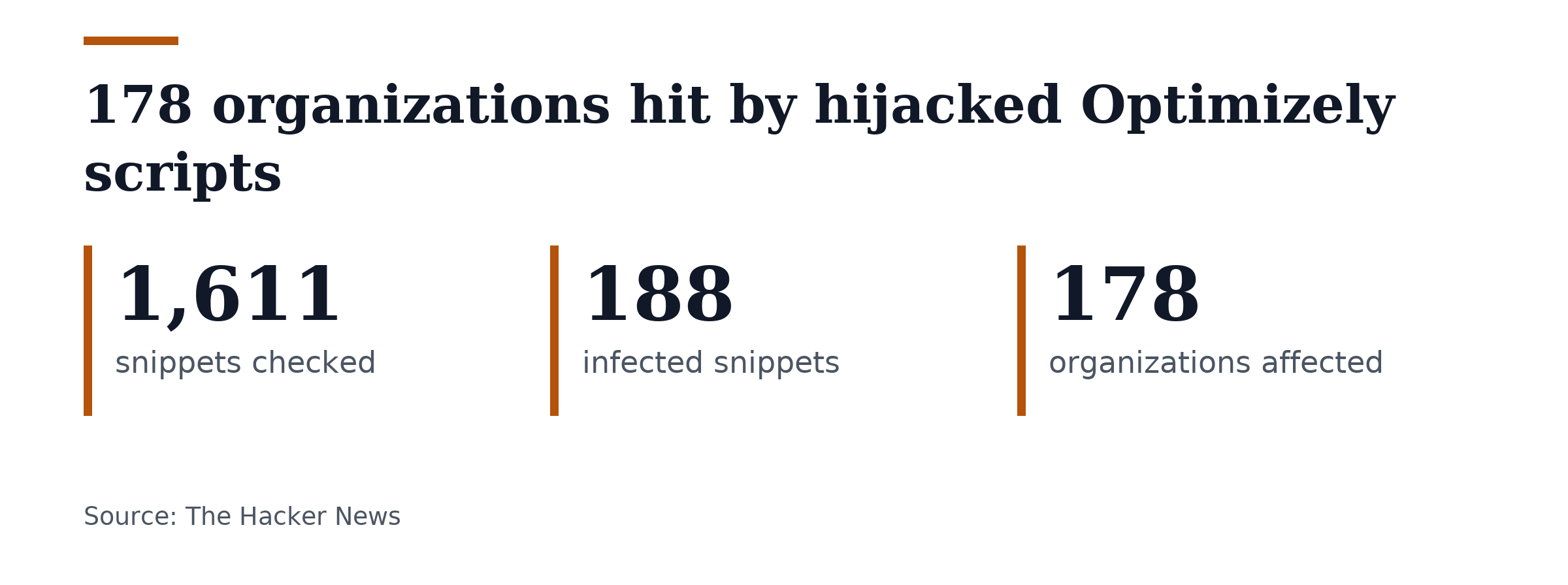
Of the 1,611 Optimizely snippets Report URI checked, 188 carried malicious code, and the infected snippets belonged to 178 organizations; Report URI says the real number is likely higher. The first infected script appeared on the BBC’s snippet at 04:21 UTC on Nov. 16, 2026. A mass cleanup began at about 20:40 UTC that day, and by 21:52 UTC only TalkTalk’s snippet still carried the code. The cleanup removed all infected files by 23:11 UTC on Nov. 16, 2026.
Smartsheet’s script was cleaned once before a hidden version reinfected it, which Report URI says indicates the attacker retained access.
Optimizely posted an incident notice at 01:02 UTC on Nov. 17, 2026, saying the attacker “exploited a vulnerability in Experimentation.” The company says it fixed the vulnerability, removed the injected code, secured affected user accounts and added protections against unauthorized code delivery. Several details are missing from Optimizely’s notice: how the flaw worked, how many projects were changed, when the fix was applied, whether the attacker still has access, and what customers should do. Optimizely spokesperson Victoria Johnson told Gizmodo that the attacker “exploited a vulnerability in the Experimentation account signup flow,” and the company has not disclosed how the attacker accessed other customers’ projects.
The loader pulled track.js, which swaps valid cryptocurrency wallet addresses found in page text, web forms, links, the clipboard and outgoing requests, but only when an address passes its chain’s checksum and appears beside a payment word such as wallet, deposit or send. An address copied from an affected page could already be the attacker’s when pasted. A card skimmer added at 13:43 UTC on Nov. 16 captured card number, expiry date and CVV from a site’s own form fields, though it could not read cards entered in cross-origin payment iframes such as Stripe hosted fields or Adyen. The code sends cookies and a page screenshot only after swapping an address near wallet or payment wording, and it cannot read HttpOnly cookies.
Report URI identifies the iOS exploit kits as Coruna and DarkSword, documented by Google researchers. Coruna targets iOS 13.0 to 17.2.1, while DarkSword targets iOS 18.4 to 18.7. On iPhones and iPads, the code loads boot.js from two .icu domains and opens an iOS exploit chain in a hidden iframe. Between 17:13 and 17:57 UTC on Nov. 16, the attacker added a Coruna iframe to visits from iOS 18.6 or earlier, and those pages reloaded every 60 seconds to retry the exploit.
Comments in the kit label iOS 18.7.3 and later, and iOS 26.3 and later, as patched. Report URI reports no iPhones actually taken over, and Cynet says its emulated iPhone retrieval indicated conditional delivery instead of a successful compromise of a real iPhone or iPad. According to Kirk, later iOS stages were meant to steal private keys and seed phrases along with keychain data, but Hudson Rock has not been able to independently reproduce those stages.
As of 19:25 UTC on Nov. 16, attacker wallets had received about $7,040 within roughly nine hours. Report URI puts the crypto total at about $7,150, mostly Bitcoin, Litecoin and USDT, while StepSecurity puts it at about $6,600. One Bitcoin payment of 0.0761 BTC, about $4,900, made up 89 percent of the 0.0853 BTC haul.
The attacker emptied the wallets early on Nov. 17, 2026, and Report URI says the Bitcoin wallet was emptied at 05:39 UTC. Two addresses had already been used before the injections began, and StepSecurity says the chain does not reveal which transfers originated from victims. A Tron cash-out address was also used in operations in March and on Nov. 3, and Hudson Rock states it cannot tie those transfers to people visiting the affected sites. Report URI cannot see how many card numbers were stolen or how many devices were compromised.
Affected organizations include CNN, the BBC, Zoom, Salesforce, GitLab, IKEA, HSBC, Equifax, Air France-KLM, Ledger and Peacock, and Report URI also lists IG and OANDA. Optimizely’s own main site and login page carried the malicious code. Only 24 affected organizations, 15 percent, had a Content Security Policy strict enough to block the attack, while 68 had none at all, and a policy permitted malware to execute and transmit stolen data to the attacker in 50 cases; allowing cdn.optimizely.com in a policy offered no protection because the malware came from that domain.
Help Net Security reports that Optimizely documentation recommends an eval setting, and that setting let malicious backup code execute on HSBC’s site. Salesforce turned off unauthorized script changes as a precaution, and Equifax discontinued Optimizely use, stating it saw no indication its own systems had been compromised. Report URI saw no evidence that Ledger hardware wallets were breached themselves.
The first injection loaded webshell.lol, which Report URI calls the same actor’s injector, and that injector also appeared in Kissmetrics, StorifyMe and Minute Media scripts starting late last week, first showing up on Turkish sites on Sept. 17. Hudson Rock and researcher Kirk of Ohey traced poisoned scripts to Kissmetrics, StorifyMe and minute-ly, with earliest tampered responses on Nov. 13. That shared hosting and loader code does not prove a single operator was behind the three services. A site that delivered the code has not necessarily had its own systems compromised.
Scott Helme of Report URI said, “malicious JavaScript was served to visitors of 178 organisations through the Optimizely Web experimentation platform.” Report URI recommends that sites open Project JavaScript and experiment custom code to look for 1688360, atob(, or unwritten scripts, and that they review users, API tokens and integrations with write access before rotating credentials. Sites whose forms take card details should treat cards entered on Nov. 16 as possibly exposed, and session tokens or other secrets in cookies without HttpOnly should be treated as exposed and rotated. Report URI advises a strict Content Security Policy, noting that allowing cdn.optimizely.com does not help and that strict-dynamic or unsafe-eval permitted the payload to run.
It also advises affected sites to consider telling customers the site served the code, and it tells visitors to update iPhones and iPads to iOS 18.7.3 or later, or iOS 26.3 or later. Visitors should compare any Nov. 16 crypto payment with the intended address and watch card statements if they paid by card. StepSecurity advises blocking indicators and searching logs back to 08:00 UTC on Nov. 16. Cynet considers cdn.optimizely.com a legitimate delivery host and advises against broadly blocking that host or affected news sites.
Indicators include domain 1688360.cc with paths /track.js, /card.php and /hit.php, and IP 136.113.106.136 is the address that domain pointed to. Indicator domains 5vobauua3ojpklx.icu and eil786npto9u5bq.icu served the iOS stage, and webshell.lol is the injector first seen at 04:21 UTC on Nov. 16. The SHA-256 hash f7b84b9a94f749f8ced3f0112d0a66894e8bbc3b4aa5592021d1b8976a9bad40 is the final version of track.js, but the payload was rebuilt 26 times during the day, so a single file hash will not capture every version.
Join the discussion