

Key facts
- Childlight estimates that every year more than 300 million children around the world experience at least one type of technology-enabled sexual exploitation or abuse.
- That total was 40 percent higher than more than 4,500 images recorded in all of 2025.
- Childlight – Global Child Safety Institute said AI-related child sexual abuse material reports rose from about 4,700 in 2023 to more than 400,000 in 2025.
- The increase represents more than 8,400 percent over two years.
Childlight – Global Child Safety Institute said technology companies’ reports to the US-based National Center for Missing and Exploited Children showed AI-related child sexual abuse material reports rising from about 4,700 in 2023 to over 400,000 in 2025.
Childlight said US notices and reports of child sexual abuse material climbed 63 percent between 2024 and 2025, while Canada’s increase was 18 percent. In North America, childhood in-person sexual abuse affected almost a third of girls and over one in 10 boys.
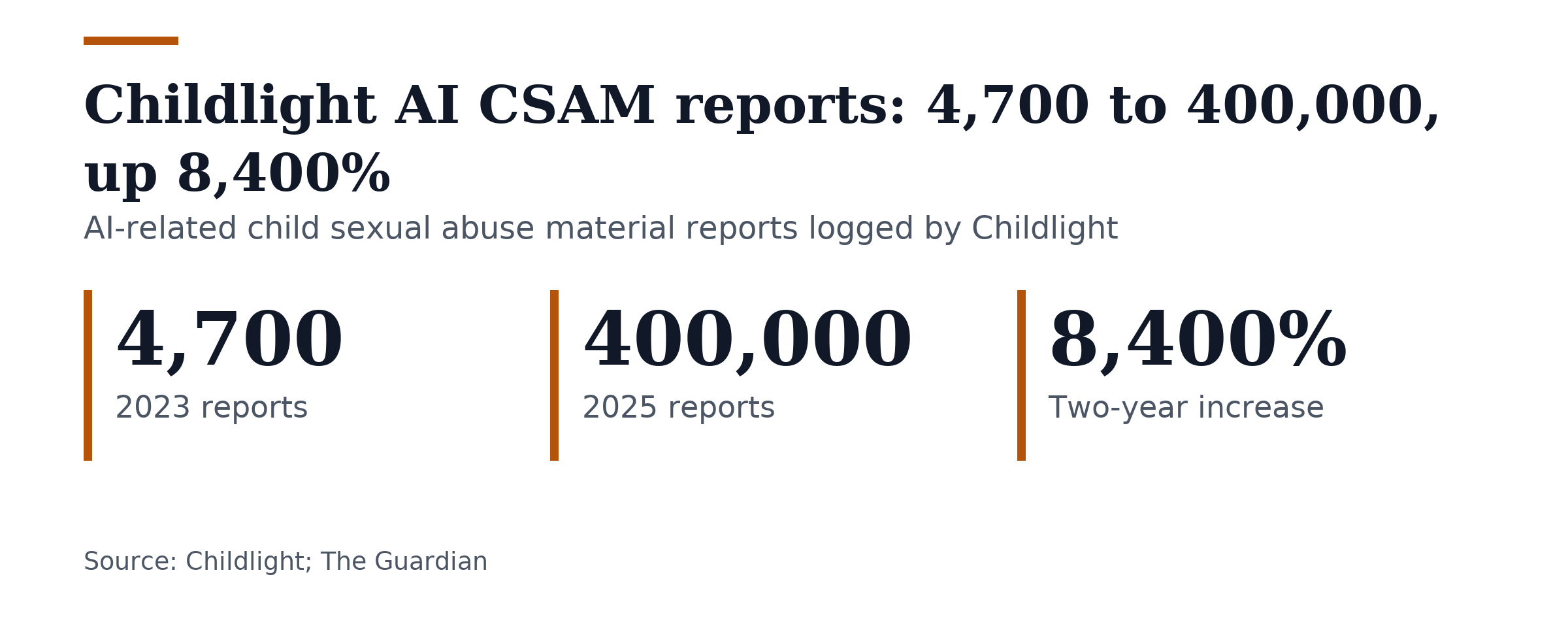
Childlight said the increase was more than 8,400 percent over two years. Its work covered deepfakes plus images created using nudify apps, which offenders can use to blackmail children for money or further images. The organization’s research centers on east Asia and the Pacific, Latin America and the Caribbean, and North America, while earlier studies examined western Europe.
In the first half of 2026, the Internet Watch Foundation assessed 6,310 AI images classed as child sexual abuse material under the law. The figure was 40 percent higher than the more than 4,500 images recorded across 2025.
The foundation said its first-half 2026 total of photorealistic child sexual abuse material exceeded its full-year 2025 count. For all of 2025, the foundation counted 8,029 AI-generated images and videos depicting realistic child sexual abuse, a 14 percent rise from the previous year. It logged 3,443 AI-generated abuse videos against only 13 in 2024. Most of the flagged images showed girls, mostly children between the ages of 7 and 13.
Childlight estimates that more than 300 million children worldwide experience at least one form of technology-enabled sexual exploitation or abuse each year. It also estimates that about one in four children will experience some form of abuse before their 18th birthday.
Report Remove logged 420 reports in the first half of 2026 from children who believe someone altered their photos to appear explicit. The total surpassed the 397 similar reports recorded during 2025.
Tech Times reported that generative AI makes image manipulation easier, so offenders can run automated tools to produce or alter material without much technical skill. A report can involve AI, nudification tools, computer-generated imagery or different editing, and some reports do not involve generative AI at all. Someone can copy and change a public photo without the child’s knowledge or agreement. The Internet Watch Foundation warned that offenders can use real photographs or existing abuse material to develop models generating further content.
Artificial images may be circulated, used to make threats, or connected to a child’s identity, harming victims. AI-generated images can use a real child’s likeness to harass, threaten, groom or blackmail that child. The UK government said AI-generated child sexual abuse material can directly affect real children and be used for grooming and blackmail.
In Britain, AI-generated child abuse imagery is a crime, and altering or sharing an AI model to produce it is also against the law. A person in Britain who builds an AI model whose purpose is to produce child abuse imagery faces up to five years in prison. The UK already treats creating, possessing or distributing child sexual abuse images as a criminal offense, including some AI-generated material.
The Crime and Policing Act 2026 makes it an offense to create or modify an AI image generator that produces or assists with child sexual abuse images. It is also an offense under the act to possess such a generator, supply one, or offer to supply one. A conviction on indictment can bring a prison term of up to five years, a fine, or both. The act targets deliberate creators, adapters, possessors and distributors of these tools rather than ordinary developers whose technology might be misused.
Hannah Swirsky, the Internet Watch Foundation’s policy lead, backs binding AI laws requiring firms to build safer models from the start. “It is incumbent on tech companies to build tools which cannot be abused this way.” Britain has no dedicated AI bill in sight. Kanishka Narayan, Britain’s AI minister, said all AI proposals remain on the table and will be judged by whether they keep Britons safer.
The Internet Watch Foundation called for legal requirements that force technology firms to build AI safeguards against misuse before release. Safeguards might include tighter limits on image generation, better detection, monitoring for attempts to get around controls, and quick reporting and removal tools. Fry of Childlight said better detection and reporting may account for some of the rise in AI-generated child sexual abuse material reports. She said governments and tech firms must act fast to prevent new abuse and remove abusive material without delay.
Paul Stanfield of Childlight urged governments to treat child sexual exploitation as a public health emergency that governments can prevent. He said governments often lack a complete picture of where harm happens and which children face the greatest danger. He said such abuse is not inevitable, and that knowledge and tools to make a difference exist.
Join the discussion