

Key facts
- Federal prosecutors charged Jacob Soall, Sharon Hazan and Guy Sheetrit in a Southern District of New York indictment for an AI-powered CEO-impersonation fraud scheme.
- The indictment alleges the three defendants and co-conspirators stole more than $129 million from companies worldwide by impersonating corporate executives and attorneys.
- Prosecutors stated that the conspiracy operated during the years 2024 through 2026.
- Prosecutors said the fraud scheme ran from July 2024 to February 2026 and targeted thousands of victims.
Federal prosecutors charged Jacob Soall, Sharon Hazan and Guy Sheetrit in a Southern District of New York indictment for an artificial intelligence (AI)-powered CEO-impersonation fraud scheme that ran from July 2024 to February 2026 and stole more than $129 million from companies worldwide.
Jacob Soall, 41, is from Marbella, Spain, and the United Kingdom. Sharon Hazan, 54, is from Israel, and Guy Sheetrit, 42, is from Israel and the United Arab Emirates. Authorities arrested Soall in Spain on June 17, Hazan in Spain on Aug. 5 and Sheetrit in the United Kingdom on Sept. 7, and extradition requests for all three men remain pending with the United States. Soall went by the nicknames Rocky Balboa and Seba Clarke, while Hazan used Superman Cash, Impossible Mission, Fat Boy and Ron.
The scheme typically began with an e-mail purporting to be from a company CEO, requesting help with a secret financial transaction described as a corporate acquisition. After the e-mail, defendants told employees to contact attorneys at major international law firms, whom the defendants also impersonated using AI. Prosecutors say the defendants used AI to mimic the voices and sometimes images of corporate executives during phone or video calls with employees. They targeted accounting employees who had authority to initiate large wire transfers.
Prosecutors allege the defendants pretended to be at least seven different high-profile corporate executives around the world and impersonated lawyers at firms among the 50 largest worldwide. Jacob Soall primarily impersonated attorneys from the United Kingdom using a handwritten script titled Lawyer Call. Defendants sent some fraudulent e-mails through an electronic signature company such as DocuSign and asked employees to sign a nondisclosure agreement. The Justice Department said, “They would explain that they needed an employee’s assistance on a confidential financial transaction.”
The impersonated attorney directed the employee to wire large payments to bank accounts controlled by the conspiracy. The group converted stolen money into cryptocurrency to conceal its source and distributed the proceeds among themselves and co-conspirators. Prosecutors say Sharon Hazan was in charge of laundering the funds for the scheme, and they also accuse Guy Sheetrit of laundering funds from it. Prosecutors allege Hazan boasted of laundering money since 1994 and over $400 million in three years, calling himself number one all over the world.
The group wired funds to accounts in the United States, Europe, the United Arab Emirates, China, Spain, Portugal, Greece, Singapore, Austria and Slovakia. Sharon Hazan was previously convicted in the Southern District of New York in 2008 of conspiracy to commit bank fraud. Court documents charge the trio with wire fraud conspiracy, wire fraud, two aggravated identity theft counts, money laundering conspiracy and two money laundering counts. The unsealed indictment is 15 pages long.
Prosecutors said a hospital system in Missouri lost nearly $5 million, while other sources put the loss at $4.8 million. A bank in Rhode Island lost $2.6 million according to one source and nearly $2.7 million according to another. A technology company in the United Kingdom lost $11.5 million or almost $11.6 million depending on the source. A hospital system in California lost $2.9 million or nearly $3 million depending on the source.
A mutual fund or finance company in Massachusetts lost $4.6 million. A pet food company in Florida lost $5.2 million. An investment company in New York was duped out of $2.8 million.
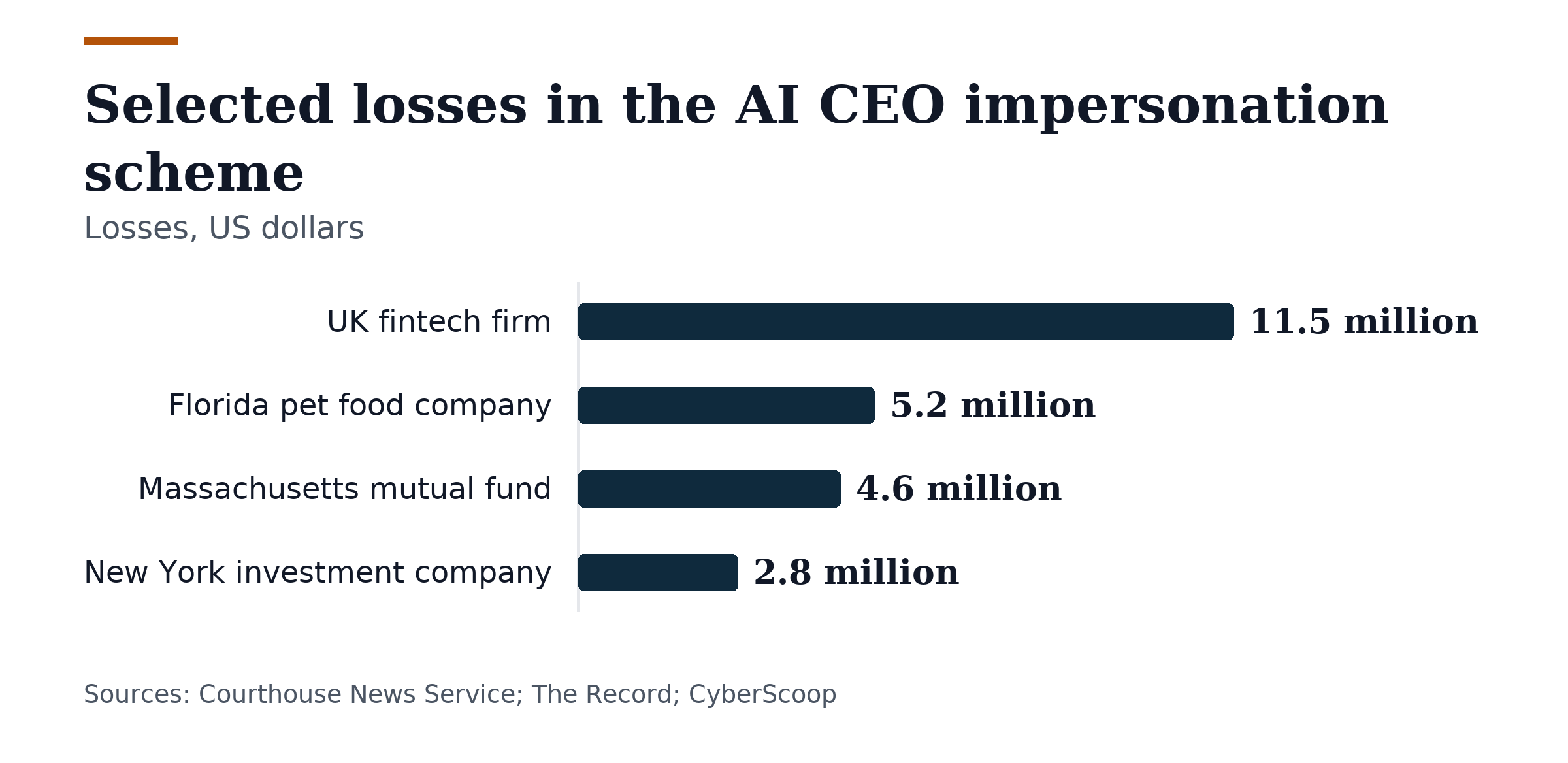
Prosecutors allege a United Kingdom-based financial technology firm lost more than $11.5 million in March 2025. They also allege a Massachusetts-based mutual fund company lost more than $4.6 million in April 2025 and a Florida-based pet food company lost more than $5.2 million in June 2025.
The conspiracy operated during the years 2024 through 2026 and targeted thousands of victims. Prosecutors and court documents state the maximum possible prison sentence is 104 years if convicted on all counts. The attorney’s office says conviction carries a maximum of 20 years on standard charges and two years for aggravated identity theft. The U.S. attorney’s office press release describes each of the seven charges against the three defendants as carrying a maximum prison sentence of 20 years.
Jamie McDonald, U.S. Attorney for the Southern District of New York, said the defendants acted “to impersonate real people and deceive corporate executives into sending them and their co-conspirators approximately $129 million.” He also said, “Super intelligence technology offers tremendous potential,” describing artificial intelligence. James C. Barnacle Jr. of the FBI New York field office said, “As criminals continue to weaponize emerging technologies.”
Attorneys representing Soall and Sheetrit did not immediately reply to an e-mail seeking comment, and reporters could not determine whether Hazan had legal counsel. The U.S. Attorney’s Office for the Southern District of New York did not immediately respond to an Associated Press voicemail seeking comment. Prosecutors say it is not immediately clear which companies the scheme targeted or which law firms the defendants impersonated.
Federal Bureau of Investigation officials asked additional potential victim companies to come forward. Jamie McDonald said, “I encourage individuals and the business community to consider how to best protect themselves from the emerging threat of SI-enabled crime.”
Join the discussion