
Key facts
- If adopted, the ban takes effect on December 1, 2028, giving manufacturers roughly 25 months to move certification work out of non-reciprocal economies.
- The rule keys on a lab's physical location rather than ownership, meaning a Western-owned facility in mainland China is treated the same as a Chinese-owned lab.
- In May 2025, the FCC stripped recognition from about 29 labs tied to foreign-adversary ownership or control, leaving most Chinese testing facilities eligible.
- Future certification work faces restrictions on measurements, technical analysis, and preparation of official test reports, while routine administrative tasks and research testing outside certification remain exempt.
The Federal Communications Commission will vote on Oct. 29, 2026, on a rule barring test labs and certification bodies in countries without reciprocal U.S. market access from certifying devices for the American market.
If adopted, the ban takes effect Dec. 1, 2028, giving manufacturers roughly 25 months to move certification work out of non-reciprocal economies. The FCC advanced the broader testing-lab framework and opened public comment in April 2026, and the October 29 vote decides whether those principles become enforceable rules.
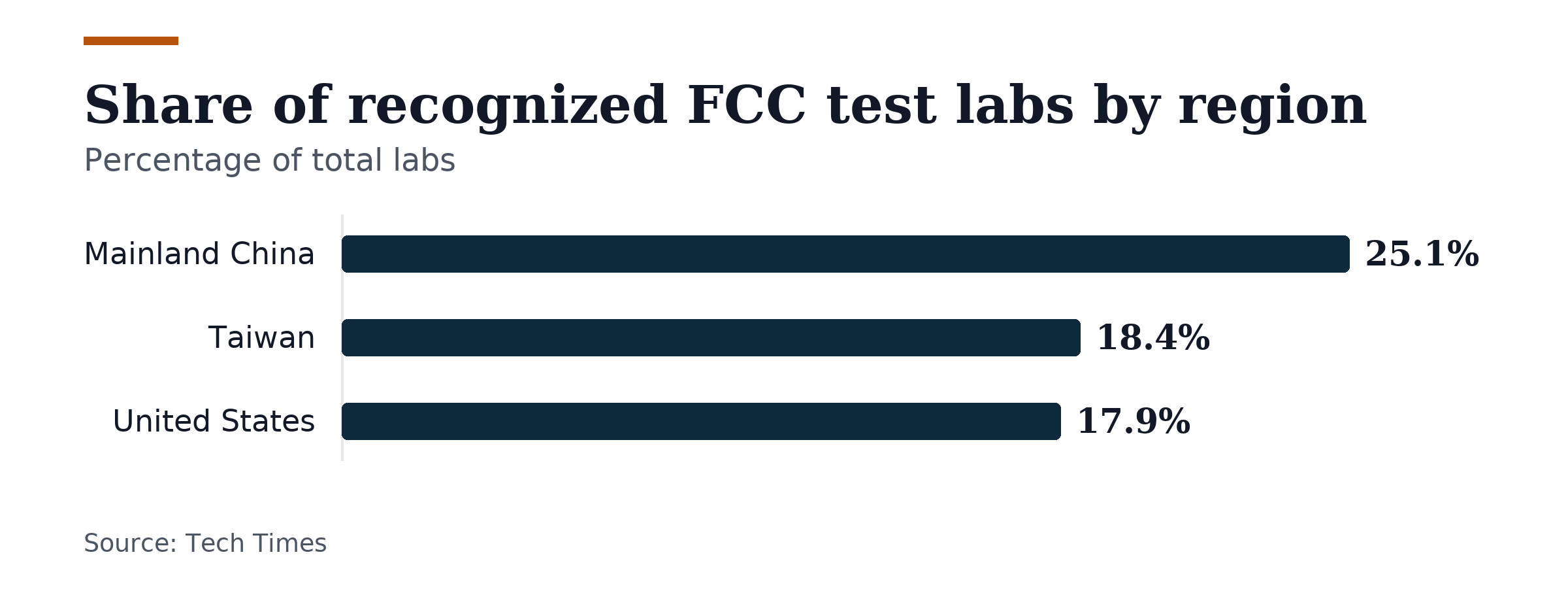
Mainland China accounted for 82 percent of FCC equipment authorization applications while U.S. labs handled under 4 percent, according to the agency. Among the 609 currently recognized test labs, mainland China holds 25.1 percent, Taiwan holds 18.4 percent, and the United States holds 17.9 percent. In 2007, U.S. labs handled about 31 percent of FCC authorization testing and Chinese labs handled about 13 percent. The Epoch Times reported, citing an FCC Office of Engineering and Technology tally, that roughly 83 percent of FCC equipment-authorization applications filed in 2025—38,491 out of 46,402—went through Chinese laboratories.
The rule keys on a lab’s physical location rather than ownership, meaning a Western-owned facility in mainland China is treated the same as a Chinese-owned lab. In May 2025, the commission stripped recognition from about 29 labs tied to foreign-adversary ownership or control, leaving most Chinese testing facilities eligible.
Future certification work faces restrictions on measurements, technical analysis, and preparation of official test reports, while routine administrative tasks and research testing outside certification remain exempt. Existing FCC equipment grants remain valid and no retroactive retesting is required solely because of the new rule.
The FCC says China’s National Intelligence Law of 2017 requires all organizations and citizens in China to support national intelligence work, and that duty applies to Chinese test labs regardless of private ownership. Testing labs obtain device technical specifications, radio frequency emissions data, circuit designs, and capability documentation during authorization submissions. The commission found 33 incorrect or false test reports from SLG-CPC Test Laboratory, a Chinese facility already under scrutiny.
Six trade groups including INCOMPAS, the Telecommunications Industry Association, and the Consumer Technology Association urged the FCC to target ownership rather than location and warned a geography-based ban would reduce capacity, delay market entry, and raise costs. Industry groups requested a three- to five-year transition period, while the order permits roughly 25 months.
A U.S. lab owner reported that Chinese facilities charge 30 to 70 percent less for testing than U.S. equivalents because of manufacturing economies of scale, lower local operating costs, and long-standing manufacturer-lab relationships. The draft order names Taiwan as a reciprocal economy, and Taiwan’s 18.4 percent share of recognized labs ranks second only to mainland China. Current Taiwan capacity cannot handle the 82 percent of U.S. device authorization testing now processed in China.
Future certification work may shift to facilities in the United States, Taiwan, Hong Kong, Japan, and Vietnam, subject to final rule status for each jurisdiction. Relocating certification work from manufacturing centers may increase logistics costs, force earlier scheduling, and extend product approval timelines. Small device makers should expect the hardest transition because they have weaker bargaining power with alternative labs and fewer ties outside China. Consumers may see little effect on already approved devices, but future hardware could face longer waits between announcement and retail availability or higher compliance costs passed through pricing.
A Further Notice of Proposed Rulemaking attached to the order asks how domestic testing capacity might be rebuilt, a question the order leaves open. Manufacturers, domestic lab operators, and policy observers are watching the attached Further Notice of Proposed Rulemaking to learn whether the security agenda includes industrial policy such as tax incentives or expedited accreditation.
The Section 214 overhaul lowers the reportable ownership threshold from 10 percent to 5 percent while preserving the 10 percent level for automatic Team Telecom referral. Every current Section 214 holder must file a one-time information collection that covers ownership, cross-border facilities, services, markets, third-party providers tied to foreign adversaries, cybersecurity certifications, and Covered List compliance. Holders must alert the FCC within 30 days of material changes to prior filings, such as new 5 percent stakeholders or shifts in cross-border facilities and services.
Current Section 214 authorization holders must pledge within 30 days of the effective date to adopt a compliant security program and must operate one within 12 months. Cybersecurity programs built around the NIST Cybersecurity Framework version 2.0 and CISA’s Cross-Sector Cybersecurity Performance Goals are presumed compliant. The framework structures cybersecurity programs around six functions beginning with Govern and Identify and ending with Respond and Recover.
The related Further Notice suggests presumptions that applications be denied when they come from foreign adversary-controlled entities, Covered List entities, or entities that previously had authorizations denied or revoked for national security reasons. Current Section 214 holders who give up unneeded or duplicate authorizations ahead of the deadline would no longer face the one-time information-collection requirement. New Section 214 applicants must have a compliant cybersecurity program operational when they begin service.
The October 29 meeting’s seven-item docket covers the test lab ban, the Section 214 overhaul, a 25 megahertz mid-band spectrum auction, and rules opening 800 MHz spectrum to commercial drone flights. The agency plans a 160 megahertz upper C-band auction in April 2027, followed later by the separate mid-band sale. U.S. government meteorological data now occupies the 1675–1695 MHz band, and the NTIA has tagged 5 megahertz there for auction while reviewing the remaining 15 megahertz. Commissioners are expected to approve all seven agenda items at the October 29 meeting based on the current panel composition.
SpaceX’s next-generation direct-to-device constellation had targeted the 2020–2025 MHz slice, but the FCC deferred that request in a separate order. The Supplemental Coverage from Space plan would add 482 megahertz for satellite-to-device links serving rural and underserved areas. In May 2026, the FCC cleared EchoStar spectrum transfers worth about $40 billion to AT&T and SpaceX, including around 65 megahertz of mid-band spectrum for Starlink’s direct-to-device network. The 800 MHz order removes an old restriction and makes about 50 megahertz of licensed spectrum available in the low band for drone operations.
China filed a WTO complaint characterizing the location-based standard as discriminatory. China’s commerce ministry said the proposal would seriously damage international economic and trade rules and warned of retaliation if it takes effect.
The FCC in March 2026 ordered a ban on importing new consumer routers manufactured overseas, citing threats from Chinese state-backed hacking groups named Volt, Salt and Flax Typhoon. The FCC cited Reuters in putting China’s share of the consumer router market at around 60 percent. Brendan Carr said the commission would continue working to keep American cyberspace and supply chains secure.
The FCC placed foreign-made advanced robotic devices on its Covered List on July 28, 2026, so new foreign-made models cannot obtain authorization for import, marketing, or sale in the United States. IDC projects U.S. humanoid robot revenue will fall 58 percent below baseline by 2030 due to the foreign robot rule, while robot vacuums will fall 18 percent below baseline.
Rules effective Oct. 13, 2026 bar approval of devices with logic-bearing hardware from blocklisted firms, and the FCC blocked two video devices carrying HiSilicon chips under this policy. Brendan Carr called surveillance hardware in video devices from Covered List companies a serious danger to Americans and the country.
Since January 2025, Chairman Brendan Carr has pursued a sequential approach including Covered List additions of DJI and Autel on December 22, 2025, a probe of nine Chinese tech firms in March 2025, the May 2025 Bad Labs order, submarine cable orders in August 2025 and 2026, and January 2026 foreign adversary attestation requirements. In January 2026 at CES, Carr promoted a single national AI governance framework in response to more than 1,200 state AI bills introduced during 2025.
The FCC blocked new Chinese-made drone models in December 2025 and foreign-made consumer routers in March 2026. In June 2026, the FCC widened equipment restrictions for Huawei and ZTE, and in July 2026 it moved to block devices containing key components from Chinese firms.
Join the discussion