

Key facts
- iFixit published a teardown of Apple's iPhone Duo foldable on October 25, 2026, examining its internals, dust resistance, and repairability.
- The score makes the iPhone Duo the most repairable foldable smartphone iFixit has seen so far, though still difficult to repair.
- iFixit exposed the iPhone Duo to fluorescent dust before opening it to test its IP68 dust and water resistance rating.
- iFixit called the dust result encouraging but said the device is not great for the beach because dust still reached moving parts.
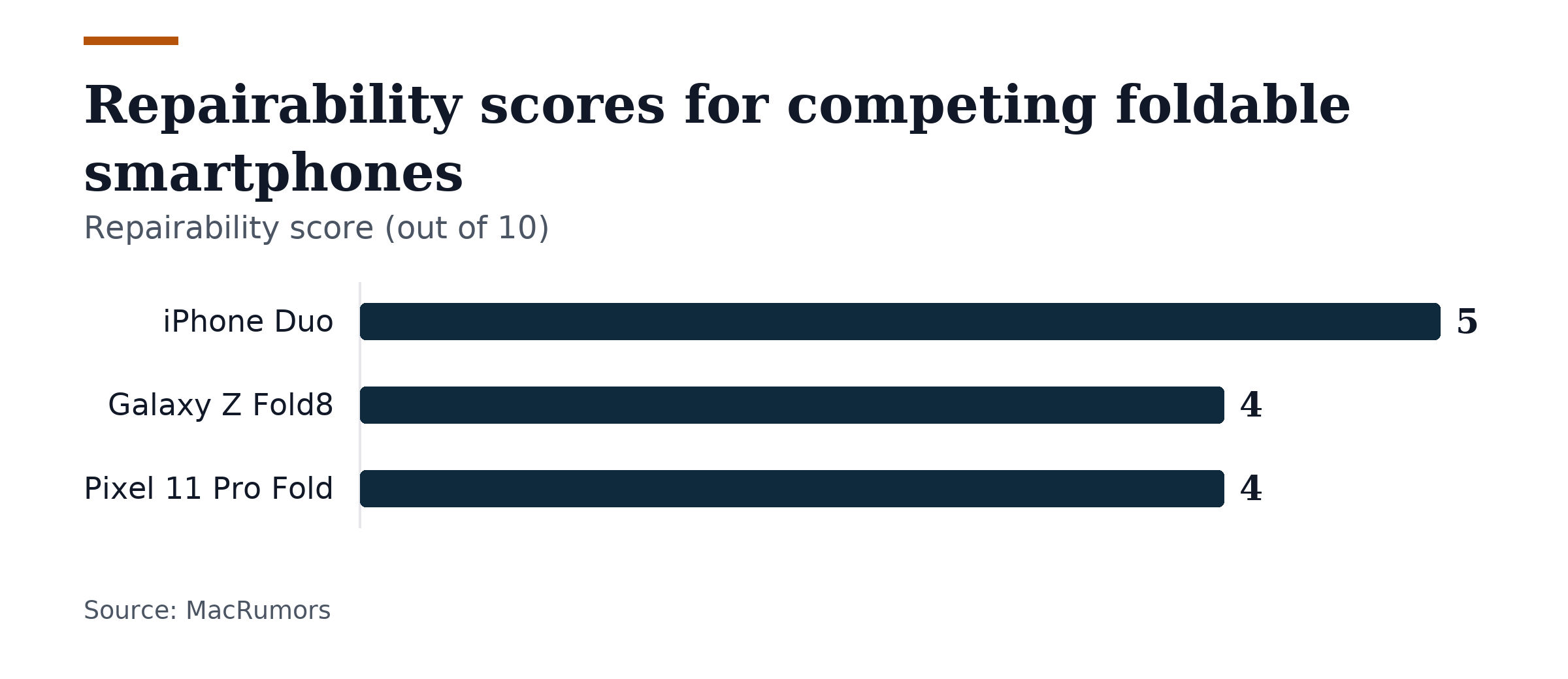
MacRumors reported on Oct. 25, 2026 that iFixit published a teardown of Apple’s iPhone Duo foldable, examining its internals, dust resistance, and repairability. The teardown gave the iPhone Duo a provisional repairability score of five out of 10. iFixit said that makes the iPhone Duo the most repairable foldable smartphone it has seen so far, though still difficult to repair. For comparison, the Galaxy Z Fold8 and Pixel 11 Pro Fold both scored four out of 10 in iFixit’s competitive comparison.
To test the IP68 dust and water resistance rating, iFixit exposed the iPhone Duo to fluorescent dust before opening it. Dust appeared in the USB-C port, speaker mesh, and bezel, though few particles reached the internals.
Particles that entered the hinge caused it to crunch, which iFixit said could lead to screen damage. The hinge gathered less dust than the Galaxy Z Fold8 or Pixel 11 Pro Fold in similar tests.
iFixit called the dust result encouraging but said the device is not great for the beach because dust still reached moving parts. JerryRigEverything found that dust entering the hinge caused the magnets holding the iPhone Duo shut to fail.
iFixit peeled away the nano-texture cover layer, which Apple designed for inexpensive replacement, though users are not supposed to remove the cover layer themselves. Cover layer replacement costs $19 with AppleCare+ and $49 without it.
The iPhone Duo uses battery adhesive introduced with the iPhone 16 that loosens with a small electrical charge. iFixit described the battery removal as the best experience from a foldable to date. iFixit said the outer display was straightforward to remove, and its robust construction aids repairability because most internal repairs go through it. iFixit said the inner screen trim comes off with heat, but removing the inner panel requires cutting through a lot of adhesive.
Apple describes the iPhone Duo’s inner display as a 10-layer stack, and iFixit peeled back some inner display layers to inspect them under a microscope. The iPhone Duo uses an unstacked logic board, the first iPhone to do so since the iPhone 8. iFixit said the single-layer logic board design is one way Apple kept the Duo thin. iFixit said a repair manual was available on day one, and the outer display comes off intact. The inner display and hinge assembly are the iPhone Duo’s biggest vulnerabilities.
iFixit said reported display failures could stem from pressure, a trapped particle, repeated bending, or a manufacturing defect. A wiring problem can produce the same effect as a physically snapped display.
In most faulty units, the hinge has a different shape, and the failure spot sits near the accordion cable where edges meet. iFixit built a 3D hinge model from teardown footage, patents, and CT scans and matched it to reported damage locations.
iFixit found breaks clustering where the crossing flex cable’s gap meets the central hinge support. The damage sits slightly lower than the display cable pass-through where edges meet and alter support as the display bends.
iFixit said the hinge’s curved rails may lift above flat plates as the phone closes, and one rail lines up with the damage. A hinge component meant to retract may not be doing so, but there is no clear answer. iFixit’s website offers an interactive CT scan of the iPhone Duo’s hinge showing supports, cable, and components beneath the display.
Join the discussion