


Key facts
- Facewatch says it actively supports tighter regulation and has engaged with the Home Office on rules for private-sector facial recognition.
- Sainsbury's plans to expand Facewatch from 55 stores to more than 200 locations by the end of 2026.
- Warren Rajah, a tech professional and CDW customer experience employee, was wrongly ejected from an Elephant and Castle store in February 2026.
- Rajah was misidentified as a suspected shoplifter despite committing no offense.
Facewatch issued about 300,000 biometric alerts to UK retailers in the first six months of 2026 while pressing the Home Office to set rules for private-sector facial recognition. Tech Times counted 297,433 alerts and Biometric Update reported almost 300,000. The company operates cameras at Sainsbury’s, B&M, Sports Direct and more than 125 other outlets. Shoppers have no national opt-out mechanism.
Shoppers entering a participating store are processed biometrically before they can object, because no national opt-out mechanism exists. UK GDPR requires participating stores to display notices that facial recognition is in use. For shoppers not matched to its watchlist, Facewatch says it deletes images right away. A shopper who believes they were wrongly added can ask Facewatch for their data, but they must hand over identification documents to a private company and wait for a manual review.
Warren Rajah, a tech professional and CDW customer experience employee, was wrongly ejected from an Elephant and Castle store in February 2026 after being misidentified as a suspected shoplifter despite committing no offense. Matt Arnold, a 46-year-old comedy promoter, was stopped at a self-checkout at Sainsbury’s East Dulwich superstore in August 2026 and told he could not be served. He called the encounter “a terrifying glimpse of the future.” Byron Long was accused of stealing approximately £75 of goods at a B&M store in Cardiff although store footage confirmed he had paid.
Facewatch advertised a 99.98 percent accuracy rate for its matching algorithm, a figure that covers only the algorithmic pipeline and not the human-review stage. Every publicly documented wrongful ejection from a Facewatch-equipped store occurred at the human-review stage, not the algorithmic matching stage. Facewatch has not published data on its real-world operational error rate. The company attributed all three documented wrongful ejections to human error.
Facewatch can alert police in an average of four seconds when a flagged high-risk repeat offender enters a participating store, in July 2026. The firm linked the police-alert launch to the Crime and Policing Act 2026, which received Royal Assent in 2026. The act eliminated a previous £200 threshold that had in practice decriminalized lower-value shoplifting.
According to the British Retail Consortium, retailers lose £2.2 billion annually to shoplifting and spend a further £1.8 billion on crime prevention, for a combined annual cost of roughly £4.2 billion. Police-recorded shop theft hit record levels in the year to March 2025, Office for National Statistics data indicated, at a pace of roughly three incidents each minute. ONS data for the year to March 2026 recorded 507,000 shop thefts, down 4 percent from the prior period. Office for National Statistics figures for England and Wales show 509,566 shoplifting offences in the year ending December 2025.
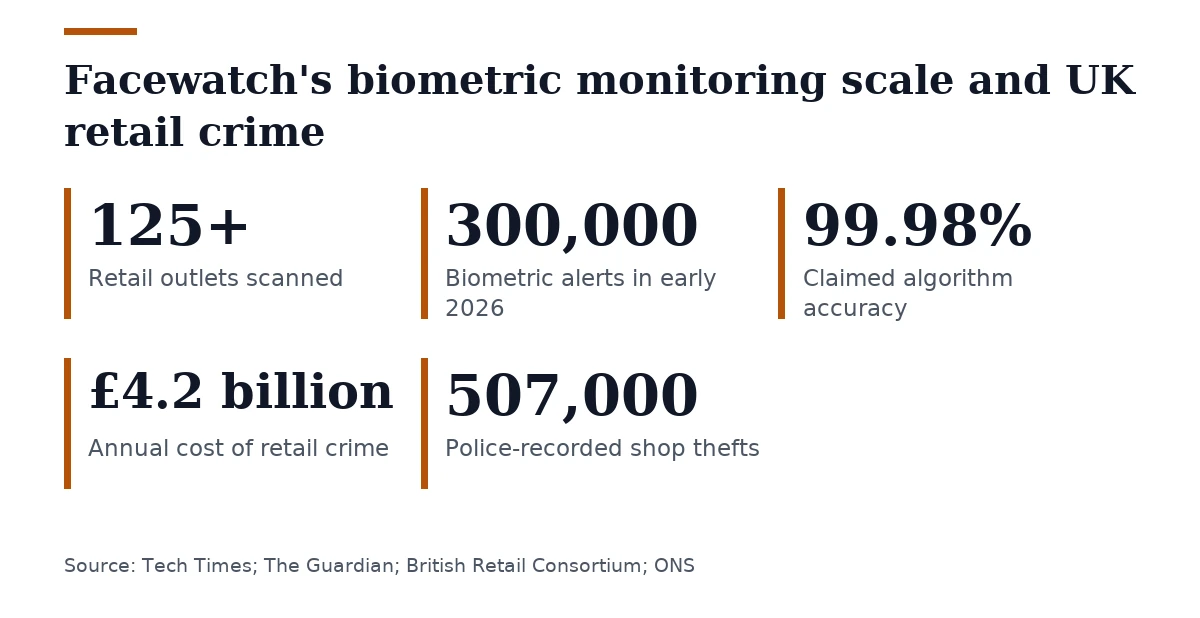
Sainsbury’s plans to expand Facewatch from 55 stores to more than 200 locations by the end of 2026. Facewatch cameras already scan customers at Sainsbury’s, B&M, Sports Direct and more than 125 other UK retail outlets. About 90 percent of flagged shoppers do not come back, Sainsbury’s says, pointing to that figure as proof the system deters theft.
Britain has no dedicated law for live facial recognition in commercial settings; deployments fall under UK GDPR and the Data Protection Act 2018. No licensing regime or independent authority has a clear mandate to approve or reject individual retail facial-recognition rollouts. The Information Commissioner’s Office can investigate specific deployments under data-protection law. The Biometrics and Surveillance Camera Commissioner holds an advisory role but cannot license or prohibit the technology outright.
The EU AI Act, rolling out since 2024, treats real-time biometric identification in public spaces as high-risk AI. The UK chose not to adopt equivalent prohibitions after leaving the EU.
Facewatch became the first UK retail facial recognition provider to receive certification under ISO/IEC 42001:2023 in June 2026. An audit by Tempo Audits found no nonconformities. Facewatch acts as data controller for its whole retailer network, assuming legal duties that would otherwise belong to each store operator. Facewatch’s chief executive Nick Fisher has not publicly addressed the competitive-moat critique directly.
Big Brother Watch’s petition to halt in-store biometric scanning has passed 42,000 signatures. The organization is scheduled to convene a victims’ summit at Parliament on October 27 where people wrongly flagged by the technology will give testimony.
The Home Office ran a public consultation on facial recognition by private organizations; its conclusions have not yet been published. The consultation ran until February 2026.
Big Brother Watch argues the opt-out arrangement is incompatible with meaningful consent under data-protection law. The group criticized police for inserting themselves into a cowboy operation. Big Brother Watch said shoppers could be matched against a hidden list put together by private businesses and security staff without public oversight.
Big Brother Watch’s director Silkie Carlo said her organization is being approached by people trying to clear their names after facial recognition mistakes. Silkie Carlo called Sainsbury’s deployment one of the largest facial recognition surveillance rollouts in the United Kingdom. Carlo is listed as a claimant in Thompson and Carlo, a High Court case on the Metropolitan Police’s live facial recognition policy. The court dismissed the claim and upheld the policy on April 21, 2026; Thompson and Carlo plan to appeal.
The Equality and Human Rights Commission warned the Metropolitan Police’s use of live facial recognition likely falls short of human rights law standards. Charlie Whelton, Liberty’s policy and campaigns officer, said “It’s not against the law to walk into a shop even if you’ve committed crimes in the past.”
Nuala Polo said there are less intrusive means to catch shoplifters than scanning millions of faces virtually without consent. Polo said it is concerning that government plans for a legal framework for facial recognition would not apply to the private sector.
Biometrics watchdogs in Britain said oversight of facial recognition is not keeping pace with the technology’s spread through police forces and retail stores.
The British Retail Consortium warned that violence, abuse and theft is spiralling out of control. Retailers and security providers including Facewatch point to organized criminal groups and repeat offenders as a growing challenge. Biometric Update reported that industry estimates suggest some prolific offenders account for a disproportionate share of retail theft. Rising food prices add to the retail crime challenge, Facewatch points out.
Asda ran a facial recognition pilot in five stores in Greater Manchester. Seven million innocent faces were scanned in the past year without consent, according to State of Surveillance. Eighty percent of the Metropolitan Police’s wrongful facial-recognition flags targeted Black people, according to State of Surveillance. The EU bans real-time facial recognition in public spaces and can impose €35 million fines, according to State of Surveillance.
A Facewatch spokesperson told TechRadar the company “actively supports” tighter regulation of the development and use of facial recognition systems.
SAI, a retail-intelligence technology provider, partnered with the Retail Trust, a charity founded in 1832, to launch the Safer Stores initiative. The Safer Stores initiative will unite retailers, technology providers, law enforcement agencies and rehabilitation groups to exchange data and create strategies aimed at repeat offenders. SAI’s platform relies on a patented Visual Language Model that blends computer vision with generative AI to study behavioral patterns and in-store context. Revenue from SAI’s surveillance work funds a charity that supports store safety and staff wellbeing.
USDAW, the union representing hundreds of thousands of shop workers, has broadly supported technology to protect staff. USDAW support is conditional on responsible deployment and genuine consultation with employees. Facewatch says it actively supports tighter regulation and has engaged with the Home Office on rules for private-sector facial recognition. The Guardian reported that evidence suggests Black and Asian people are more likely to be incorrectly identified than white people by Facewatch technology.
Join the discussion