
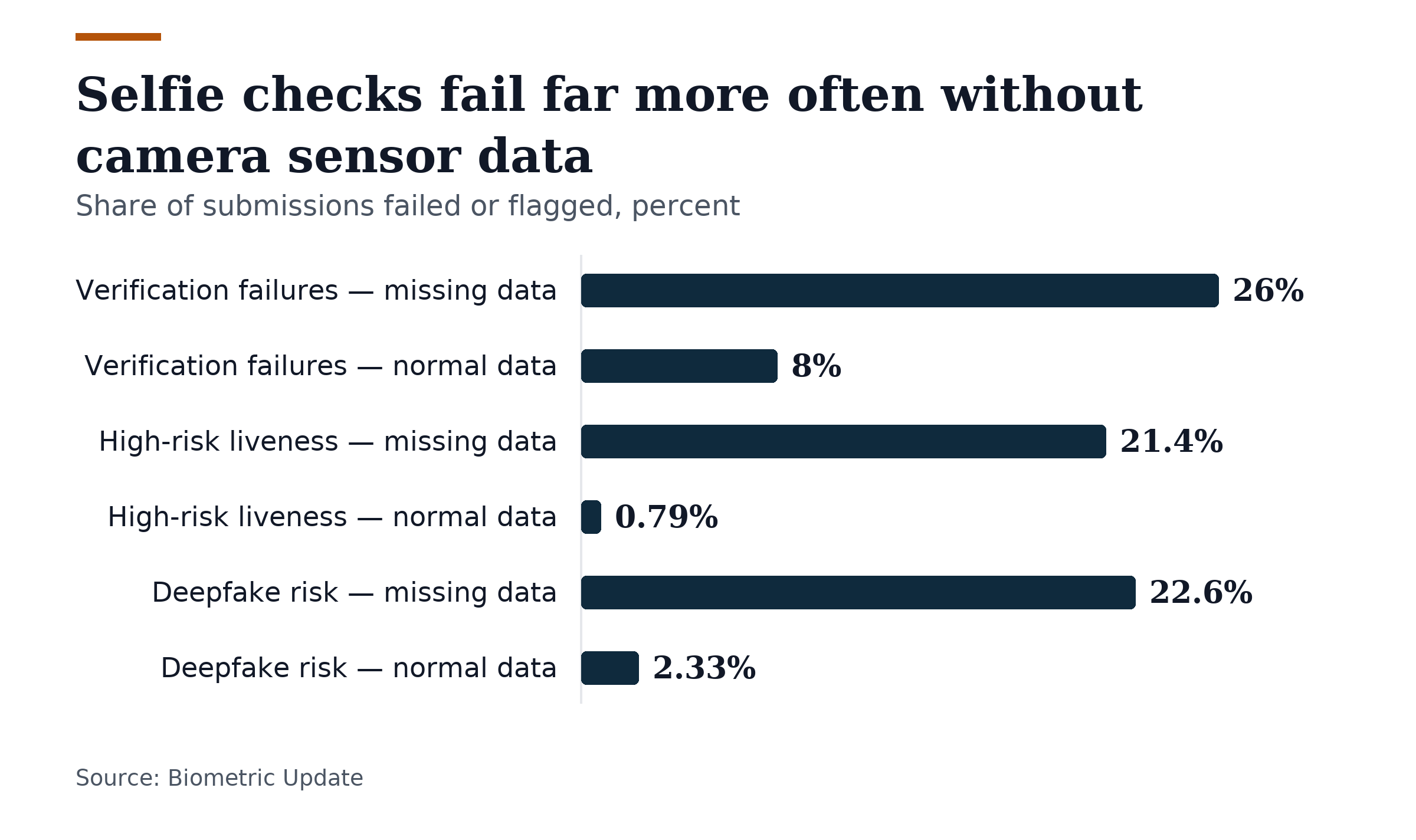
Persona found selfies missing camera sensor metadata failed verification more than three times as often as selfies with expected sensor data across 50 organizations, Biometric Update reported. Among submissions lacking sensor data, 26 percent of 202,360 selfies failed verification, compared with 8 percent of submissions containing expected sensor data. Persona reviewed more than seven million selfie verifications during one month in fintech, cryptocurrency, gaming, and online marketplaces.
Submissions missing sensor data received high-risk liveness results in 21.4 percent of cases, versus 0.79 percent of normal submissions. They also showed medium or high-risk deepfake assessments in 22.6 percent of cases, versus 2.33 percent of normal traffic.
Persona’s 2026 H1 selfie fraud report found injection attacks represented roughly 14 percent of fraud attempts in its dataset, and 75 percent of those injection attacks were not AI-generated or AI-manipulated selfies. Persona said the study focused on organizations with high levels of injection attacks.
The company’s initial approach checked camera device labels to spot virtual cameras, with five virtual camera labels accounting for roughly 60 percent of flagged submissions. Recognizable virtual camera software represented 68 percent of flagged submissions, while individual phone mirroring setups represented the remaining 32 percent. Persona’s second detection path examined device and camera details for gaps and alterations while a verification ran.
Persona warned that submissions should not be rejected only because metadata is missing, noting that legitimate devices and browsers sometimes leave out sensor information. It said metadata checks should work alongside other injection attack detection methods, not replace them.
The company’s injection attack detection framework relies on device intelligence, application integrity testing, runtime and network monitoring, image analysis, and recurring fraud pattern detection. NIST’s SP 800-63A-4 digital identity guidelines advise capture sensor authentication to build confidence that provided media comes from a real sensor. Persona received high-level IAD certification under CEN/TS 18099, a European technical specification, for its Android SDK after independent evaluation by CLR CERT.
Join the discussion