


Key facts
- The attacker changed employee access controls and took over an employee's work account to reach Todoist's cloud infrastructure.
- Todoist first published its incident notice on November 24, 2026.
- Todoist stopped using the salted SHA1 password-hashing method over a decade ago because it is outdated.
- Todoist retired the salted SHA1 hashing method after the breach.
About 6% of Todoist customers had e-mail addresses, password hashes and account creation dates stolen after a hacker entered Todoist’s production systems and version control using stolen credentials between Nov. 22 and Nov. 23, the company confirmed.
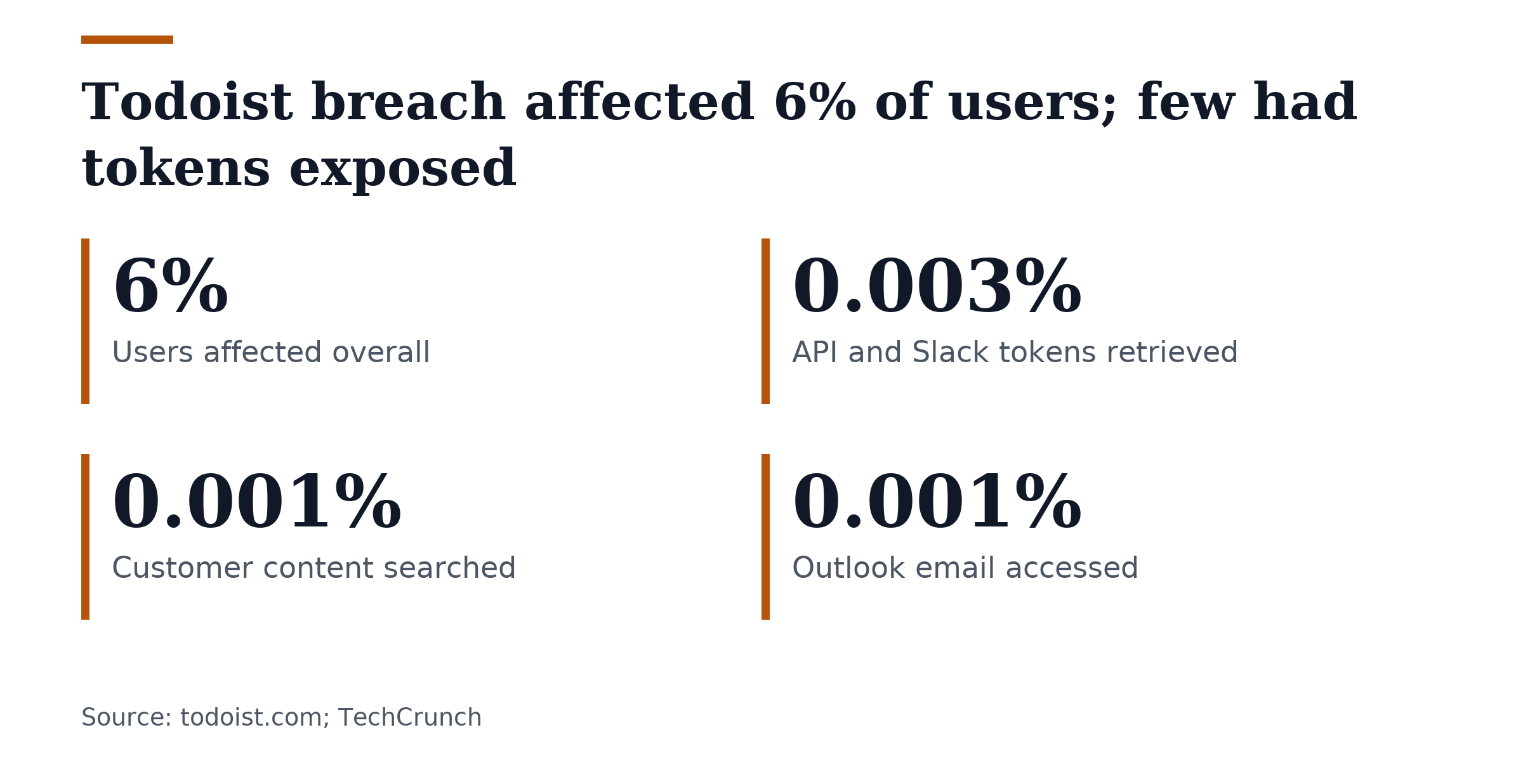
About 6% of Todoist customers were affected, and the company said early users with older salted SHA1 password hashes were the ones whose e-mail addresses, password hashes and account creation dates were taken. The company found no evidence that the attacker logged in to any affected account in that 6% group. Smaller groups were also exposed: about 0.001% had customer content searched for credentials resembling API keys or tokens, about 0.001% had connected Outlook e-mail information accessed through the Todoist for Outlook add-in, and about 0.003% had Todoist API tokens and Slack integration tokens retrieved. Todoist first published its incident notice on Nov. 24 and disclosed on Nov. 25 that about 6% of users were affected.
A hacker using stolen credentials entered Todoist’s source code and version control between Nov. 22 and 23, then changed employee access controls and took over an employee’s work account to reach the company’s cloud infrastructure. The intruder modified automated workflows in three Todoist repositories and obtained additional credentials. Source code was viewed, though Todoist’s investigation found no changes to application code.
Todoist has not established how the attacker originally obtained the stolen credential. The company suspects an employee’s device may have been compromised but has not confirmed that theory.
Using an exposed API token, the attacker accessed project, task and comment data through Todoist’s /sync API endpoint for some affected accounts. Manual keyword searches asked for the opening 300 or 320 characters of matching tasks or comments, while credential-pattern searches pulled 200 to 260 characters from comments and separately took out the matching credential text. An automated scanner later asked for up to 700 characters at the start of matching fields and as many as 500 characters from the matching pattern. Todoist cautions that recorded commands show what the attacker requested but do not confirm every result was retrieved.
The attacker used credentials stolen from the Todoist for Outlook add-in to request previews of 10 messages from chosen mailboxes sorted by arrival time, then launched keyword searches asking for as many as 25 or 50 results for each mailbox. The recorded Outlook requests did not request full e-mail message bodies.
AndroGuider says the disclosed details give no sign Todoist kept or revealed passwords in plaintext and do not establish that task content, payment-card details or private project data were accessed. The outlet also says exposed e-mail addresses could support credential-stuffing and phishing even if hashes remain uncracked, and that account creation dates paired with e-mail addresses can help attackers create convincing social-engineering messages.
Todoist blocked the access paths used in the attack, disabled the Todoist for Outlook e-mail add-on, and restricted remote command execution in its cloud environment. The company disabled affected passwords, signed affected accounts out, revoked and replaced exposed internal credentials, revoked API tokens, disconnected connected OAuth applications, and ended active sessions. It also deleted attacker-created cloud accounts, revoked credentials, halted running tasks and examined changed authentication settings.
Todoist limited which changes can activate sensitive infrastructure workflows and closed the access routes the attacker followed between systems. It reviewed controls that enforce shorter credential lifetimes on platforms that support them, added an automated code-review check meant to flag modifications that might reveal credentials or private information, and reviewed every credential permission to restrict what a stolen credential can reach.
Todoist stopped using the salted SHA1 password-hashing method over a decade ago because it is outdated, and it retired that method after the breach. Certain older accounts kept SHA1-based password hashes because their passwords were not updated after the company discontinued that method. The company’s disclosure says it should have retired support for the older hashing method sooner. A password hash represents a stored password value rather than the plaintext password, salting inserts a random value before hashing to complicate bulk attacks, and older formats can be vulnerable to guessing attempts.
Founder and CEO Amir Salihefendić apologized to users on X and said the company would review what caused the breach. Todoist said protecting customer information is its responsibility, that it fell short, and that it is sorry for letting users down.
This breach is part of a broader pattern of credential-based attacks against companies including Uber and Klue in 2026.
Affected users should reset their Todoist passwords and change reused passwords on other services, because recovered credentials may unlock e-mail accounts, cloud storage, social-media profiles or workplace services. Users should revoke and replace API keys, recovery phrases or access tokens stored in Todoist comments, and update API tokens and reconnect integrations. They should watch for phishing e-mails claiming to be from Todoist, and Todoist said it will not ask users to send passwords or install software in response to the incident; customers who did not receive a notification e-mail do not need to take action.
Todoist notified affected users by e-mail from no-reply@notify.todoist.com. If a user’s Slack integration was disconnected, they should reconnect it; if they used the Todoist for Outlook add-in, they should reconnect it and may be asked to approve a new app that appears unverified while Microsoft verification is completed, and work or school accounts may be blocked until verification is complete.
If a user used a Todoist API token in scripts or services, they should update them with the new token available under Settings → Integrations → Developer. Removing stored credential content from Todoist does not invalidate a secret that an attacker may already have copied.
AndroGuider advises users to enable two-factor authentication or other added login protections if available. Users should create a unique, long password kept by a reputable password manager, review recent account activity for unexpected changes, and watch their e-mail account for signs of unauthorized access.
They should be cautious of messages that ask for a password, verification code or payment information, create urgency, direct recipients to unfamiliar login pages, include suspicious attachments or shortened links, or claim an account will be deleted unless the recipient acts immediately. Users should avoid links in unsolicited messages, open Todoist through a bookmarked address or the official application, and look for notices there. They should not reply directly to security e-mails asking for sensitive information, and they should contact Todoist through official support channels if suspicious activity is detected. Exposed addresses let attackers send bogus Todoist security alerts, password-reset notices, subscription offers or account-verification messages, so phishing threats may continue after the technical intrusion ends.
Companies that rely on Todoist for work should view the breach as a possible credential-security incident. Administrators should find employees who reused Todoist passwords on corporate systems, mandate password changes where appropriate, and check authentication logs for unusual sign-ins. Employers should tell staff that leaked e-mail addresses and account creation dates can support believable impersonation attempts, and vendor security reviews should cover access controls, logging, breach-notification practices, multifactor authentication and password storage.
The scope of the investigation can change as forensic work continues, so users should rely on Todoist’s official notifications for account-specific information, and they should look for follow-up communications explaining whether individual accounts were affected and whether Todoist is forcing password resets. Unsettled items include the hashing approach and salting safeguards, how many records were taken, how long the intruder could reach systems, and whether any further account or task data was seen or deleted.
Join the discussion