

Key facts
- Australia's Parliament passed the Digital Duty of Care law on Wednesday, Nov. 25, 2026, exposing tech platforms to fines for not preventing foreseeable online harms.
- The law obliges Big Tech to cut the risk of harm before it happens under a digital duty of care, the government said.
- The maximum penalty for breaches rises to 5% of global revenue, replacing the originally proposed cap of 109 million Australian dollars ($72 million).
- The House of Representatives passed the bill by 97 votes to 43 under the center-left Labor Party government's majority.
Australia’s Parliament passed the Digital Duty of Care law on Nov. 25, exposing tech platforms to fines of up to 5% of global revenue for failing to prevent foreseeable online harms.
The House of Representatives passed the bill by 97 votes to 43 under the center-left Labor Party government’s majority. The Senate followed with a 36-to-23 vote on Nov. 24 after a deal between the government and the minor Greens party.
The law obliges Big Tech to cut the risk of harm before it happens under a digital duty of care, the government said, shifting from reactive removal to proactive harm reduction. Baseline safety rules apply to online services such as games, apps and artificial intelligence chatbots, with the goal of shielding Australians from seriously harmful material and conduct. The measure amends and repeals prior codes under Australia’s 2021 Online Safety Act, which set 17 online safety codes and standards for unlawful and age-restricted material.
Platforms must give regulators risk assessments at least once a year and warn regulators ahead of major changes that could bring new harm risks, including addictive design features. They must also let users in Australia opt out of a platform’s algorithm and instead see content only from accounts they follow, a right that applies to users aged 16 and over. The measure adds stronger privacy protections and expanded powers for regulators to remove nudifying services that fabricate naked images from genuine images.
The law clarifies hostile attitudes to women as material showing hatred or inferiority of women, or promoting violence, abuse, exclusion or denial of women’s rights. Platforms must protect children from content promoting eating disorders, hostile ideas about women, pornography, crime or dangerous stunts, or causing serious mental health distress. It targets engagement features such as infinite scrolling and algorithm-driven recommendations, requiring platforms to assess and address risks of excessive use.
The government agreed to create a pathway for an independent digital complaints ombudsman to resolve user disputes with technology platforms. Australians gain a private right of action, allowing individuals to directly sue digital platforms for breaching their duty of care and causing harm.
The maximum penalty for breaches rises to 5% of global revenue, replacing the originally proposed cap of 109 million Australian dollars ($72 million), after Greens amendments. Fines of up to 5% of global revenue could run into billions for the largest technology platforms, and for companies generating hundreds of billions annually the penalty would mean enormous financial exposure. Companies are expected to spend more on content moderation, risk management, compliance and tools that detect harmful content as a result of the changes.
Prime Minister Anthony Albanese said the law would protect children and society by placing responsibility on tech platforms. Opposition leader Angus Taylor of the conservative Liberal Party called the legislation authoritarian and a blank check for political censorship. Taylor said he would repeal the law if his party wins the 2028 elections. Opposition Senator Sarah Henderson argued the legislation grants the government broad authority and would damage smaller technology companies, calling it policy on the run aimed at shutting down lawful speech.
Greens chief negotiator Sarah Hanson-Young told Big Tech to make platforms safe or face court after the Senate vote. The Tech Council of Australia, whose members include Google, Microsoft and LinkedIn, supported the law. The council warned that letting individuals sue is complex and must not hinder business investment in Australia.
U.S. Ambassador to Australia David Brat said the fines would lead platforms to censor lawful speech. Brat said the United States, as Australia’s largest foreign investor, is concerned about disproportionate compliance burdens on American companies. The Australian opposition and the U.S. government warned the law would censor lawful speech, with the opposition calling it a blank cheque for political censorship.
The Trump administration filed serious concerns in September with a parliamentary committee examining the draft law, including how Australia would designate foreseeable harm. Communications Minister Anika Wells said in October that the law would apply to Truth Social, President Donald Trump’s platform. Wells said on Nov. 24 that officials were working through differences with American counterparts. Wells also said in October that earlier online safety codes were written by large technology companies for their own benefit.
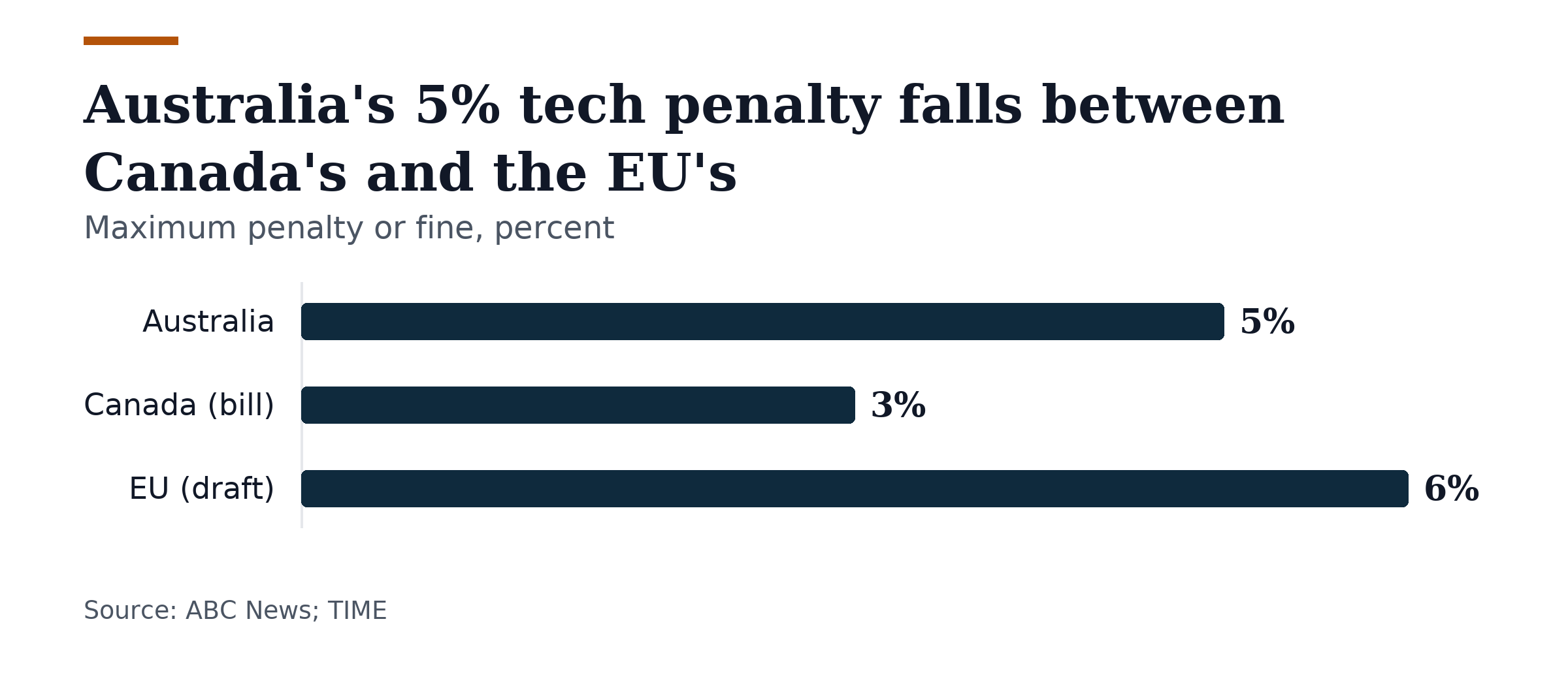
Australia’s law follows the European Union’s Digital Services Act of 2022 and the United Kingdom’s Online Safety Act enacted a year later. A bill before Canada’s parliament would impose a 3% penalty on Big Tech unless it cuts harmful-content risks, while the European Union has drafted a 6% fine against companies that push unfair trade practices. In December 2025 Australia barred residents under 16 from social media in a measure described as a world first, with results mixed and other countries following.
U.S.-headquartered tech firms including Meta and Apple said they want to improve child protection and curb harm but objected to the breadth of Australia’s laws. Critics argue there is no clarity on which body determines what qualifies as harmful content.
The legislation follows a U.S. case in which mining magnate Andrew Forrest sued Meta over scam ads using his likeness without permission, a case that remains unresolved. In October, a U.S. judge ordered Meta to pay New Mexico $25 billion over privacy deception on Facebook. The jury found Meta liable and the penalty was the largest fine ever against the company.
Lisa Given, an information sciences expert at RMIT University in Melbourne, called the draft law very good and largely consistent with European laws. Given said coordinated international legislation improves the chances of pushing Big Tech to make real changes in system design.
Join the discussion