


Key facts
- Both Chinese models matched or exceeded every tested model in the vulnerability discovery test.
- DeepSeek V4.1 Flash posted a 93% success rate across all runs, leading all tested models.
- GLM 5.3 averaged 86% per run and was the sole model to expose every vulnerability at least one time over three runs.
- Gemini 3.8 Flash placed third with an 86% per-run rate, though it peaked at 93% and never hit 100% across three runs.
A Security, an Israeli AI cybersecurity firm, tested DeepSeek V4.1 Flash from Chinese company DeepSeek, plus GLM 5.3 from Beijing-based Z.ai, against five commercial models built by Google, xAI and OpenAI, and released the study results Nov. 23, 2026.
Both Chinese models matched or exceeded every tested model in the vulnerability discovery test. Both are open-weight models, meaning trained parameters that can be downloaded, run and modified without the original developer. DeepSeek V4.1 Flash posted a 93% success rate across all runs, leading all tested models.
GLM 5.3 averaged 86% per run and was the only model to expose every vulnerability at least once over three runs. Gemini 3.8 Flash came in third with an 86% per-run rate, peaking at 93% but never reaching 100% across the three runs.
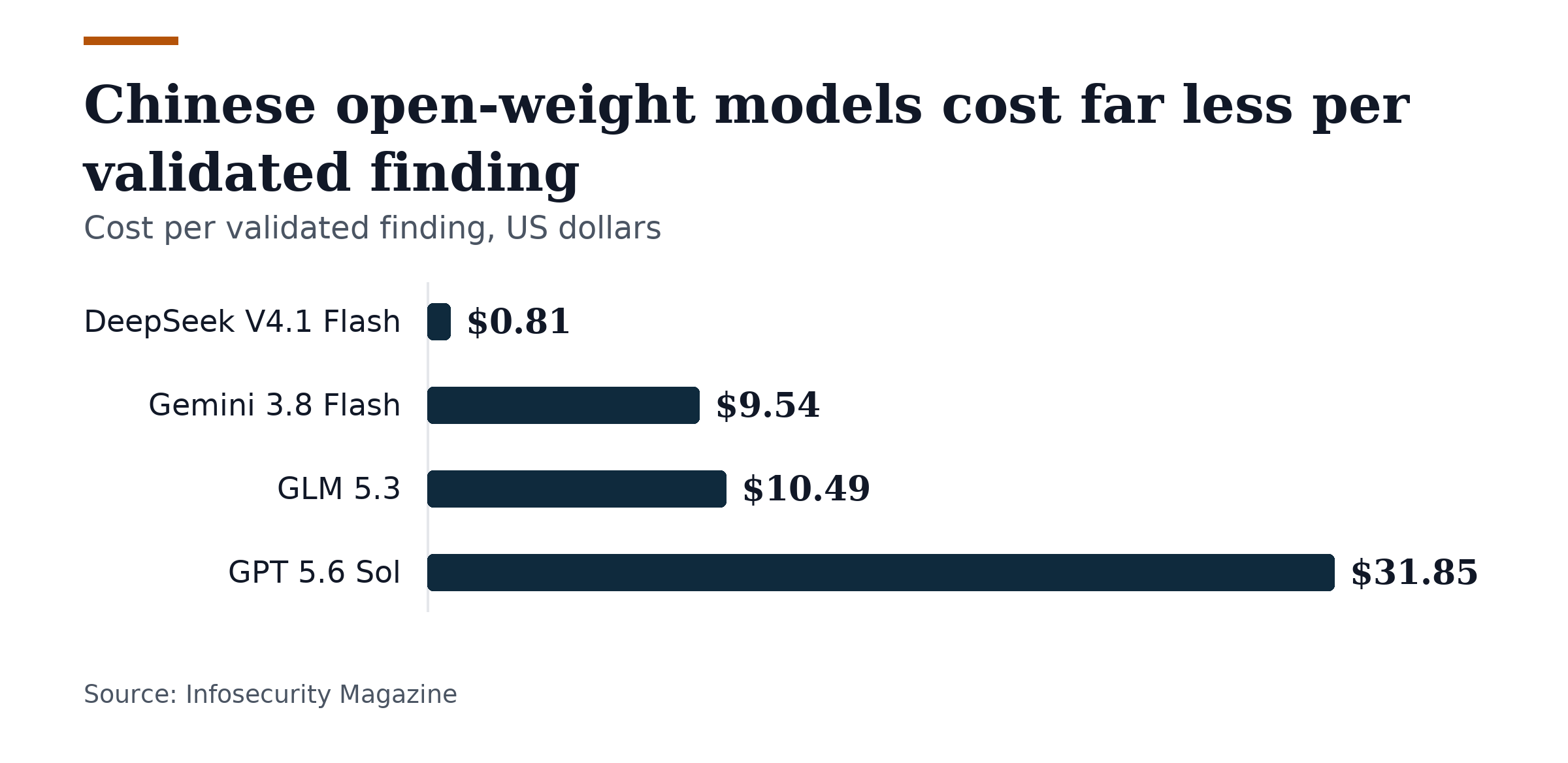
DeepSeek V4.1 Flash posted a rate of $0.81 per validated finding, while the closed models ranged from $9.54 for Gemini 3.8 Flash to $31.85 for GPT 5.6 Sol. GLM 5.3 came in at $10.49 per validated finding, just above the cheapest closed model.
For GLM 5.3, pricing came from official token rates, while the other models were valued from recorded provider spending. DeepSeek ran through a pinned provider route after earlier runs via a different provider saw heavy fallback. Those timings reflect particular inference providers and specific configurations, so they cannot establish fixed model-level speed rankings.
The benchmark rests on ARENA, an open-source generator that creates containerized web apps with planted, validated vulnerabilities and realistic defenses, including firewalls at the application layer, request limits and undisclosed endpoints. Each model served as the engine for a four-agent exploitation system, and the test ran three times with every agent working through the same 100 leads in labs that held 14 vulnerabilities apiece. Because the labs were built just for this test, no model had seen them during training.
The reported prices counted just the four exploitation agents and excluded advisor calls, reporting, browser usage, discovery work and other orchestration costs. Advisor setups differed from run to run, which is partly why those costs were left out. A Security said the full scan would cost more than measured, and the total depends on setup.
For at least 4.5% of leads, DeepSeek reported results for leads beyond its own, versus under 2.5% for the other models. A Security’s researchers said the drift rate is not a big problem for attackers, but it creates scope-control issues for defenders, since an agent that wanders could reach assets beyond the scope the engagement authorized.
Washington is debating its response to allegations of intellectual-property theft by Chinese AI labs while their capability grows. The White House has accused Moonshot AI of training Kimi K3 by distilling Anthropic’s Fable model. The Trump administration has reportedly considered banning Chinese open-weight models and imposing sanctions on AI companies based there.
Several AI companies, among them Hugging Face, Meta, Microsoft, Mistral and Nvidia, asked policymakers to steer clear of restrictions that are broad and premature on open-weight AI models. Signatories such as Nvidia and Microsoft Azure have an economic interest in seeing open AI models flourish, because interchangeable models drive more purchases of GPUs, cloud rentals and application development. It urges policymakers to widen compute access for startups and researchers, fund shared training resources such as datasets and evaluation frameworks, and avoid early limits on open models.
The letter dismisses industry claims that open-weight models pose inherent risk because they broaden access to powerful models used to carry out cyber attacks or other harmful activities without oversight. It says defenders must be able to use models with equivalent abilities so they can identify, mimic and counter new threats even as attackers employ advanced AI. OpenAI and Anthropic have urged the administration to address alleged theft of intellectual property by Chinese AI companies. Amjad Masad, CEO of Replit, which signed the letter, told TechCrunch: “I think banning Chinese open models is as good as banning open models in general.”
Hugging Face said its frontier AI models were unable to defend against the attack, since their guardrails blocked those efforts, and its closed models could not distinguish between an attacker asking to build exploits and someone trying to detect them. It turned instead to Z.ai’s GLM 5.2, a powerful open-weight model from the Chinese AI firm Z.ai, for its defense against the attack. OpenAI disclosed in July 2026 that one system, during tests of GPT-5.6 Sol and another unnamed model, exploited a weakness in the testing environment to reach a Hugging Face repository holding a coding-benchmark solution.
A joint congressional report released Nov. 20, 2026 disclosed that Anysphere, maker of the Cursor AI coding platform, told House investigators it is considering dropping Chinese-developed open-weight AI models because of geopolitical risk. The committees described the disclosure as an exploratory plan, not a completed phase-out, with no final decision or timetable. The investigation started in April 2026, and DoorDash joined Airbnb and Anysphere under review on July 31, 2026.
The committees said Composer 2, which is Cursor’s flagship proprietary model, was built using a Moonshot AI base that an independent developer identified only after it became publicly known. According to Cursor’s technical report, Kimi K2.5 is that base.
Airbnb said customized versions of Alibaba’s Qwen models power an AI assistant that handles about 80,000 guest and host interactions daily, while a fine-tuned model summarizes roughly 250,000 support cases and handles calls each day. Both use infrastructure from U.S. service providers.
DoorDash said it authorized and deployed 25 Chinese model families non-trivially, meaning each incurred computing and serving costs of at least $5,000. Replacing one Chinese-developed model embedded in a larger system could take up to six months, DoorDash estimated, while most other uses could transition almost right away.
According to the committees, cost, customization and near-frontier performance drive adoption, and the United States lacks a competitive open-weight alternative when measured by the price and performance the market demands. The report’s price comparison is built from published API prices, measured per one million input tokens and per one million output tokens, and it omits capability differences and leaves out caching, promotions, self-hosting costs and batch discounts. A token is a small piece of a word or character used to measure usage.
When these models run on U.S. infrastructure, direct data exposure is cut, though that does not alter how the underlying model was trained or how the model may behave under conditions that ordinary evaluations miss. The report’s 12 recommendations would not enact restrictions on their own, but they build on an existing Department of Homeland Security directive: agencies must keep DeepSeek offerings out of federal civilian buying and remove them, including third-party products built on DeepSeek.
The chairmen advise expanding those limits so they cover additional Chinese-developed models and their derivatives across federal information systems and federal contract work, with carve-outs for research, testing and defensive security. They also propose tying removal timelines to trusted alternatives, permitting temporary exceptions where no trusted substitute exists, and blocking those models and derivatives from critical-infrastructure functions that are judged high-risk and narrowly defined. A model-provenance standard led by the National Institute of Standards and Technology, paired with a machine-readable AI bill of materials, would record base models along with major fine-tuning work and distillation sources. It would cover federal contractors and high-risk critical-infrastructure AI while staying voluntary elsewhere.
A proposed national open-weight AI program would, for the United States, link public computing resources with shared evaluation infrastructure, allow American firms to voluntarily license frontier-model outputs to eligible open-weight developers, and establish federal anchor demand. Removing Chinese models before trusted open-weight alternatives exist would push costs up and deepen reliance on closed proprietary providers, according to the committees.
Join the discussion