


Key facts
- The observed n0n initial access cases relied on weak or stolen credentials instead of exploiting vulnerabilities.
- Check Point Research recorded 1,063 ransomware attacks in October 2026, setting a monthly record.
- The October 2026 ransomware tally rose 35% from the same month in 2025.
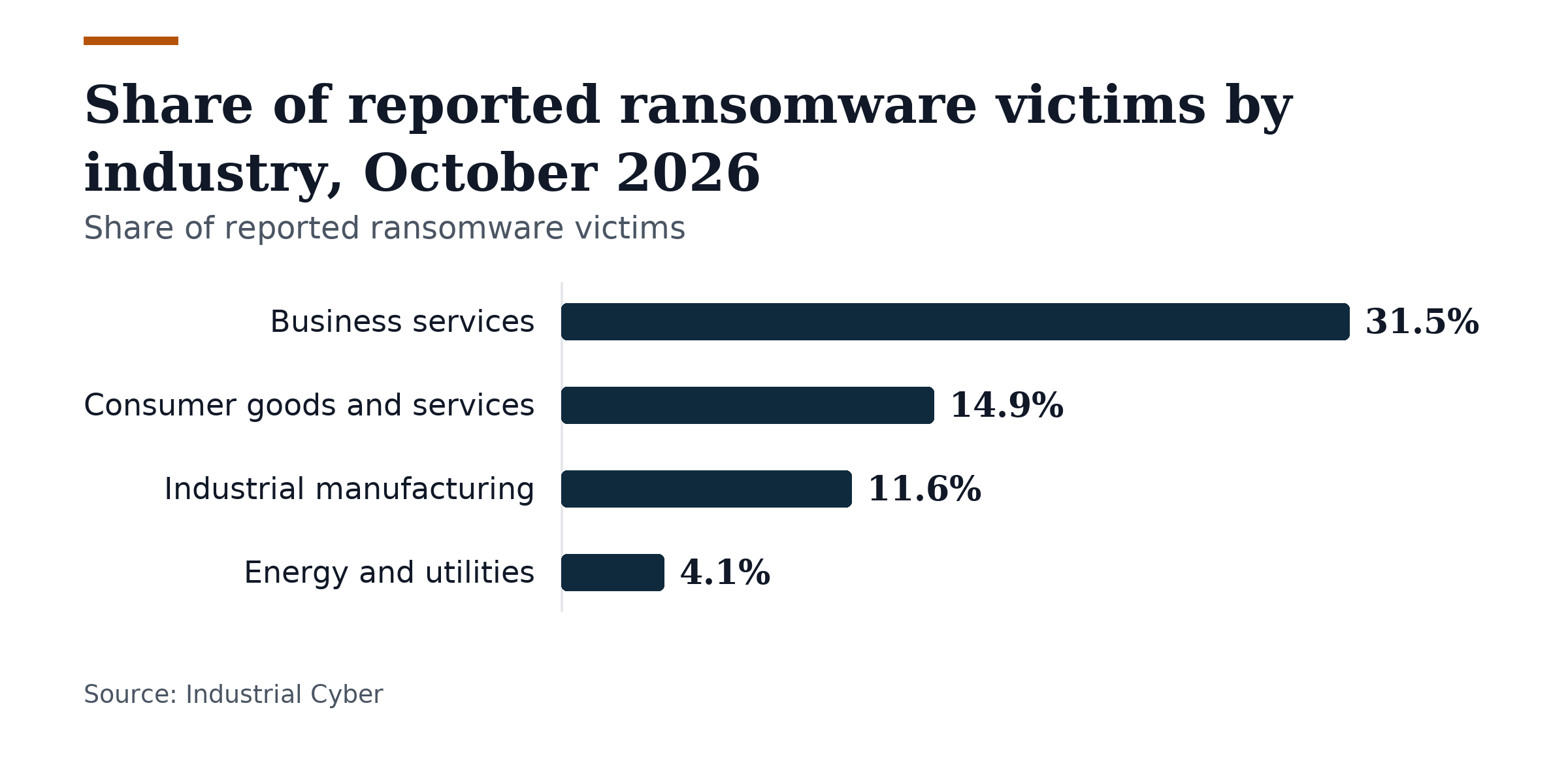
- Industrial manufacturing represented 11.6% of reported ransomware victims, placing it third among affected industries.
In October 2026, Check Point Research’s ransomware tally reached 1,063 attacks, a monthly record.
That marked a 35% increase from October 2025 even as weekly cyber attack volumes fell 9% from September 2026. The average organization faced 2,550 cyber attacks per week during October 2026, up 32% year-over-year. Check Point Research called the tally a new all-time high that remained well above the prior year’s level.
Business services made up the largest share of reported ransomware victims at 31.5%. Consumer goods and services represented 14.9%, the second-largest share, while industrial manufacturing represented 11.6%, third among affected industries. Energy and utilities made up 4.1%.
North America made up 48% of reported ransomware incidents; Europe accounted for 22% and Asia-Pacific for 18%. Regional growth was steepest in Europe, where attacks rose 39% compared with the previous year.
Africa had the highest regional volume, at 3,834 weekly attacks per organization, up 38% from the previous year, and regained the top regional spot last held in September 2025. Latin America ranked second at 3,483 weekly attacks per organization, and Asia-Pacific third at 3,436. North America saw its regional attack volume climb 33% year-over-year. Every region and industry listed posted higher attack rates than a year earlier.
Education recorded the highest weekly attack volume of any industry in October 2026, averaging 5,934 attacks, up 33% from October 2025. Among listed industries, agriculture’s average weekly attacks climbed the most year-over-year, up 93% to 3,218. Telecommunications saw 3,068 weekly attacks, a 19% year-over-year increase. Hospitality, travel and recreation logged 3,053 weekly attacks, a 46% year-over-year increase.
Energy and utilities logged 2,972 weekly attacks, up 21% year-over-year. Industrial manufacturing recorded 1,838 weekly attacks, up 20%. Hardware and semiconductors logged 2,550 weekly attacks after a 74% increase.
Within a month of surfacing in September 2026, n0n joined the top three ransomware operators, quadrupling its monthly share. n0n’s share of published ransomware attacks in October 2026 reached 8%, and by early November 2026 it had claimed more than 170 victims. n0n pursued data theft and extortion and relied heavily on AI-assisted tooling. In the n0n cases observed, initial access came from weak or stolen credentials rather than exploited vulnerabilities.
The Gentlemen led October’s ransomware cartels with 13% of all published attacks. Qilin accounted for 12%. Over the past three months, the number of active ransomware cartels did not change.

Founded in mid-2025, The Gentlemen operates as a Ransomware-as-a-Service cartel (a seller of ransomware tools to affiliates) and also works as an Initial Access Broker (a seller of access to compromised systems) selling affiliates access to roughly 14,000 compromised FortiGate devices. The cartel’s tooling runs on Windows, Linux and ESXi systems. Qilin’s victim disclosures stretch back to 2022, and its listings climbed sharply from March 2025 onward.
High-risk generative AI prompts made up one in every 35 enterprise prompts in October 2026, creating a leakage risk for sensitive data. High-risk prompts affected 90% of organizations using generative AI tools on a regular basis. In August 2026 the exposure rate was one in 43; by September 2026 it was one in 39. Phishing occurred less often in October 2026.
In late September 2026, SOCRadar’s Threat Research Unit found an exposed staging server belonging to n0n. Researchers counted 1,719 files on the server, 829 of them attack scripts, plus source code covering five variants of a custom encryptor. Configuration details surfaced for opencode, an AI coding agent, or a tool that assists with writing code, and the setup drew on 154 models from several providers. n0n ran up more than $7,216 in large language model API costs, which let programs tap into AI text generators, by mid-to-late October 2026.
The cartel looked for exposed Remote Desktop Protocol services, which let users connect to another computer over a network, and used automated credential stuffing against FortiGate SSL-VPN appliances, which provide remote access to a private network. Such attacks test username and password pairs against a target system at machine speed. n0n targeted 305 FortiGate SSL-VPN appliances using credential stuffing.
After gaining access in some cases, n0n deleted data and backups, and n0n claimed to have hit logistics, healthcare and government organizations. n0n’s Tor leak site, on the Tor anonymity network, listed 93 victims as of mid-October 2026, but researchers confirmed only 23 targeted organizations across 14 countries. Listed ransom demands totaled $283.7 million, and individual demands ran from about $2.4 million to $25 million. Researchers have confirmed no ransom payments to n0n.
Check Point said the findings support a prevention-first strategy built on AI-powered protection, shared intelligence and consistent security governance. SOCRadar said the exposed server discovery gives defenders an unusual look at how a current ransomware operation operates.
Join the discussion