

Key facts
- Mior can also modify virtual machine memory and forge signed attestation reports, requiring attacker control over the server hypervisor and BIOS.
- AMD issued security advisories listing SEV firmware for Mior and microcode for Skyfall, both carrying a date of August 12.
- The ETH Zurich research team attacked SEV-SNP during start-up by redirecting Platform Security Processor writes to a controlled graphics card memory.
- Skyfall was discovered by researchers from ETH Zurich and Google, building upon Transient Scheduler Attacks initially disclosed on July 8, 2025.
Researchers disclosed Mior and Skyfall on Nov. 13, 2026, two vulnerabilities that let a malicious cloud host pull data from AMD SEV-SNP confidential virtual machines, The Hacker News reported.
The Hacker News reported Nov. 13, 2026, that Mior and Skyfall are two new flaws in AMD’s SEV-SNP confidential-computing technology, which isolates virtual machines from the host, and that a malicious cloud host can read VM memory through them. With control of the server hypervisor and BIOS, Mior can also change VM memory and create forged attestation reports that appear valid. Skyfall pulls register values and a disk-encryption key after the host forces a failed VM start that leaves processor state behind.
Mior lands while SEV-SNP is initializing. The ETH Zurich researchers pointed Platform Security Processor writes at memory on a graphics card they controlled. During start-up the PSP builds the Reverse Map Table, which assigns ownership and permissions to every memory page, and the processor reads those values back to check its own work.
The researchers left part of the real Reverse Map Table uninitialized, including the entry that guards the table itself. That opening lets the hypervisor rewrite memory protections. The researchers changed the BIOS so the chip’s memory-routing settings stayed unlocked, and they said this fits AMD’s threat model because AMD’s model explicitly distrusts the UEFI. “We operate in AMD’s threat model defined for SEV-SNP.
AMD explicitly distrusts the UEFI, thus an attacker can modify the UEFI,” the researchers said, as reported by The Hacker News.
The team ran Mior 1,000 times on an EPYC 9135, a Zen 5 processor, succeeding every time across two test runs. The attack also worked with SEV-SNP’s optional ciphertext hiding turned on, a mode meant to keep encrypted VM memory unreadable even to a compromised hypervisor. The researchers said Zen 3 and Zen 4 chips might also be affected, but they had no test system permitting BIOS changes on those chips.
Mior is separate from the earlier Fabricked and RMPocalypse attacks, which also damaged the Reverse Map Table when SEV-SNP starts up, and it worked on firmware older than the Fabricked fix. For Mior, AMD names SEV-SNP as the only affected technology, leaving out SEV and SEV-ES. Mior gives an attacker nothing against ordinary virtual machines, since those already trust their host and firmware.
Researchers from ETH Zurich and Google found Skyfall, building on Transient Scheduler Attacks disclosed July 8, 2025, a disclosed attack class. It exploits data remnants from failed VM launches. When the hypervisor deliberately blocks a VM start, the processor saves part of the VM state without normal cleanup, and the host can read the leftovers through transient scheduler attacks.
To capture a disk-encryption key, the researchers changed the VM kernel so it pauses while the key sits in registers; in a real attack, a malicious hypervisor could use SEV-Step to advance the VM until the key lands there. Skyfall can read only three fixed cache lines in a targeted page, at offsets 0x0c0, 0x380 and 0x3c0. Despite that narrow primitive, the demonstration pulled a test VM’s saved register values and its disk-encryption key.
Outside virtual machines, the team read decrypted microcode updates on each test chip and pulled register values from System Management Mode memory, which the operating system kernel cannot normally reach. Testing covered EPYC 7313, a Zen 3 chip, and EPYC 9124 and 9334, both Zen 4; Zen 5 was not part of the demonstration. This microcode and System Management Mode readings need privileged software already present on the target, so they are not remote-only attacks.
Skyfall needs a malicious host or hypervisor but no hardware tampering. The attack is software-driven from the host side.


The program committee for the IEEE Symposium on Security and Privacy, which accepted the Skyfall paper, said a realistic VM attack would require an idle processor core, repeated failed VM starts, rapid performance-counter reads, and a virtual machine that neither crashes nor times out. The reviewers questioned how practical the VM threat scenario is as presented.
AMD’s advisories, both dated August 12, assign CVE-2026-0462 to Mior, scored 5.9 on CVSS, and CVE-2026-40671 to Skyfall, scored 4.9. The Mior advisory prints trusted computing base values next to each fixed firmware version, but gives no procedure for VM owners to verify them. AMD has not said whether real attacks have used Mior or Skyfall.
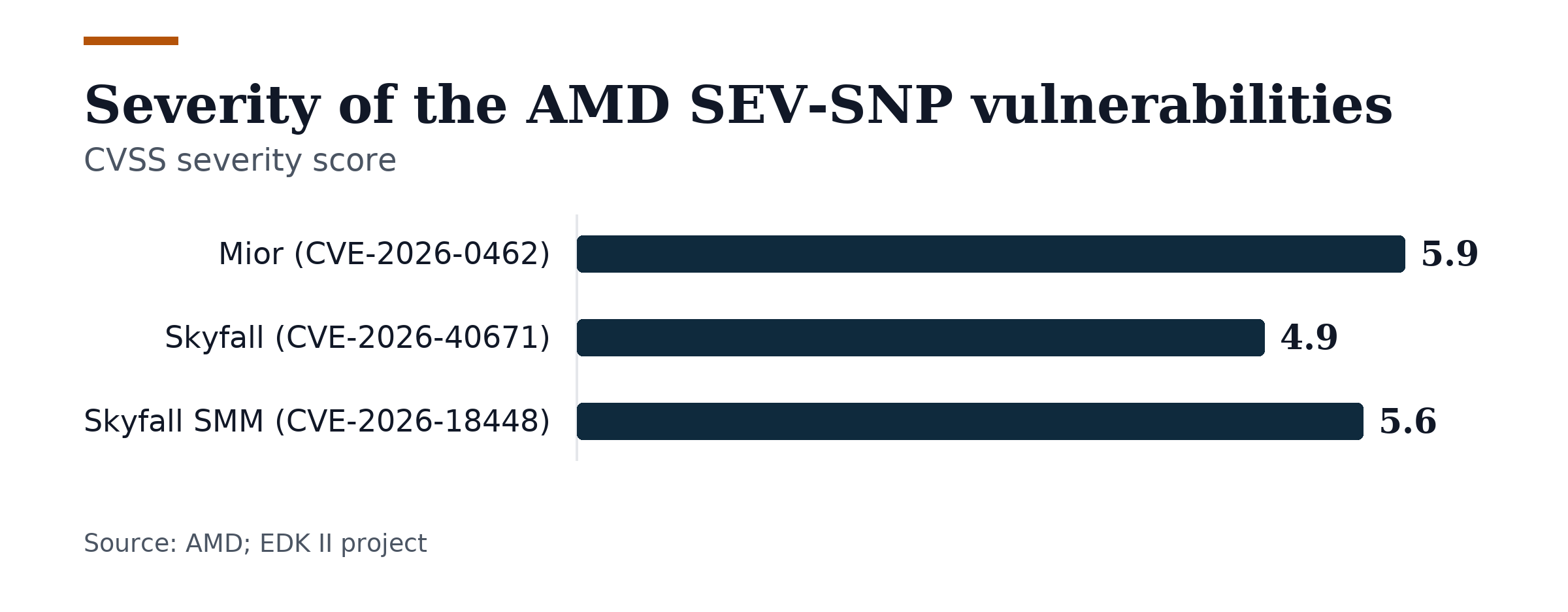
EDK II gave Skyfall’s System Management Mode leak the identifier CVE-2026-18448 and a 5.6 rating. AMD’s EDK II bulletin says the leak stems from firmware code that lacks mitigations against transient scheduler attacks. The bulletin covers EPYC and Ryzen chips, including embedded ones.
For the five EPYC server lines, the EDK II bulletin lists only a November patch, although platform firmware with the fix is already available for EPYC 4004 and EPYC 4005 models.
AMD will send platform firmware to server makers in November for Skyfall and in December for Mior, while embedded-chip fixes come later. Server owners must download the BIOS update from the company that sold the machine, because AMD provides firmware to original equipment manufacturers rather than shipping it directly.
Supermicro has issued a BIOS fix list covering many of its H12, H13 and H14 boards, and says those boards also need a BMC firmware update while affected products remain under test. BMC is the board’s baseboard management controller. Tenants renting confidential VMs cannot patch the host themselves, since the fixes live in host firmware, so they depend on their cloud provider.
AMD dated a Skyfall patch for the Instinct MI300A accelerator September 21. Fixes for embedded EPYC models are due between January and April 2027. AMD names the same five EPYC server lines for both flaws, yet the advisories set different target months for the TurinPI_1.0.0.C package.
The Mior team says fixed firmware is already available, and the Skyfall team reports it has released new microcode. AMD’s advisories offer no guidance on whether the patches work independently or need BIOS updates, and they contain no workaround. Each team published proof-of-concept code, and the Mior code depends on a BIOS deliberately changed to keep memory-routing settings unlocked.
Defenders should confirm with their server maker whether BIOS and BMC updates exist for H12, H13 and H14 boards, and cloud tenants should ask providers when host firmware arrives. For rented confidential VMs, provider diligence is the effective mitigation because tenants cannot patch the host.
Join the discussion