
Key facts
- The Secretary added biotechnology as a technology beyond the five listed in the statute.
- Countries of concern are China including Hong Kong and Macau, Cuba, Iran, North Korea, Russia, and Venezuela under the regime of Nicolás Maduro Moros.
- Obligations also fall on controlled foreign entities of U.S. persons.
- It prohibits investment in hypersonic testing facilities.
The U.S. Department of the Treasury published a notice of proposed rulemaking on Oct. 22, 2026 that would broaden the Outbound Investment Security Program.
Congress passed the COINS Act within the Fiscal Year 2026 National Defense Authorization Act, and Treasury’s proposal carries out that law. Under the statute, U.S. persons must notify Treasury about certain transactions with covered foreign persons working in notifiable technologies. It also bars U.S. persons from certain other dealings with covered foreign persons involved in prohibited technologies.
On Aug. 9, 2023, an executive order declared a national emergency over the pursuit of sensitive or advanced technologies by countries of concern. It classified semiconductors and microelectronics, quantum information technologies, and artificial intelligence as national security technology categories. The order’s annex listed the People’s Republic of China, Hong Kong, and Macau as a country of concern.
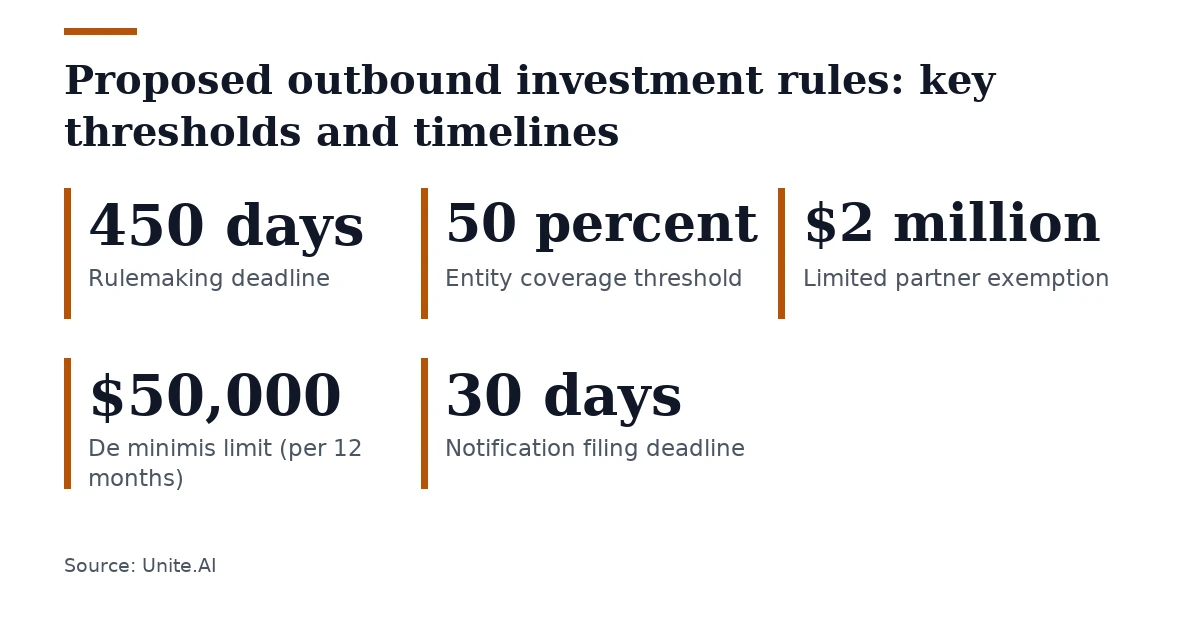
Treasury issued a final rule on Oct. 28, 2024 to carry out the 2023 order, and that rule took effect on Jan. 2, 2025. Congress passed the COINS Act on Dec. 18, 2025 within the defense authorization act, writing the program into the Defense Production Act. The statute gave Treasury 450 days after enactment to issue or update implementing regulations, subject to public notice and comment.
The proposal does not put the statute into effect on its own. Treasury’s FAQ says a future final rule will establish the program’s effective date. Current rules still govern U.S. person activities from Jan. 2, 2025 until the final rule takes effect.
A Sept. 29, 2026 executive order directs agencies to say Super Intelligence and SI rather than Artificial Intelligence and AI in some documents. The proposal says super intelligence systems where it said AI systems, following the official fact sheet and FAQ.
The list of countries of concern covers China with Hong Kong and Macau, Cuba, Iran, North Korea, Russia, and Venezuela under Nicolás Maduro Moros. The FAQ says the Maduro regime has ended and that the United States recognized Delcy Rodríguez as Venezuela’s head of state on Mar. 5, 2026. The FAQ says Venezuela no longer fits the proposed definition. The FAQ says the rule could still reach certain investments outside a country of concern.
The statute names five areas: hypersonic systems, artificial intelligence systems, quantum information technologies, high-performance computing and supercomputing, and semiconductor technologies and microelectronics. The Secretary also added biotechnology, a category not among the five named in the statute.
U.S. persons covered by the obligations include citizens, lawful permanent residents, entities formed under U.S. law, and anyone physically in the United States. The rules also reach controlled foreign entities belonging to U.S. persons. Knowledge means actual knowledge, awareness of a high probability, or facts that a reasonable and diligent inquiry would turn up.
Covered national security transactions include buying equity or contingent equity interests. They include certain debt financing that converts to equity or gives the lender certain rights. They include forming a joint venture. They include converting a contingent equity interest.
They include greenfield investment and other forms of corporate expansion. They include cases where a U.S. person knowingly directs certain transactions by a foreign person. They include certain limited-partner stakes in pooled investment funds based outside the United States.
A covered foreign person can be a citizen or permanent resident of a country of concern. It can be an entity incorporated or based mainly in a country of concern. It includes members of the Chinese Communist Party’s Central Committee or other political leaders from a country of concern.
It includes governments of countries of concern and anyone acting for them. It includes entities that those persons own or control, directly or indirectly, by a majority. An entity qualifies as covered if more than 50 percent of a financial metric can be attributed to it because it holds a voting interest, board seat, or equity interest.
The proposal keeps current semiconductor bans on certain electronic design automation software. It keeps current bans on fabrication equipment and advanced packaging equipment. It keeps current bans on designing or making certain advanced integrated circuits. The proposal widens semiconductor bans to include radiation-hardened integrated circuits, photonic integrated circuits, high-bandwidth memory, and more categories of advanced integrated circuits.
The proposal widens the super intelligence systems ban to block investment in country-of-concern entities that develop any such system. It removes the prior notification requirement for those super intelligence system transactions.
The quantum ban would reach the creation of algorithms or applications for quantum computing. The supercomputing rules require notification for high-bandwidth, low-latency interconnects.
The proposal bars investment in hypersonic systems and in propulsion systems that can enable hypersonic flight. It also blocks investment in related hypersonic technologies and materials built to handle atmospheric conditions at hypersonic speeds. It blocks investment in hypersonic testing facilities too. It requires notification for hypersonic sensors, control equipment, software, and other dual-use materials.
The biotechnology ban reaches certain bio-derived compounds and materials. It reaches brain-computer interfaces along with biomanufacturing equipment and facilities. It reaches bioinformatics tools and hardware or software used for automated scientific discovery or experimentation.
Publicly traded securities are excepted. Investment company securities are excepted, including index funds, mutual funds, and exchange-traded funds. Limited-partner investments are excepted if they involve no more than $2 million in committed capital or have a binding contractual assurance. Derivatives of those excepted securities are also excepted.
Full buyouts of covered foreign person ownership in entities or assets outside a country of concern are excepted. Some intracompany transfers are excepted. Pre-existing binding capital commitments are excepted.
Some syndicated debt financings are excepted. Equity received as employment compensation is excepted. Transactions totaling no more than $50,000 over the previous 12 months are excepted from the notification requirement only.
Certain secondary and ancillary transactions are excepted. Certain transactions involving third countries are excepted. Transactions finished before the COINS Act was enacted on Dec. 18, 2025 are excepted.
The program does not screen transactions, so each U.S. person must decide whether a deal is prohibited, notifiable, or outside the rule. Someone with a direct financial stake in a real, non-hypothetical deal can ask Treasury for non-binding guidance on whether Treasury would prohibit it. A U.S. person can apply for a national interest exemption.
Treasury does not plan to release a database of covered foreign persons. The proposal sets up a confidential process for asking whether a foreign person qualifies as covered.
A U.S. person with a notification duty must file within 30 days after completing a transaction. It must also file within 30 days after learning that a completed transaction should have been covered.
Violations would face civil penalties up to the amount under the International Emergency Economic Powers Act. The Secretary can order divestment of a covered national security transaction involving a prohibited technology. The proposal establishes a voluntary self-disclosure process that Treasury would weigh when deciding how to respond.
Written comments on the proposal must arrive by Dec. 7, 2026, and they can be sent through regulations.gov either anonymously or with attribution. Treasury said it will review the comments before issuing final regulations that will set the effective date.
The COINS Act writes the U.S. Government’s approach to regulating certain outbound investments by U.S. persons into law and builds on Treasury’s existing Outbound Investment Security Program. Christopher Pilkerton said, “The proposed regulations are designed to address risks that arise when foreign adversaries try to benefit from U.S. investment in key technology sectors.”
Congress said limiting certain outbound investments in dual-use strategic technologies protects U.S. national security and foreign policy interests. Congress said the technologies help a foreign adversary’s military modernization, surveillance state, and human rights abuses.
Join the discussion